


Tatung Co’s (大同) share price plunged 9.92 percent yesterday, as investors reacted negatively to its plan to raise fresh funds.
The home appliance supplier plans to raise NT$7 billion (US$233.58 million) by issuing 500 million new common shares to repay bank loans, improve its financial structure and replenish its operating capital, the company said in a statement released on Thursday night.
The company set its subscription price at NT$14 per share — a 29 percent discount to its closing price of NT$19.65 on Wednesday.
That spurred a wave of selling yesterday, with the stock nosediving to close at NT$17.7 in Taipei trading, snapping a three-session winning streak.
Shares of Tatung have jumped 105.97 percent to date this year, outperforming the broader market’s 13.35 percent increase over the sameperiod, Taiwan Stock Exchange data showed.
“The stock has climbed to a relatively high level in the short term, and the capital-raising plan triggered a sell-off as investors dumped their holdings and look to use the proceeds to buy new shares and gain from the disparity,” Jih Sun Securities Investment Consulting Co (日盛投顧) said in a note.
Tatung said that part of the proceeds, about NT$2.6 billion, is to be used to fund new solar investment projects as part of its efforts to seek new revenue resources in the “green” energy supply chain.
About NT$2.3 billion are to be spent to build a new ground-mount solar farm in Tainan’s Cigu District (七股) through its fully owned subsidiary Tung-Yang Co (同陽能源), the statement said.
The Tainan plant will have an annual installed capacity of 40 megawatts.
That is not Tatung’s first investment in solar energy, with the company having tapped into the solar panel installation sector for years.
Tatung expects its solar panel installations, mainly rooftop models, to grow 50 percent year-on-year to 75 megawatts this year.
The company is shifting its focus to building large-scale ground-mount and floating solar systems, it said.
The latest solar system installation project is awaiting approval by the Tainan City Government, Taiwan Power Co (台電) and the Ministry of Economic Affairs.
Tatung plans to use the remaining NT$300 million from its proceeds to subscribe to about 20 million new common shares of its solar wafer manufacturing unit, Green Energy Technology Inc (綠能科技), which plans to use the money to build a new diamond-wire cutting system to lower manufacturing costs.
Tatung’s board on Thursday also agreed to speed up disposal of several subsidiaries that have been performing poorly or are not relevant to its core business.
It is looking to sell Tatung Vietnam (大同越南), Tatung Global Strategy Investment and Trading (BVI) Inc and Tatung InfoComm Co (大同電信), the statement said.

The EU and US are nearing an agreement to coordinate on producing and securing critical minerals, part of a push to break reliance on Chinese supplies. The potential deal would create incentives, such as minimum prices, that could advantage non-Chinese suppliers, according to a draft of an “action plan” seen by Bloomberg. The EU and US would also cooperate on standards, investments and joint projects, as well as coordinate on any supply disruptions by countries like China. The two sides are additionally seeking other “like-minded partners” to join a multicountry accord to help create these new critical mineral supply chains, which feed into

For weeks now, the global tech industry has been waiting for a major artificial intelligence (AI) launch from DeepSeek (深度求索), seen as a benchmark for China’s progress in the fast-moving field. More than a year has passed since the start-up put Chinese AI on the map in early last year with a low-cost chatbot that performed at a similar level to US rivals. However, despite reports and rumors about its imminent release, DeepSeek’s next-generation “V4” model is nowhere in sight. Speculation is also swirling over the geopolitical implications of which computer chips were chosen to train and power the new
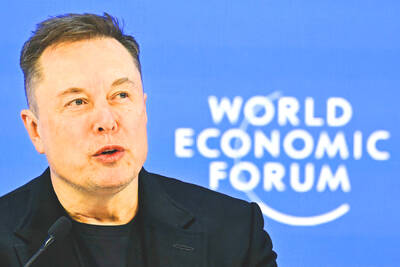
Elon Musk’s lieutenants have reached out to chip industry suppliers, including Applied Materials Inc, Tokyo Electron Ltd and Lam Research Corp, for his envisioned Terafab, early steps in an audacious and likely arduous attempt to break into the production of cutting-edge chips. Staff working for the joint venture between Tesla Inc and Space Exploration Technologies Corp (SpaceX) have sought price quotes and delivery times for an array of chipmaking gear, people familiar with the matter said. In past weeks, they’ve contacted makers of photomasks, substrates, etchers, depositors, cleaning devices, testers and other tools, according to the people, who asked not to

Japan approved ¥631.5 billion (US$3.97 billion) in additional subsidies to hasten Rapidus Corp’s entry into the high-stakes artificial intelligence (AI) chipmaking arena, ramping up support for a project widely regarded as a long shot. The capital is intended to bankroll Rapidus’ work for information technology firm Fujitsu Ltd, one of the initial customers that Tokyo hopes would get the signature endeavor off the ground. The new money raises the fees and investments that the government is injecting into the start-up to ¥2.6 trillion by the end of the current fiscal year to March next year, the Japanese Ministry of Economy, Trade and


 RSS
RSS