


Handset chip designer MediaTek Inc (聯發科) yesterday said its first bio-processor would be available for use in smartphones and wearable devices next quarter at the earliest, joining rivals in extending chip offerings for fledging health data demand.
MediaTek, which supplies Chinese brands including Xiaomi Corp (小米) and Oppo Mobile Telecommunications Corp (歐珀移動), said its bio-processor module would allow users to track health data such as heart rate, blood pressure and peripheral oxygen saturation.
The company is developing bio-processors to track more health data, including blood sugar, said T.L. Lee (李宗霖), general manager of MediaTek’s wireless communications business unit.
“We are optimistic about this new product line, which adds to the company’s offerings of mobile phone processors,” Lee told a media briefing in Taipei. “This new product can multiply [shipments], as the module can be incorporated with our mobile processors, with solutions for the Internet of Things or with wearable devices.”
INVESTMENT
MediaTek in 2001 invested in bio-processors development in collaboration with National Taiwan University and National Taiwan University Hospital, Lee said.
The new bio-processors are expected to increase revenue as soon as next year, he said, citing sizeable market potential due to increasing healthcare needs in aging societies.
In addition to bio-processors, MediaTek is also scheduled to step up the launch of processors with artificial intelligence (AI) features, such as the release of facial recognition with 3D scanning for smartphones and other devices in the first half of next year, Lee said, while demonstrating the application on a Samsung Electronics Co smartphone.
Samsung adopted MediaTek’s AI processor — dubbed Helio P25 — for its J7 Plus model.
Lee gave an upbeat outlook for the company’s first-quarter business, citing rising demand for its new Helio P series processors.
KEEPING PACE
To cope with increasing demand for mid and high-end smartphones, the company is to keep Helio P series processors as its priority next year, Lee said.
MediaTek plans to relaunch the Helio X series — the company’s premium mobile processors — only when demand for flagship handsets improves, Lee added.
The company stopped rolling out new Helio X chips earlier this year due to weak demand, Lee said.
Consumer demand for smartphones in emerging markets such as India, Southeast Asia and Latin America would be the major growth drivers for MediaTek’s products, he said.
For the whole of this year, shipments of mobile phones to emerging markets are forecast to grow 7 to 8 percent annually, he said.
“The strongest growth will come from India, as people there are replacing feature phones with smartphones,” Lee said. “India is a populous country with a fast-growing economy.”

ENERGY ISSUES: The TSIA urged the government to increase natural gas and helium reserves to reduce the impact of the Middle East war on semiconductor supply stability Chip testing and packaging service provider ASE Technology Holding Co (日月光投控) yesterday said it planned to invest more than NT$100 billion (US$3.15 billion) in building a new advanced chip testing facility in Kaohsiung to keep up with customer demand driven by the artificial intelligence (AI) boom. That would be included in the company’s capital expenditure budget next year, ASE said. There is also room to raise this year’s capital spending budget from a record-high US$7 billion estimated three months ago, it added. ASE would have six factories under construction this year, another record-breaking number, ASE chief operating officer Tien Wu

The EU and US are nearing an agreement to coordinate on producing and securing critical minerals, part of a push to break reliance on Chinese supplies. The potential deal would create incentives, such as minimum prices, that could advantage non-Chinese suppliers, according to a draft of an “action plan” seen by Bloomberg. The EU and US would also cooperate on standards, investments and joint projects, as well as coordinate on any supply disruptions by countries like China. The two sides are additionally seeking other “like-minded partners” to join a multicountry accord to help create these new critical mineral supply chains, which feed into

For weeks now, the global tech industry has been waiting for a major artificial intelligence (AI) launch from DeepSeek (深度求索), seen as a benchmark for China’s progress in the fast-moving field. More than a year has passed since the start-up put Chinese AI on the map in early last year with a low-cost chatbot that performed at a similar level to US rivals. However, despite reports and rumors about its imminent release, DeepSeek’s next-generation “V4” model is nowhere in sight. Speculation is also swirling over the geopolitical implications of which computer chips were chosen to train and power the new
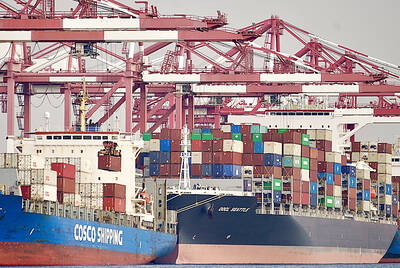
TECH WINNERS: Taiwan and South Korea reported robust trade, which suggests that they have critical advantages in the rapidly expanding AI supply chain, an official said Exports last month surged to a new high, as booming demand tied to artificial intelligence (AI) infrastructure fueled shipments of advanced technology components, underscoring the nation’s pivotal role in the global semiconductor supply chain. Outbound shipments climbed to US$80.18 billion, the highest ever for a single month, rising 61.8 percent from a year earlier and marking the 29th consecutive month of growth, the Ministry of Finance said yesterday. “The surge was driven primarily by global investment in AI infrastructure,” Department of Statistics Director-General Beatrice Tsai (蔡美娜) said. The mass production of next-generation AI computing systems has accelerated procurement across the semiconductor supply


 RSS
RSS