


The 20th round of trade talks between Taiwan and the UK, which were held in London on Friday, aimed to enhance cooperation in the agriculture and energy industries, the Ministry of Economic Affairs said.
Vice Minister of Economic Affairs Wang Mei-hua (王美花) led the Taiwanese delegation at the talks, which yielded a consensus to set up a platform next year to discuss cooperation in the agriculture and energy sectors.
Wang and British Minister of State for Trade and Investment Greg Hands presided over this year’s meeting at a time when Taipei and London have seen their bilateral economic ties increase.
In the first 10 months of this year, two-way trade between Taiwan and the UK totaled US$4.69 billion, up 3.2 percent from a year earlier.
The UK is Taiwan’s third-largest trading partner in Europe, while investment by UK firms in Taiwan was the second-highest among EU members, the ministry said.
“The UK and Taiwan have a very strong trade and investment relationship,” Wang said in a statement, adding that the UK is a priority destination for Taiwanese investment in Europe.
Hands said the new dialogue is expected to bring big business opportunities to UK firms, as Taiwan is planning to raise renewable energy production from 4 percent of the total energy supply to 20 percent by 2025.
“Our new trade dialogues in agriculture and energy will offer UK expertise in leading industries,” Hands said in the statement.
Upcoming dialogue about energy development is expected to bolster cooperation in offshore wind energy, with the UK as a key partner of Taiwan in the area, the UK Department for International Trade said.
Both sides have agreed to resolve remaining issues on agricultural cooperation, which is expected to lead Taiwan to lift a ban on British pork.
In addition, the two sides signed an agreement to make it easier for UK-made specialized medicines to be used in Taiwan, while both have agreed to build on the UK’s financial service exports to Taiwan last year — worth US$208 million — to push for financial technology exchanges between the two nations.
Taiwan and the UK also signed a memorandum of understanding (MOU) to facilitate the process of filing patent applications involving biological material.
The MOU reflects an increasing number of patent applications from the UK in the biomedical sciences that use biological material, the Intellectual Property Office said.
Taiwan’s Patent Act (專利法) stipulates that patent applications must deposit samples of biological materials with a domestic depository agency, but the MOU effectively simplifies the process by eliminating the inconveniences of depositing biological materials in a foreign country and decreases the costs associated with it, the Intellectual Property Office said in a statement.
Both sides are looking to increase the number of biotechnology, medicine and food patents each nation files with the other, it said.
The first round of Taiwan-UK trade talks took place in 1991, with new talks having taken place almost every year since then.

SECOND-RATE: Models distilled from US products do not perform the same as the original and undo measures that ensure the systems are neutral, the US’ cable said The US Department of State has ordered a global push to bring attention to what it said are widespread efforts by Chinese companies, including artificial intelligence (AI) start-up DeepSeek (深度求索), to steal intellectual property from US AI labs, according to a diplomatic cable. The cable, dated Friday and sent to diplomatic and consular posts around the world, instructs diplomatic staff to speak to their foreign counterparts about “concerns over adversaries’ extraction and distillation of US AI models.” Distillation is the process of training smaller AI models using output from larger, more expensive ones to lower the costs of training a powerful new
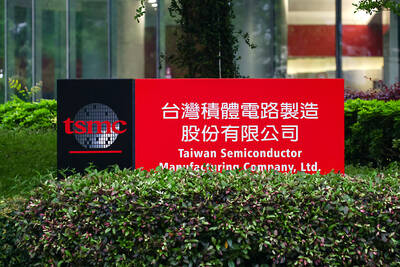
Shares of Taiwan Semiconductor Manufacturing Co (TSMC, 台積電) have repeatedly hit new highs, but an equity analyst said the stock’s valuation remains within a reasonable range and any pullback would likely be technical. The contract chipmaker’s historical price-to-earnings (P/E) ratio has ranged between 20 and 30, Cathay Futures Consultant Co (國泰證期) analyst Tsai Ming-han (蔡明翰) told Central News Agency. With market consensus projecting that TSMC would post earnings per share of about NT$100 (US$3.17) this year, supported by strong global demand for artificial intelligence (AI) applications, and the stock currently trading at a P/E ratio of below 25, Tsai said the valuation
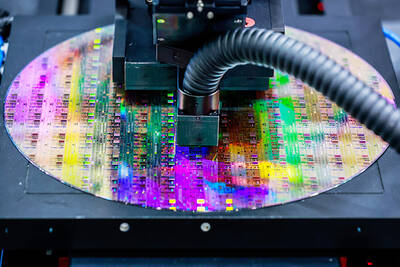
The artificial intelligence (AI) boom has triggered a seismic reshuffling of global equity markets, with Taiwan and South Korea muscling past European nations one by one. With its stock market now valued at nearly US$4.3 trillion, Taiwan surpassed the UK, Europe’s biggest market, earlier this month, data compiled by Bloomberg showed. South Korea is about US$140 billion away from doing the same. The tech-heavy Asian markets have shot past Germany and France in the past seven months. The shift is largely down to massive gains in shares of three companies that provide essential hardware for AI: Taiwan Semiconductor Manufacturing Co (TSMC, 台積電),
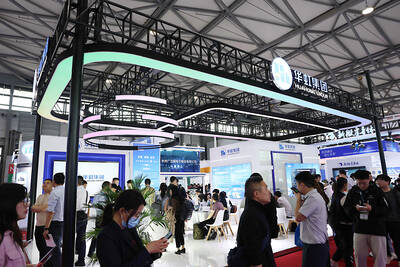
The US Department of Commerce last week ordered multiple chip equipment companies to halt shipments of certain tools to China’s second-largest chipmaker, Hua Hong Semiconductor Ltd (華虹半導體), its latest action to slow the country’s development of advanced chips, two people familiar with the matter said. The department sent letters to at least a handful of companies informing them of restrictions on tools and other materials destined for two Hua Hong facilities US officials believe make China’s most sophisticated chips, the people said. Top US chip equipment companies Lam Research Corp, Applied Materials Inc and KLA Corp, each of which has significant


 RSS
RSS