


Taiwan’s official manufacturing purchasing managers’ index (PMI) reached 57.7 last month, staying above the expansion mark for 20 months in a row, as manufacturers benefitted from inventory demand ahead of the year-end holiday season, the Chung-Hua Institution for Economic Research (CIER, 中華經濟研究院) said yesterday.
Manufacturing remained in expansion mode on the back of solid demand with the global economy recovering, the institute said.
The expansion mode might continue in the near term, as firms in major industrial sectors are upbeat about their business outlook in the coming six months, the PMI report showed.
“The stable recovery in the global economy may help boost demand for consumer electronics in light of the latest PMI data,” CIER president Wu Chung-shu (吳中書) told a news conference in Taipei.
Wu said it was possible CIER might raise its economic growth forecast for this year.
The PMI seeks to gauge the health of the manufacturing industry, with scores greater than 50 indicating business expansion and those below suggesting contraction.
Preorders for Apple Inc’s iPhone X appear stronger than expected and might continue to be a catalyst for local firms in its supply chain if the facial recognition feature proves popular, CIER economist Chen Shin-hui (陳馨蕙) said.
However, of the five factors in the PMI, only the sub-index for inventories moved higher, up 0.6 to 54.8, while the other four moved lower, CIER said.
The sub-index on new business orders stood at 58.6, down from 60.4 in September; the sub-index on industrial output was 57.9, while the employment sub-index registered 57.3, it said.
Supply Management Institute in Taiwan (中華採購與供應管理協會) executive director Steve Lai (賴樹鑫) said iPhone X sales in the next two weeks might establish the popularity of the new model.
There have been rumors that Apple compromised on the yield rate to avoid a launch delay.
While iPhone series remain a critical growth driver, connected vehicles, Internet of Things and other applications have gained importance, allowing local firms to cut dependence on mobile devices, Lai said.
The sub-index on input prices held high at 72.5, compared with 75.3 in September, as price hike expectations drove firms to increase purchase activity.
London-based IHS Markit, which compiles the private Nikkei Taiwan PMI, said inflationary pressures might pile up going forward, given raw material costs and stock shortages.
The Nikkei Taiwan PMI stood at 53.6 for last month.
The non-manufacturing industry also reported business increase last month, with the its index standing at 53.6, CIER said.
The upturn was not extended to hotel and restaurant operators or property developers and brokers, the report showed.
Additional reporting by CNA
Taiwan Semiconductor Manufacturing Co (TSMC, 台積電) yesterday reported record revenue of NT$416.975 billion (US$13.17 billion) for last month, putting the world’s largest contract chipmaker on track to set a record for quarterly revenue. Last month’s figure surpassed March’s record NT$415.19 billion and represented increases of 1.5 percent from April and 30.1 percent from a year earlier. For the first five months of the year, TSMC generated NT$1.96 trillion in revenue, up 30 percent year-on-year, it said in a statement. TSMC has forecast second-quarter revenue of between US$39 billion and US$40.2 billion, representing sequential growth of about 10 percent and year-on-year growth of about
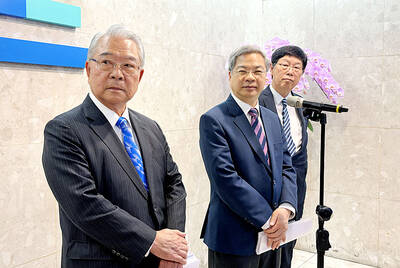
PATENT PROBE: US lawmakers called for a ban on imports of chips made by TSMC if they are found to infringe on US patents, with a preliminary ruling expected soon Minister of Economic Affairs Kung Ming-hsin (龔明鑫) yesterday expressed confidence in Taiwan Semiconductor Manufacturing Co’s (TSMC, 台積電) compliance with patent regulations after reports linked the company to a patent infringement lawsuit in the US. US Representative Ryan Zinke, and US senators Tim Sheehy, Roger Marshall and Bernie Moreno urged the US International Trade Commission in a May 22 letter to ban imports of chips made by TSMC if they are found to infringe on US patents, Axios reported on Wednesday. An administrative law judge is expected to issue a preliminary ruling this month, with the commission potentially making a final decision in

Infineon Technologies AG is preparing to open its largest single investment, a 5 billion euro (US$5.8 billion) semiconductor factory built with the help of EU subsidies, as the bloc seeks to boost chip production. The power chip fab, which is an extension of the German company’s Dresden campus, is scheduled to open on July 2, Infineon chief operating officer Alexander Gorski said this week at the site. The project is a major recipient of EU Chips Act funds, receiving about 1 billion euros in subsidies. The new plant represents a rare success for the bloc’s flagship semiconductor law, which was drawn up during

Taiwanese authorities are considering much stricter export controls on artificial intelligence (AI) chip sales to China to further align with US measures, according to people familiar with the matter, an effort to address semiconductor smuggling that risks drawing a rebuke from Beijing. The idea is to give authorities more legal tools to address diversion of advanced hardware, like AI servers with Nvidia Corp chips, from Taiwan to China. Such sales are already banned under US regulations unless companies get Washington’s permission, per curbs the US first imposed in 2022 to prevent Beijing from using advanced Nvidia processors to gain a military


 RSS
RSS