


Bogged down by policy uncertainty under military rule, Thai companies are spreading out.
Thai businesses invested a record US$13 billion abroad last year, dwarfing inflows of US$1.6 billion, according to the UN Conference on Trade and Development.
By contrast, companies in Singapore and Indonesia cut investment overseas last year, while deals by Malaysian firms slumped to the lowest level in a decade.
Three years after the military seized power in a coup, Thailand’s economy is losing its might with growth rates that are lagging peers in Southeast Asia. As consumers rein in spending, companies including Asia’s biggest cement maker, Siam Cement PCL, are turning to overseas markets.
Investment abroad totaled US$2.9 billion in January to April, according the central bank data.
“With robust, but moderating growth in the home market, Thai companies have been comparatively more ambitious in seeking to become regional or even global champions,” Deutsche Bank AG head of mergers and acquisitions for Southeast Asia Eugene Gong said in an e-mail.
Siam Cement, the largest producer in Asia by market capitalization, bought a Vietnamese manufacturer of building materials in March in a deal valued at US$440 million, while BCPG PCL, an owner of clean-energy projects, announced plans in April to pay as much as US$358 million for a stake in Singapore’s Star Energy Group Holdings.
Overseas acquisitions announced by Thai companies totaled US$1.5 billion so far this year, compared with US$1.7 billion in the same period a year ago, according to data compiled by Bloomberg.
That figure stands at almost US$48 billion in the past five years compared with US$19 billion in the previous five.
The biggest areas of investment from 2011 to last year were in finance, extraction of crude oil and natural gas, manufacturing of beverages and food, and wholesale trade, according to central bank data.
The top destinations were other nations in Southeast Asia, particularly Cambodia, Laos, Myanmar and Vietnam.
By contrast, domestic conditions remain subdued. Consumer confidence has weakened, while private investment has slumped this year.
A stronger currency and rising cash pile are also helping to drive investors overseas. Thai companies hold about US$36 billion in cash, 44 percent more than five years ago, according to data compiled by Bloomberg.
Bangchak Petroleum PCL, owner of BCPG, said the baht’s appreciation provides it with an opportunity to invest overseas at a cheaper cost. The downside is that revenue from abroad is lower when converted into the local currency, it said in an e-mail.
The baht, little changed yesterday, has gained more than 5 percent against the US dollar this year, the best performer in Southeast Asia.
The currency was also among the few gainers in Asia last year.
In 2015, outward investment slid to US$1.7 billion at the same time that the currency lost almost 9 percent.
Thai companies benefit from factors such as strong domestic cash flows and access to debt capital at highly attractive terms, Morgan Stanley cohead of investment banking for Southeast Asia David Aronovitchsaid in an e-mail.
“Business owners are increasingly confident to make significant forays overseas,” Aronovitch said. “This, of course, is due to attractive growth rates available in adjacent markets, with large populations characterized by high expected growth and attractive potential returns.”
Siam Cement sets aside about US$1.5 billion a year on capital spending for its overseas projects in Southeast Asia, which include a plant in Vietnam and a packaging business in Indonesia, the company said in an e-mail.
Cement plants in Myanmar and Laos started operating this year, it said.
The surge in outflows is set to continue with significant investment in projects starting from scratch, Geneva, Switzerland-based UN Conference on Trade and Development analyst Astrit Sulstarova said.
“Greenfield investment is a driving force of Thai companies’ international expansion,” Sulstarova said. “Total investment of announced greenfield projects amounted to US$15 billion in 2016, a historical high. The implementation of these projects will result in a large amount of outward FDI [foreign direct investment] from Thailand.”
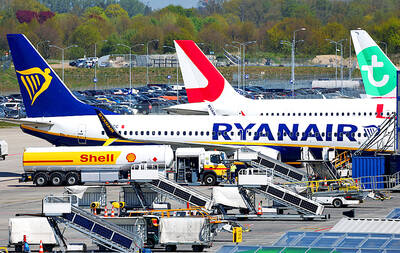
Ryanair, Transavia, Volotea and other low-cost airlines are feeling the financial pain from high jet fuel prices as a result of the Middle East war and are cutting flights. The closure of the Strait of Hormuz has taken a huge chunk of oil supplies off the market, sending the price of jet fuel soaring and triggering fears of shortages that could force airlines to cancel flights. Airlines are not waiting for a lack of supplies to react. “Travel alert: Airlines are cutting thousands of flights right now,” Travel Therapy host Karen Schaler said in an Instagram reel this past weekend.
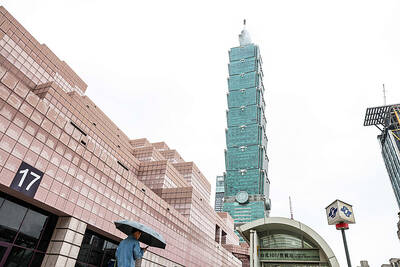
MANAGING RISKS: Taiwan has secured LNG sufficient to cover 95 percent of electricity demand for next month, UBS said, describing the government’s approach as proactive UBS Group AG has raised its forecast for Taiwan’s economic growth this year to 8 percent, up from 6.9 percent previously, and said expansion could reach as high as 8.6 percent if external energy shocks are avoided. The upgrade reflects a stronger-than-expected first-quarter performance and sustained momentum in artificial intelligence (AI)-driven exports, which UBS said are providing a firm foundation for growth despite geopolitical and energy risks. Taiwan’s GDP expanded 13.69 percent year-on-year in the first quarter, the fastest growth since the second quarter of 1987, the Directorate-General of Budget, Accounting and Statistics (DGBAS) reported on Thursday. On a seasonally
The Fair Trade Commission’s (FTC) ongoing review of Grab Holdings Ltd’s US$600 million acquisition of Foodpanda Taiwan’s operations, announced on March 23, has taken on fresh urgency as industry experts warn that the transaction could embed significant Chinese cybersecurity vulnerabilities into Taiwan’s digital infrastructure through Grab’s deep ties to autonomous-driving firm WeRide (文遠知行). Less than 16 months after the FTC blocked Uber Eats’ direct attempt to acquire Foodpanda Taiwan — citing potential combined market shares of 80 to 90 percent — the emergence of Grab as the buyer has prompted questions about whether the same competitive harm is simply being rerouted

The list of Asian stocks that benefit from business partnership with Nvidia Corp is getting longer, as the region further integrates into the artificial intelligence (AI) chip giant’s business ecosystem. Just in the past week, South Korea’s LG Electronics Inc, Taiwan’s Nanya Technology Corp (南亞科技), as well as China’s Huizhou Desay SV Automotive Co (德賽西威) and Pateo Connect Technology Shanghai Corp (博泰車聯) have become the latest to rally on news of tie-ups, supply-chain participation or product collaboration with the US chip designer. Asian suppliers account for about 90 percent of Nvidia’s production costs, up from about 65 percent last year, data compiled


 RSS
RSS