


On Pingtung Prison’s sunlit roof, prisoner no. 24 has a view of a brighter future. Former police officer Chen, serving time for bribery, is learning how to install solar panels in a program that is part of the nation’s shimmering vision of a future without nuclear power.
The 48-year-old is working on a project that has seen the prison become the first to send solar power into the electricity grid.
“I should be out in two to three years,” said Chen, whose full name cannot be disclosed under prison rules. “This should help [in finding a future job].”
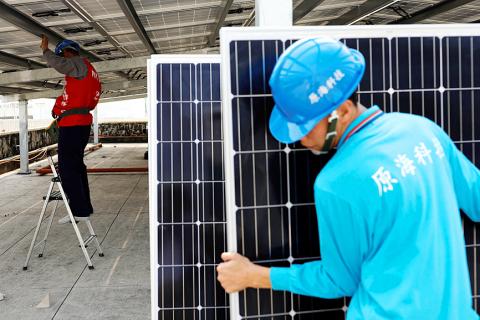
Photo: Tyrone Siu, Reuters
With a capacity of 1.8MW — enough to supply power to 639 average Taiwanese households for a year — the drop-in-the-ocean project highlights the towering scale of President Tsai Ing-wen’s (蔡英文) pledge to make the nation nuclear-free by 2025.
Nuclear accounts for about 14 percent of Taiwan’s total electricity generation. “Renewable” sources, including solar, wind and hydro, together account for less than 5 percent, leaving the 2025 goal of having “renewables” — primarily solar — account for a fifth of electricity generation by 2025 looking like a mirage.
At the prison, where temperatures outside can peak at about 33?C in summer, the arithmetic was simple: It is not possible for “renewables,” dependent on weather conditions, to be a main supply source, the chief project manager at Taichung-based Lixma Tech Co (力瑪科技) said.
“’Renewable’ energy can reduce and replace a lot of traditional power generation — coal or nuclear power — only during peak electricity consumption periods,” Lixma chief executive officer Thomas Hsu (許俊吉) said.
With plentiful sunshine at its disposal, Taiwan has certainly made progress in expanding solar energy. From its current capacity of about 1,061MW, Taipei is targeting about double that amount by the middle of next year, with other jails among those considering solar projects, Pingtung prison officials said.
To match official government targets of having solar power account for 73 percent of total “renewable” energy capacity by 2025, Taiwan would need to multiply its current solar power capacity by about 20 within nine years — about 20,000MW. That kind of power could mean panels taking up about 25,000 hectares — nearly the size of Taipei.
While Pingtung adds Taiwan to the ranks of such nations as the US, Brazil and South Africa in developing solar prison projects, it will have to resolve numerous roadblocks if it is to implement the massive rollout of “renewables” it needs to meet its goals, experts and industry insiders say.
Problems in grid transmission for “renewable” energy, outdated regulations governing an industry long dominated by state monopoly Taiwan Power Co (Taipower, 台電), environmental concerns and rival interests among government agencies and local communities are among the issues to be overcome.
“The biggest uncertainty is how to get consensus among the various stakeholders,” Renewable Energy Project Development Office head Laurence Li said, adding that private sector players are eager to participate.
While a key player in encouraging “renewable” projects, Taipower is also the main operator of the nuclear energy industry, as well as coal and liquefied natural gas plants.
Financing development is another issue.
At Pingtung Prison, Lixma shoulders all costs and says it will receive about NT$9 million (US$290,135) a year from Taipower for solar power from the prison.
Hsu said the firm will not break even on the project until the ninth year of its 20-year contract with the prison and Taipower.
Better known for the aged soy sauce its inmates have been making for decades, the prison is content to offer its 10,0002m of roof space for the 6,000 installed panels.
“We are primarily a resource for absorbing solar energy,” vice warden Lin Cheng-rong said. “It is the companies with technical capabilities who invest and set up the solar panels and who sell the energy to Taipower.”
Part of the central government’s corrections agency, the prison cannot keep revenue from the energy it is generating, or even directly use the power itself — before lights-out at 9pm, its bulbs run on electricity from the Taipower grid.
For inmate Chen, once the solar panel installation is complete, he is to return to tending crops on the grounds — but with rooftop views still firmly on his mind.
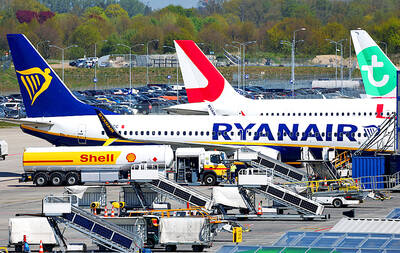
Ryanair, Transavia, Volotea and other low-cost airlines are feeling the financial pain from high jet fuel prices as a result of the Middle East war and are cutting flights. The closure of the Strait of Hormuz has taken a huge chunk of oil supplies off the market, sending the price of jet fuel soaring and triggering fears of shortages that could force airlines to cancel flights. Airlines are not waiting for a lack of supplies to react. “Travel alert: Airlines are cutting thousands of flights right now,” Travel Therapy host Karen Schaler said in an Instagram reel this past weekend.
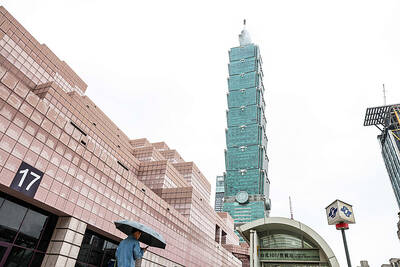
MANAGING RISKS: Taiwan has secured LNG sufficient to cover 95 percent of electricity demand for next month, UBS said, describing the government’s approach as proactive UBS Group AG has raised its forecast for Taiwan’s economic growth this year to 8 percent, up from 6.9 percent previously, and said expansion could reach as high as 8.6 percent if external energy shocks are avoided. The upgrade reflects a stronger-than-expected first-quarter performance and sustained momentum in artificial intelligence (AI)-driven exports, which UBS said are providing a firm foundation for growth despite geopolitical and energy risks. Taiwan’s GDP expanded 13.69 percent year-on-year in the first quarter, the fastest growth since the second quarter of 1987, the Directorate-General of Budget, Accounting and Statistics (DGBAS) reported on Thursday. On a seasonally
The Fair Trade Commission’s (FTC) ongoing review of Grab Holdings Ltd’s US$600 million acquisition of Foodpanda Taiwan’s operations, announced on March 23, has taken on fresh urgency as industry experts warn that the transaction could embed significant Chinese cybersecurity vulnerabilities into Taiwan’s digital infrastructure through Grab’s deep ties to autonomous-driving firm WeRide (文遠知行). Less than 16 months after the FTC blocked Uber Eats’ direct attempt to acquire Foodpanda Taiwan — citing potential combined market shares of 80 to 90 percent — the emergence of Grab as the buyer has prompted questions about whether the same competitive harm is simply being rerouted

The list of Asian stocks that benefit from business partnership with Nvidia Corp is getting longer, as the region further integrates into the artificial intelligence (AI) chip giant’s business ecosystem. Just in the past week, South Korea’s LG Electronics Inc, Taiwan’s Nanya Technology Corp (南亞科技), as well as China’s Huizhou Desay SV Automotive Co (德賽西威) and Pateo Connect Technology Shanghai Corp (博泰車聯) have become the latest to rally on news of tie-ups, supply-chain participation or product collaboration with the US chip designer. Asian suppliers account for about 90 percent of Nvidia’s production costs, up from about 65 percent last year, data compiled


 RSS
RSS