


The broad plains of Mugie, a huge estate on a high plateau northwest of Mount Kenya, are crisscrossed with cattle trails and the wildlife is mostly gone.
The knee-high grass remains, but not for long, manager Josh Perrett said.
Tensions between semi-nomadic pastoralists and settled landowners are nothing new, nor is competition between livestock and wildlife, but in Kenya’s central Laikipia highlands they are taking a destructive, sometimes violent turn.
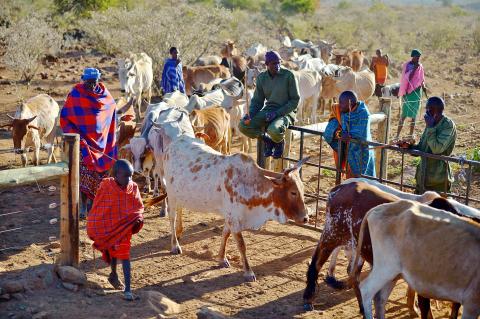
Photo: AFP
Last month, about 30,000 livestock arrived on Mugie, displacing wildlife. The illegal herders — some armed with spears, others with AK-47s — cut through fences, making off with wire and posts.
The shooting, looting, poaching and rustling that accompanied them left Perrett despondent.
“Twenty years of time, effort, sweat, money... It’s fallen apart in two weeks, destroyed,” the 35-year-old said. “Before, you would see elephant, a few hundred head of buffalo, Jackson’s hartebeest, oryx, Grant’s gazelle, impala. Now you see thousands of head of cattle, a lot of sheep and goats.”
At the 17,600 hectare Suyian ranch, south of Mugie, thatched huts for tourists were burned down and shots fired last week as herders swept in.
Black and white landowners alike spoke of invasions and fear.
The dangerous situation in Laikipia is an acute expression of a chronic and complex tangle of population growth, livestock increases, overgrazing, erratic rainfall, climate change, weapons, money and politics.
A recently published four-decade study by the International Livestock Research Institute in Nairobi uncovered “catastrophic ... widespread” declines in Kenyan wildlife as herds of livestock displace wild animals. The data was Kenya specific, but the problem is continental.
“At the basis of all this is the human population explosion,” lead author Joe Ogutu said.
The report blamed “policy, institutional and market failures,” saying regulation was needed to reduce livestock numbers, which have increased 76 percent, while wildlife fell by 68 percent.
As pastoralist populations have grown, so have their herds, grazing sparse pasture into desert.
Exacerbating the situation, the value of cattle has increased dramatically, making it a smart investment for urban elites, a mobile bank account hidden from scrutiny and taxation.
When land can no longer sustain their livestock, the people move.
In Kenya, Laikipia’s private and community reserves and ranches are the grassy frontier between the pastoralist north and the agricultural south.
“Population growth, livestock growth, that’s the pressure on conservation,” said Tom Silvester, the 49-year-old manager of Loisaba, a 22,662 hectare conservancy to the east of Mugie that is recovering from large-scale illegal grazing last year.
Tens of thousands of cattle a day reduced Loisaba’s grass plains to tufts of dry sedge and stubble, spike thorn, acacia and shimmering croton bushes.
Well-managed, grassland acts like a reservoir in tough times. Loisaba, Mugie and others have established controlled grazing programs with neighboring communities enabling the survival of both livestock and wildlife, but the system breaks down when huge herds arrive.
“We are neighbors with Loisaba, we are part of the whole thing,” said 70-year-old Lesibia Larari, owner of 70 cows. “We have a stake in it, but the others do not care about being good neighbors.”
Adowan Letowon, a 28-year-old Samburu moran, or warrior, with a long knife in his belt and a mobile phone in his hand, has relied on Loisaba to get his cattle through every dry season and drought since he was 13.
“We have been here for long. Our children, our cattle do not die because of this land,” he said.
In easier times, neighboring communities are a buffer against illegal grazers, but when they come in their hundreds with tens of thousands of cattle they are unstoppable.
“The answer is not fences and guns, it is conversation and understanding,” said Charles Lekalasimi, a 24-year-old Samburu university student interning at Loisaba.
Like most of the herders — legal and illegal — Lekalasimi is a moran. He understands the social value of cattle and said his contemporaries listen when he tells them 50 fat cows are better than 200 skinny ones.
Conversation and understanding look a lot like capitulation.
Perrett is negotiating with the Samburu and Pokot to leave their guns and dogs behind, stop killing the wildlife and keep sheep and goats out in return for access for less destructive cattle.
However, he expects Mugie to be “a dust bowl” by the time they leave.
Meanwhile, the wildlife tourism that drives the conservancy’s business model is suspended.
“What we were selling, you can’t sell that now,” he said.
Managing coexistence in an increasingly crowded world is a challenge for individuals and government, but residents and landowners said the Kenyan government is not playing its part.
Last month, Kenyan President Uhuru Kenyatta condemned those who “invade land” in Laikipia, but took no action against lawbreakers, while local leaders have stoked tensions by encouraging pastoralists to take grass they say belongs to the herders.
With national elections due in August, few expect vote-costing action against the illegal grazers, while the ethnic logic of Kenyan politics means some candidates stand to benefit from a favorable shift in population dynamics ahead of the vote.
“The solution is coexistence, talking, dialogue. Recognizing that resources are limited and working out how to equitably divide it between wildlife and livestock,” Silvester said.

The domestic unit of the Chinese-owned, Dutch-headquartered chipmaker Nexperia BV will soon be able to produce semiconductors locally within China, according to two company sources. Nexperia is at the center of a global tug-of-war over critical semiconductor technology, with a Dutch court in February ordering a probe into alleged mismanagement at the company. The geopolitical tussle has disrupted supply chains, with some carmakers reportedly forced to cut production due to chip shortages. Local production would allow Nexperia’s domestic arm, Nexperia Semiconductors (China) Ltd (安世半導體中國), to bypass restrictions in place since October on the supply of silicon wafers — etched with tiny components to

Singapore-based ride-hailing and delivery giant Grab Holdings Ltd has applied for regulatory approval to acquire the Taiwan operations of Germany-based Delivery Hero SE's Foodpanda in a deal valued at about US$600 million. Grab submitted the filing to the Fair Trade Commission on Friday last week, with the transaction subject to regulatory review and approval, the company said in a statement yesterday. Its independent governance structure would help foster a healthy and competitive market in Taiwan if the deal is approved, Grab said. Grab, which is listed on the NASDAQ, said in the filing that US-based Uber Technologies Inc holds about 13 percent of

Taiwan is open to joining a global liquefied natural gas (LNG) program if one is created, but on the condition that countries provide delivery even in a scenario where there is a conflict with China, an energy department official said yesterday. While Taiwan’s priority is to have enough LNG at home, the nation is open to exploring potential strategic reserves in other countries such as Japan or South Korea, Energy Administration Deputy Director-General Chen Chung-hsien (陳崇憲) said. While the LNG market does not have a global reserve for emergencies like that of oil, the concept has been raised a few times —

Taiwan Semiconductor Manufacturing Co (TSMC, 台積電) yesterday received government approval to deploy its advanced 3-nanometer (3nm) process at its second fab currently under construction in Japan, the Ministry of Economic Affairs said in a news release. The ministry green-lit the plan for the facility in Kumamoto, which is scheduled to start installing equipment and come online in 2028 with a monthly production capacity of 15,000 12-inch wafers, the ministry said. The Department of Investment Review in June 2024 authorized a US$5.26 billion investment for the facility, slated to manufacture 6- to 12nm chips, significantly less advanced than 3nm process. At a meeting with


 RSS
RSS