


Smartphone camera lens supplier Largan Precision Co (大立光) yesterday said shipments would grow in the next two months, as clients are slated to launch new smartphones equipped with dual cameras.
“This month’s shipments will be better than last month’s and I expect clients to make more shipment requests next month,” Largan CEO Adam Lin (林恩平) told a media briefing after the company’s annual general meeting at its headquarters in Taichung.
Consolidated revenue last month rose 8 percent month-on-month, but dropped 24 percent year-on-year to NT$3.36 billion (US$104.27 million), according to company statistics.
Analysts attributed the monthly increase in revenue to increased handset shipments from clients other than Apple Inc and strong sales of some high-end models featuring dual cameras.
Largan’s sales performance this year has been lackluster due to weaker sales of Apple’s iPhone 6S. While many clients are adopting dual-camera modules for new handsets in the second half, Lin said he is not certain about Largan’s business outlook for the second half, citing unclear order visibility due to unpredictable consumer demand for new handsets.
In addition, maintaining a good yield rate for dual-camera products poses a challenge to Largan, due to demands from clients for higher quality, Lin said.
Commenting on Largan’s new factory in Taichung, Lin said the company recently restarted construction and expects the facility to be complete before the end of this year.
Construction was suspended in April after two workers fell to their deaths.
Largan is to install equipment and build clean rooms before the new factory becomes operational in the second quarter of next year, Lin said.
He said the government recently approved an increase of the new factory’s clean water supply to 1,500 tonnes per day, which has largely eased Largan’s concerns about a potential water shortage.
Citing Taiwan’s limited water resources, the Ministry of Economic Affairs previously denied Largan’s request to supply 1,500 tonnes of clean water, saying it would only grant half that amount to the firm and suggesting that it use recycled water.
Following continued negotiations with the ministry, Lin said the request for a daily water supply of 1,500 tonnes was approved recently, adding that camera lens production requires extremely clean water, otherwise it would scratch the products and cause defects.
Although the water supply issue has been resolved, Lin said he is worried about a potential nationwide electricity shortage.
Largan’s power generators can only support its operations for four hours and it does not have an alternative to meet its electricity demands, Lin said.
Largan shareholders yesterday approved a cash dividend of NT$63.5 per common share, based on the firm’s net income of NT$24.15 billion last year, or earnings per share of NT$180.08.
That translates into a payout of 35.26 percent, compared with 35.2 percent in 2014.
The dividend represents a yield of 2.11 percent, based on Largan’s closing price of NT$3,000 yesterday.

ENERGY ISSUES: The TSIA urged the government to increase natural gas and helium reserves to reduce the impact of the Middle East war on semiconductor supply stability Chip testing and packaging service provider ASE Technology Holding Co (日月光投控) yesterday said it planned to invest more than NT$100 billion (US$3.15 billion) in building a new advanced chip testing facility in Kaohsiung to keep up with customer demand driven by the artificial intelligence (AI) boom. That would be included in the company’s capital expenditure budget next year, ASE said. There is also room to raise this year’s capital spending budget from a record-high US$7 billion estimated three months ago, it added. ASE would have six factories under construction this year, another record-breaking number, ASE chief operating officer Tien Wu

The EU and US are nearing an agreement to coordinate on producing and securing critical minerals, part of a push to break reliance on Chinese supplies. The potential deal would create incentives, such as minimum prices, that could advantage non-Chinese suppliers, according to a draft of an “action plan” seen by Bloomberg. The EU and US would also cooperate on standards, investments and joint projects, as well as coordinate on any supply disruptions by countries like China. The two sides are additionally seeking other “like-minded partners” to join a multicountry accord to help create these new critical mineral supply chains, which feed into

For weeks now, the global tech industry has been waiting for a major artificial intelligence (AI) launch from DeepSeek (深度求索), seen as a benchmark for China’s progress in the fast-moving field. More than a year has passed since the start-up put Chinese AI on the map in early last year with a low-cost chatbot that performed at a similar level to US rivals. However, despite reports and rumors about its imminent release, DeepSeek’s next-generation “V4” model is nowhere in sight. Speculation is also swirling over the geopolitical implications of which computer chips were chosen to train and power the new
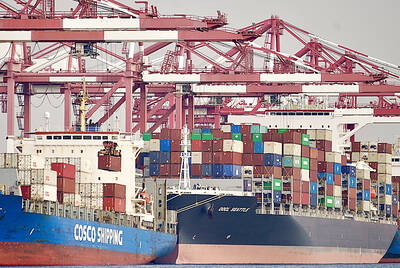
TECH WINNERS: Taiwan and South Korea reported robust trade, which suggests that they have critical advantages in the rapidly expanding AI supply chain, an official said Exports last month surged to a new high, as booming demand tied to artificial intelligence (AI) infrastructure fueled shipments of advanced technology components, underscoring the nation’s pivotal role in the global semiconductor supply chain. Outbound shipments climbed to US$80.18 billion, the highest ever for a single month, rising 61.8 percent from a year earlier and marking the 29th consecutive month of growth, the Ministry of Finance said yesterday. “The surge was driven primarily by global investment in AI infrastructure,” Department of Statistics Director-General Beatrice Tsai (蔡美娜) said. The mass production of next-generation AI computing systems has accelerated procurement across the semiconductor supply


 RSS
RSS