


Taiwan-based HTC Corp (宏達電), which recently launched its first virtual-reality (VR) headset, the HTC Vive, has projected that the global VR market will overtake the smartphone market in four years.
In a report on China’s Sina Web site, Wang Tsung-ching (汪叢青), head of HTC Vive China, said it took only five years for smartphone sales to jump past personal computer sales in terms of volume, and now that smartphone demand is slowing, VR devices are expected to become the next big consumer technology on the market.
With the rapid evolution of technology, the VR market is likely to overtake the smartphone market in four years, creating a big impact in the high-tech sector and to the daily lives of consumers, Wang said.
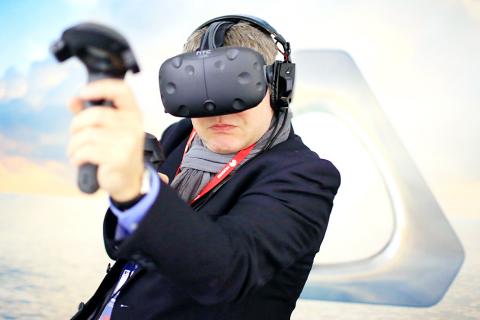
Photo: Bloomberg
The HTC Vive, jointly developed by HTC and US video game supplier Valve, was unveiled at the Mobile World Congress (MWC) in March last year.
The headset is equipped with tracked controllers that allow wearers to inspect objects from every angle and interact with their surroundings. The gadget, priced at US$799, is now on sale globally. HTC’s venture into VR technology is seen as an effort to diversify its product line amid tight competition in the global smartphone market.
According to a Gartner Inc research report, worldwide smartphone sales this year are expected to grow only 7 percent, marking the first year of single-digit percentage growth in a saturated market.
Amid optimism toward HTC’s VR operations after Wang’s forecast, investors rushed to pick up HTC shares soon after the local equity market opened yesterday.
Targeting the VR market in China, HTC is to launch preorders for the Vive on TMall (天貓), one of China’s largest e-commerce platforms, today.
HTC is also to work with Jingdong Mall (京東), another Chinese e-commerce operator, to sell the HTC Vive as part of a package that is to include its latest flagship smartphone, the HTC 10.
HTC chairwoman Cher Wang (王雪紅) is scheduled to address a conference on the HTC Vive in Beijing later today, which is also part of the company’s promotional efforts in the Chinese market.
Several big names in the VR business are expected to attend the conference, including Valve game designer Chet Faliszek; Hua Yong (華勇), founder of the Chinese online gaming company Hangzhou Shunwang Technology Co (順網); and Hubert Larenaudie, founder and senior vice president of game engine developer Unity Technologies.
HTC has also scheduled a HTC Vive summit in Shenzhen in March next year.

GROWING OWINGS: While Luxembourg and China swapped the top three spots, the US continued to be the largest exposure for Taiwan for the 41st consecutive quarter The US remained the largest debtor nation to Taiwan’s banking sector for the 41st consecutive quarter at the end of September, after local banks’ exposure to the US market rose more than 2 percent from three months earlier, the central bank said. Exposure to the US increased to US$198.896 billion, up US$4.026 billion, or 2.07 percent, from US$194.87 billion in the previous quarter, data released by the central bank showed on Friday. Of the increase, about US$1.4 billion came from banks’ investments in securitized products and interbank loans in the US, while another US$2.6 billion stemmed from trust assets, including mutual funds,

AI TALENT: No financial details were released about the deal, in which top Groq executives, including its CEO, would join Nvidia to help advance the technology Nvidia Corp has agreed to a licensing deal with artificial intelligence (AI) start-up Groq, furthering its investments in companies connected to the AI boom and gaining the right to add a new type of technology to its products. The world’s largest publicly traded company has paid for the right to use Groq’s technology and is to integrate its chip design into future products. Some of the start-up’s executives are leaving to join Nvidia to help with that effort, the companies said. Groq would continue as an independent company with a new chief executive, it said on Wednesday in a post on its Web
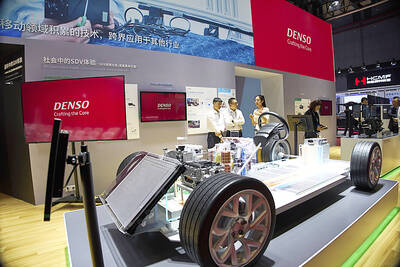
JOINT EFFORTS: MediaTek would partner with Denso to develop custom chips to support the car-part specialist company’s driver-assist systems in an expanding market MediaTek Inc (聯發科), the world’s largest mobile phone chip designer, yesterday said it is working closely with Japan’s Denso Corp to build a custom automotive system-on-chip (SoC) solution tailored for advanced driver-assistance systems and cockpit systems, adding another customer to its new application-specific IC (ASIC) business. This effort merges Denso’s automotive-grade safety expertise and deep vehicle integration with MediaTek’s technologies cultivated through the development of Media- Tek’s Dimensity AX, leveraging efficient, high-performance SoCs and artificial intelligence (AI) capabilities to offer a scalable, production-ready platform for next-generation driver assistance, the company said in a statement yesterday. “Through this collaboration, we are bringing two

Even as the US is embarked on a bitter rivalry with China over the deployment of artificial intelligence (AI), Chinese technology is quietly making inroads into the US market. Despite considerable geopolitical tensions, Chinese open-source AI models are winning over a growing number of programmers and companies in the US. These are different from the closed generative AI models that have become household names — ChatGPT-maker OpenAI or Google’s Gemini — whose inner workings are fiercely protected. In contrast, “open” models offered by many Chinese rivals, from Alibaba (阿里巴巴) to DeepSeek (深度求索), allow programmers to customize parts of the software to suit their


 RSS
RSS