


Is a succession plan in the making at the top of Asustek Computer Inc (華碩)?
Chairman Jonney Shih (施崇棠) has held that position for more than 20 years, showing no signs of relinquishing it, and the PC company has never said it has a succession plan in place.
However, an announcement from Asustek on Wednesday caught the market off guard, with the company saying it is inviting one of its founders, Ted Hsu (徐世昌), to serve as chief strategy officer — a new position in the decisionmaking inner circle.
Hsu, an old acquaintance of Shih’s, joined Pegatron Corp (和碩) in 2008 after Asustek span off its computer-related contract manufacturing unit.
He moves back to Asustek next month from his current post of vice chairman at Pegatron.
At Asustek, Hsu is to share corporate strategy and major decisionmaking with Shih, vice chairman Jonathan Tsang (曾鎗聲) and chief executive officer Jerry Shen (沈振來), the company said.
Hsu is expected to be nominated to sit on the company’s board in July at the earliest, according to Asustek.
The unexpected appointment has sparked questions: Is Shih planning to retire soon, and why did he not tap high-ranking Asustek executives — such as Shen — for the post, instead of a person who left the firm eight years ago?
“Shen is qualified as a CEO and chairman at the same time, but it is too physically challenging for him and might not be the best option for the company,” said a Yuanta Securities Investment Consulting Co (元大投顧) analyst, who declined to be named.
Other industry watchers said 64-year-old Shih is intending to spend more time with his family and has decided on a succession plan after his right-hand man and former chief financial officer David Chang (張偉明) passed away in July last year.
If Shih promoted Shen to chairman, a scramble to fill Shen’s position might trigger a power struggle among the firm’s top executives, and that would be bad for the company, industry watchers said.
Therefore, Hsu’s seniority at Asustek might be enough to maintain the delicate balance of power among ranking executives, while his close personal relationship with Shih also makes him a promising candidate, they said.
During his time in Asustek, Hsu won praise for being an important research and development leader with a strong engineering background. He participated in some major decisionmaking and, in the early 2000s, he suggested Asustek — a supplier of high-end motherboards at the time — set up ASRock Inc (華擎), a subsidiary to specifically target mid and low-end motherboard markets.
It was a decision that proved to be visionary, as it helped Asustek to expand its motherboard market share in the global market and widened the distance between Asustek and its competitors in the industry, according to people familiar with the matter.
Shih once described Hsu as a natural manager with keen observation and extraordinary foresight for industry trends.
“I think he is like Zhuge Liang (諸葛亮) [a military strategist during China’s Three Kingdom’s era],” the Chinese-language Business Today (今周刊) quoted Shih as saying in an interview in April last year.
However, Hsu still seems to be a surprising choice for chairman, given his unfamiliarity with Asustek’s operations over the past eight years.
“To be honest, I am a bit terrified, as I am not familiar with Asustek’s operations after years of not being around the company,” Hsu said on Thursday after being asked by reporters how he felt about returning.
In addition, the company is under mounting pressure to reevaluate its non-PC strategy amid declining PC demand and a fiercely competitive smartphone market, but perhaps more importantly, the company needs to show its ability to innovate and transform and stop relying on PC’s, said Thompson Wu (武光明), an analyst at Credit Suisse Group AG’s Taiwan equity research division.
“We believe Asus needs to execute a significant strategic transformation,” Wu wrote in a note on Friday. “The new chief strategy officer, Ted Hsu, comes at a critical time in Asus’ transformation.”
Besides its recent emphasis in gaming PCs, Asustek has expressed interest in robotics and is planning to unveil its first consumer service robot during the Computex trade show in Taipei, which opens at the end of next month.
Wu said further investment in industrial PCs and the use of the Internet of Things technologies in industry are options for Asustek going forward.
Whether the company wants to admit to Shih’s succession plan or not, challenges await, and if Hsu will be truly embraced by other Asustek executives and employees remains to be seen.

GROWING OWINGS: While Luxembourg and China swapped the top three spots, the US continued to be the largest exposure for Taiwan for the 41st consecutive quarter The US remained the largest debtor nation to Taiwan’s banking sector for the 41st consecutive quarter at the end of September, after local banks’ exposure to the US market rose more than 2 percent from three months earlier, the central bank said. Exposure to the US increased to US$198.896 billion, up US$4.026 billion, or 2.07 percent, from US$194.87 billion in the previous quarter, data released by the central bank showed on Friday. Of the increase, about US$1.4 billion came from banks’ investments in securitized products and interbank loans in the US, while another US$2.6 billion stemmed from trust assets, including mutual funds,
AI TALENT: No financial details were released about the deal, in which top Groq executives, including its CEO, would join Nvidia to help advance the technology Nvidia Corp has agreed to a licensing deal with artificial intelligence (AI) start-up Groq, furthering its investments in companies connected to the AI boom and gaining the right to add a new type of technology to its products. The world’s largest publicly traded company has paid for the right to use Groq’s technology and is to integrate its chip design into future products. Some of the start-up’s executives are leaving to join Nvidia to help with that effort, the companies said. Groq would continue as an independent company with a new chief executive, it said on Wednesday in a post on its Web
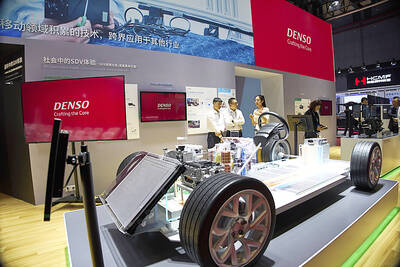
JOINT EFFORTS: MediaTek would partner with Denso to develop custom chips to support the car-part specialist company’s driver-assist systems in an expanding market MediaTek Inc (聯發科), the world’s largest mobile phone chip designer, yesterday said it is working closely with Japan’s Denso Corp to build a custom automotive system-on-chip (SoC) solution tailored for advanced driver-assistance systems and cockpit systems, adding another customer to its new application-specific IC (ASIC) business. This effort merges Denso’s automotive-grade safety expertise and deep vehicle integration with MediaTek’s technologies cultivated through the development of Media- Tek’s Dimensity AX, leveraging efficient, high-performance SoCs and artificial intelligence (AI) capabilities to offer a scalable, production-ready platform for next-generation driver assistance, the company said in a statement yesterday. “Through this collaboration, we are bringing two
Even as the US is embarked on a bitter rivalry with China over the deployment of artificial intelligence (AI), Chinese technology is quietly making inroads into the US market. Despite considerable geopolitical tensions, Chinese open-source AI models are winning over a growing number of programmers and companies in the US. These are different from the closed generative AI models that have become household names — ChatGPT-maker OpenAI or Google’s Gemini — whose inner workings are fiercely protected. In contrast, “open” models offered by many Chinese rivals, from Alibaba (阿里巴巴) to DeepSeek (深度求索), allow programmers to customize parts of the software to suit their


 RSS
RSS