


Epistar Corp (晶電) yesterday posted sales of NT$6.05 billion (US$186.44 million) for the first quarter of the year, up 2.36 percent from the previous quarter on increasing demand for backlight units used in TVs and growing orders for LED lighting products.
The quarterly sales were slightly better than the market’s consensus estimate of NT$5.98 billion.
Epistar, the nation’s No. 1 LED chipmaker, attributed the quarterly growth to smooth inventory digestion and rising orders for backlight units and LED lighting products, especially last month.
The company’s revenue last month jumped 35.77 percent to NT$3.23 billion from February, the company’s highest monthly revenue in the past 10 months.
However, first-quarter sales still represented an annual decline of 8.85 percent from the previous year’s NT$6.64 billion due to intensified pricing competition because of oversupply in the past year.
Morgan Stanley said it has turned more cautious on Epistar’s operations due to the continued excessive supply in the market and forecast that the company’s revenue would fall by 1.77 percent to NT$6.65 billion this quarter from last year.
“Epistar has started to consolidate its existing fabrication plants and progressively scale down its capacity, but these moves might not help it turn around meaningfully in a short period of time, as we expect tough competition to persist amid industry oversupply,” Morgan Stanley analyst Sharon Shih (施曉娟) said in a note released on Thursday.
Everlight Electronics Co (億光), the nation’s largest LED chip packager and lighting product supplier, also posted an annual decline in revenue in the first quarter.
Everlight’s revenue dropped 4 percent year-on-year and 7.3 percent quarter-on-quarter to NT$6.95 billion in the first quarter, the firm said in a filing with the Taiwan Stock Exchange.
Everlight attributed the decline in revenue to sluggish demand in the LED industry.
The company said demand for backlight units used in TVs and smartphones only resurfaced this month.
Mega International Investment Services Corp (兆豐投顧) said it expects improving demand for LED backlight units to help Everlight’s sales grow more than 7 percent quarter-on-quarter to NT$7.48 billion this quarter.
That would represent an annual increase of 6 percent from the second quarter of last year, it said.
Epistar shares fell 0.22 percent to close at NT$22.8 in Taipei trading yesterday, while Everlight shares rose 0.51 percent to close at NT$49.1.
Both shares underperformed the TAIEX, which gained 0.6 percent.

GROWING OWINGS: While Luxembourg and China swapped the top three spots, the US continued to be the largest exposure for Taiwan for the 41st consecutive quarter The US remained the largest debtor nation to Taiwan’s banking sector for the 41st consecutive quarter at the end of September, after local banks’ exposure to the US market rose more than 2 percent from three months earlier, the central bank said. Exposure to the US increased to US$198.896 billion, up US$4.026 billion, or 2.07 percent, from US$194.87 billion in the previous quarter, data released by the central bank showed on Friday. Of the increase, about US$1.4 billion came from banks’ investments in securitized products and interbank loans in the US, while another US$2.6 billion stemmed from trust assets, including mutual funds,
AI TALENT: No financial details were released about the deal, in which top Groq executives, including its CEO, would join Nvidia to help advance the technology Nvidia Corp has agreed to a licensing deal with artificial intelligence (AI) start-up Groq, furthering its investments in companies connected to the AI boom and gaining the right to add a new type of technology to its products. The world’s largest publicly traded company has paid for the right to use Groq’s technology and is to integrate its chip design into future products. Some of the start-up’s executives are leaving to join Nvidia to help with that effort, the companies said. Groq would continue as an independent company with a new chief executive, it said on Wednesday in a post on its Web
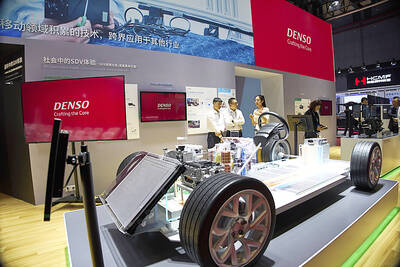
JOINT EFFORTS: MediaTek would partner with Denso to develop custom chips to support the car-part specialist company’s driver-assist systems in an expanding market MediaTek Inc (聯發科), the world’s largest mobile phone chip designer, yesterday said it is working closely with Japan’s Denso Corp to build a custom automotive system-on-chip (SoC) solution tailored for advanced driver-assistance systems and cockpit systems, adding another customer to its new application-specific IC (ASIC) business. This effort merges Denso’s automotive-grade safety expertise and deep vehicle integration with MediaTek’s technologies cultivated through the development of Media- Tek’s Dimensity AX, leveraging efficient, high-performance SoCs and artificial intelligence (AI) capabilities to offer a scalable, production-ready platform for next-generation driver assistance, the company said in a statement yesterday. “Through this collaboration, we are bringing two

Even as the US is embarked on a bitter rivalry with China over the deployment of artificial intelligence (AI), Chinese technology is quietly making inroads into the US market. Despite considerable geopolitical tensions, Chinese open-source AI models are winning over a growing number of programmers and companies in the US. These are different from the closed generative AI models that have become household names — ChatGPT-maker OpenAI or Google’s Gemini — whose inner workings are fiercely protected. In contrast, “open” models offered by many Chinese rivals, from Alibaba (阿里巴巴) to DeepSeek (深度求索), allow programmers to customize parts of the software to suit their


 RSS
RSS