


Asian stocks fell on Friday, with the regional benchmark index heading for a weekly loss, after Japanese shares declined as the strengthening yen pressured major exporters.
The MSCI Asia Pacific Index lost 0.3 percent to 120.83 as of 4:04pm in Hong Kong. The measure is poised for a 0.5 percent decline this week as Japan’s Topix index erased its gains from the Bank of Japan’s stimulus on Jan. 29 and the yen headed for its biggest weekly advance since 2009. Investors are awaiting Friday’s US monthly payrolls report after data showed factory orders fell in December last year.
“The Bank of Japan has done what they should, but what they could do had its limits,” said Juichi Wako, a senior strategist at Nomura Holdings Inc in Tokyo. “Until now, the view on the US economy was that it was recovering, but the pace was not as fast as hoped. Now there is some concern in the market that it may actually be contracting.”
Japan’s TOPIX dropped 1.4 percent, bring losses this week to 4.4 percent.
The index has wiped out a 5.1 percent rally following the Bank of Japan’s stimulus boost. The yen traded at 116.77 per US dollar after rising in the past four days.
The stronger yen dragged down Japan’s exporters, with Nissan Motor Co slumping 3.3 percent. Mazda Motor Corp sank 4.8 percent after reporting net income fell. Toshiba Corp plunged 11 percent to a 36-year low after widening its loss outlook to a record ¥710 billion (US$6 billion) as the industrial group continues restructuring in the wake of an accounting scandal.
The TAIEX fell 0.84 percent to 8,063 on Wednesday before closing for the Lunar New Year holiday.
China’s Shanghai Composite Index declined 0.6 percent, paring this year’s biggest weekly gain to 1 percent, its best performance since December last year, ahead of the week-long Lunar New Year holiday. Taiwanese and Chinese markets are closed all week, while Hong Kong is shut for the first three days, resuming on Thursday.
“We have had a bit of a bounce, but it has been a really weak one,” said Shane Oliver, head of investment strategy in Sydney at AMP Capital Investors Ltd, which oversees about US$120 billion. “It lacks strength, which gets me a little bit concerned that there might still be a lot of downside to come before we can see the bottom.”
The People’s Bank of China injected 330 billion yuan (US$50 billion) into the banking system this week, adding to last month’s injection of 2 trillion yuan as policymakers moved to ease a cash shortage before the holiday starting tomorrow. The yuan in Hong Kong is set for its fourth weekly gain, the longest run of advances since October 2014. China relaxed restrictions on foreign funds as policymakers seek to gain entry to MSCI Inc’s global stock indexes and bolster the nation’s financial markets after record capital outflows.
Australia’s S&P/ASX 200 Index fell 0.1 percent. New Zealand’s benchmark added 0.3 percent. South Korea’s Kospi index gained 0.1 percent. Hong Kong’s Hang Seng Index rose 0.6 percent, increasing for a second day.
Singapore’s Straits Times Index climbed 2.3 percent, with Singapore Telecommunications Ltd surging 6 percent, the most since 2009. Shares on the benchmark index trade at about the value of its companies’ net assets, the cheapest among markets in Southeast Asia.
The Jakarta Composite Index rallied 2.6 percent, heading for its highest close since Aug. 6 last year, after the nation’s economic growth beat analysts estimates, as the government stepped up measures to boost state spending and lure foreign investment.
E-mini futures of the Standard & Poor’s 500 Index were little changed. The US equity benchmark index rose 0.2 percent on Thursday amid a rally in raw-material and industrial shares, as the US dollar’s weakness boosted commodity prices and optimism for profits at multinational companies.
Patchy US economic data ignited the US dollar’s retreat this week, as concern grows over the vulnerability of the US economy to outside forces.
The fixed-income market is all but pricing in zero rate hikes from the US Federal Reserve this year, as central banks from Asia to Europe have mixed success with their efforts to stymie the turmoil that’s roiled markets this year.
While a weaker US dollar makes commodities cheaper, and therefore more appealing in other currencies, oil remains an entity unto its own, reverting to losses on Thursday as investors focused on the fact US crude supplies are at their highest in more than 80 years.
Additional reporting by staff writer
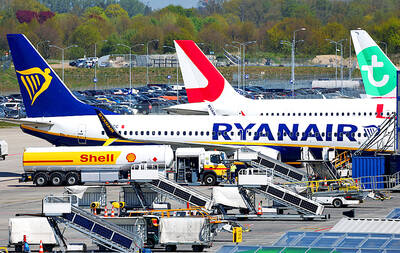
Ryanair, Transavia, Volotea and other low-cost airlines are feeling the financial pain from high jet fuel prices as a result of the Middle East war and are cutting flights. The closure of the Strait of Hormuz has taken a huge chunk of oil supplies off the market, sending the price of jet fuel soaring and triggering fears of shortages that could force airlines to cancel flights. Airlines are not waiting for a lack of supplies to react. “Travel alert: Airlines are cutting thousands of flights right now,” Travel Therapy host Karen Schaler said in an Instagram reel this past weekend.
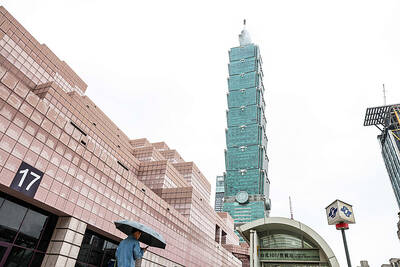
MANAGING RISKS: Taiwan has secured LNG sufficient to cover 95 percent of electricity demand for next month, UBS said, describing the government’s approach as proactive UBS Group AG has raised its forecast for Taiwan’s economic growth this year to 8 percent, up from 6.9 percent previously, and said expansion could reach as high as 8.6 percent if external energy shocks are avoided. The upgrade reflects a stronger-than-expected first-quarter performance and sustained momentum in artificial intelligence (AI)-driven exports, which UBS said are providing a firm foundation for growth despite geopolitical and energy risks. Taiwan’s GDP expanded 13.69 percent year-on-year in the first quarter, the fastest growth since the second quarter of 1987, the Directorate-General of Budget, Accounting and Statistics (DGBAS) reported on Thursday. On a seasonally

The list of Asian stocks that benefit from business partnership with Nvidia Corp is getting longer, as the region further integrates into the artificial intelligence (AI) chip giant’s business ecosystem. Just in the past week, South Korea’s LG Electronics Inc, Taiwan’s Nanya Technology Corp (南亞科技), as well as China’s Huizhou Desay SV Automotive Co (德賽西威) and Pateo Connect Technology Shanghai Corp (博泰車聯) have become the latest to rally on news of tie-ups, supply-chain participation or product collaboration with the US chip designer. Asian suppliers account for about 90 percent of Nvidia’s production costs, up from about 65 percent last year, data compiled

The Fair Trade Commission’s (FTC) ongoing review of Grab Holdings Ltd’s US$600 million acquisition of Foodpanda Taiwan’s operations, announced on March 23, has taken on fresh urgency as industry experts warn that the transaction could embed significant Chinese cybersecurity vulnerabilities into Taiwan’s digital infrastructure through Grab’s deep ties to autonomous-driving firm WeRide (文遠知行). Less than 16 months after the FTC blocked Uber Eats’ direct attempt to acquire Foodpanda Taiwan — citing potential combined market shares of 80 to 90 percent — the emergence of Grab as the buyer has prompted questions about whether the same competitive harm is simply being rerouted


 RSS
RSS