


The Chung-Hua Institution for Economic Research (CIER, 中華經濟研究院) yesterday forecast the economy would grow by 2.24 percent annually next year, from a predicted 0.93 percent this year, suggesting a modest pickup in both domestic and external demand led by markets in developed countries would boost the nation’s recovery.
Its estimate comes even though companies in a variety of sectors have forecast weakening profits for the first half of next year compared with the second half of this year, the Taipei-based think tank said.
“We expect GDP growth to be stronger next year on the back of an improving global economy,” CIER researcher Peng Su-ling (彭素玲) said.
The global economy is estimated to grow 2.9 percent next year, an increase from this year’s projected 2.6 percent, CIER said, citing international research bodies.
Exports — the main driver of the nation’s growth — are expected to grow 2.93 percent to NT$2.89 trillion (US$87.4 billion) next year, compared with a downturn of 10.37 percent this year, CIER said.
Firms that supply well-known international technology brands might benefit from the launches of new-generation devices in the second half of next year, and the Internet of Things might also bring business opportunities as applications mature, Peng said.
Imports — much of which stem from export demand — could edge up 1.32 percent to NT$2.2 trillion next year, compared with a projected slump of 16.4 percent this year, as price disruptions caused by cheaper global crude prices wane, but do not disappear, the institute said.
Mineral, chemical and plastic products, which account for 20 percent of total outbound shipments, would continue to suffer, as customers remain conservative about inventory replenishment until crude costs bottom out, the institution said.
Private consumption is expected to inch up 1.92 percent next year, slowing from an estimated 2.54 percent pickup this year, the institute said, with the job market lending further support, despite consumers tightening their belts somewhat.
Most companies in the manufacturing and service sectors plan to hire more employees, although they believe revenue and profit are set to trend downward from now, based on current business visibility, CIER said in a separate report.
The institution sees a business outlook index of 49.6 for the manufacturing industry for the first half of next year and 46.6 for the service industry, CIER president Wu Chung-shu (吳中書) said.
Values above 50 suggest expansion, while those below the halfway mark indicate a contraction.
The index on profitability forecasts registered 43.1 for producers and 44.5 for service providers in the coming six months, the report said.
However, the employment gauge was 52.1 for manufacturers and 56.3 for service providers in the first half of next year, the report said.
“The findings show that the job market could emerge from this global slowdown unharmed, unlike the turmoil following the 2008-2009 economic meltdown,” Wu said.
The central bank might hold policy interest rates unchanged at 1.75 percent at its quarterly board meeting on Thursday, Standard Chartered Bank Taipei-based economist Tony Phoo (符銘財) said.
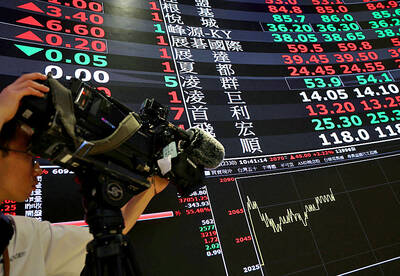
After several years flying high as Asia’s best Nvidia Corp proxy, Taiwan Semiconductor Manufacturing Co (TSMC, 台積電) is increasingly vying with other artificial intelligence (AI) stocks for investor attention. Stock traders are chasing a wider array of beneficiaries as mainstream usage of AI creates demand for hardware beyond the most-advanced chips TSMC makes for Nvidia. Subthemes from the deepening memory crunch to advances in robotics are also luring bids. At the same time, investment caps on single stocks are pushing funds to diversify, while retail investors long familiar with TSMC through its US depositary receipts are being offered a broader set of
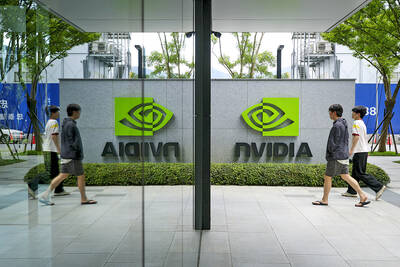
UNDER MICROSCOPE: Taiwan detained three people who allegedly conspired to buy servers in Taiwan and export them using fraudulent documentation, prosecutors said Nvidia Corp chief executive officer Jensen Huang (黃仁勳) on Saturday urged Super Micro Computer Inc to tighten up on compliance after Taiwan detained three people this week for allegedly making fraudulent declarations about artificial intelligence (AI) servers made by its US partner. The development marked the nation’s first crackdown on semiconductor smuggling, which grew after the US slapped restrictions on exports of high-end chips such as Nvidia AI accelerators to China. Nvidia is “rigorous” in explaining regulations to all of its partners, Huang told reporters after arriving in Taipei. “Ultimately Super Micro has to run their own company,” he said in response to

TECH RELIANCE: Growth is increasingly reflecting an unequal K-shaped distribution, where technology sectors outperform and other industries struggle, an expert said Standard Chartered Bank has significantly raised its forecast for Taiwan’s economic growth to 9.5 percent this year, up from 7.6 percent previously, citing surging artificial intelligence (AI) demand driving exports, semiconductor production and investment. The upgrade reflects a sustained AI supercycle that continues to fuel demand for advanced chips and technology infrastructure, which form the backbone of Taiwan’s exports, the bank said in a report this week. “We raise our 2026 growth forecast to reflect a much stronger-than-expected first-quarter GDP figure,” Standard Chartered senior economist for greater China and Asia Tommy Wu (胡東安) said in the report. Driven largely by a 35.3 percent

Two of Taiwan’s international carriers, Starlux Airlines Co (星宇航空) and EVA Airways Corp (長榮航空), have retained the five-star airline rating awarded by international airline review organization Skytrax. Starlux was awarded the distinction for a second consecutive year, while EVA Air received it for the 11th straight year, Skytrax said in statements released yesterday and on Thursday last week, respectively. The five-star rating is considered one of the airline industry's highest honors and is awarded following professional audits of airline product and frontline service standards, Skytrax said. The ratings are based on in-depth assessments using unified global quality standards rather than customer review scores


 RSS
RSS