


Global oil prices hit multimonth peaks on Friday on the back of the struggling US dollar and increasing geopolitical turmoil in the crude-rich Middle East, dealers said.
Brent North Sea crude for delivery in November added US$0.56 to stand at US$53.61 per barrel just after midday in London, having earlier hit US$54 — the highest since late August.
US benchmark West Texas Intermediate for delivery in November won US$0.96 to US$50.39 per barrel compared with Thursday’s close. The contract had earlier touched a 2.5-month peak at US$50.58.
“Oil prices are continuing to rise, as they have been in recent days,” Commerzbank analyst Carsten Fritsch said. “Increased risk appetite coupled with a weaker US dollar is giving tailwind to the oil prices. In addition, some market observers have made optimistic remarks about the future development of the market.”
The flagging greenback makes dollar-priced oil cheaper for buyers using stronger currencies, which tends to stimulate demand and prices.
Meanwhile, Russia continued to launch airstrikes in Syria in support of Syrian President Bashar al-Assad.
“Russia’s military intervention in support of Assad has finally turned the war in Syria into a proxy war between the world powers, which significantly increases the geopolitical risks,” Fritsch added.
Crude futures also climbed on Friday on hopes that increasing demand and declining US crude production would ease a supply glut.
PRECIOUS METALS: Gold advanced to a six-week high as minutes of the Federal Reserve’s latest meeting increased speculation that the central bank will hold off raising interest rates until next year.
The odds of a rate increase this year have dropped in the past month and traders and analysts surveyed by Bloomberg are the most bullish on gold in three weeks.
Signs that US growth may be slowing have helped gold rebound almost 8 percent from a five-year low set in July, even as Fed Chair Janet Yellen has said the central bank still expects to raise rates this year.
Higher borrowing costs curb the appeal of bullion, which does not pay interest or give returns like other assets such as bonds and equities.
Gold futures for December delivery advanced 1 percent to settle at US$1,155.90 an ounce at 1:47pm on the Comex in New York, after touching US$1,159.30, the highest since Aug. 24. Prices are up 1.7 percent this week.
Platinum futures climbed for a sixth day, the longest rally since April last year. Palladium and silver also advanced.
BASE METALS: The price of zinc rebounded sharply this week after troubled Swiss mining giant Glencore PLC slashed its output by one-third, in a “significant” tightening of supplies, traders said.
The industrial metal rallied to a two-month pinnacle at US$1,875 per tonne in Friday morning deals, up 12 percent from the closing level the previous day. By late Friday on the LME, zinc for delivery in three months spiked to US$1,843 a tonne from US$1,692 a week earlier.
Three-month copper rose to US$5,298 a tonne from US$5,122. Three-month aluminium increased to US$1,611.50 a tonne from US$1,560. Three-month lead advanced to US$1,781 a tonne from US$1,655. Three-month tin climbed to US$16,005 a tonne from US$15,530. Three-month nickel rebounded to US$10,530 a tonne from US$10,035.

ENERGY ISSUES: The TSIA urged the government to increase natural gas and helium reserves to reduce the impact of the Middle East war on semiconductor supply stability Chip testing and packaging service provider ASE Technology Holding Co (日月光投控) yesterday said it planned to invest more than NT$100 billion (US$3.15 billion) in building a new advanced chip testing facility in Kaohsiung to keep up with customer demand driven by the artificial intelligence (AI) boom. That would be included in the company’s capital expenditure budget next year, ASE said. There is also room to raise this year’s capital spending budget from a record-high US$7 billion estimated three months ago, it added. ASE would have six factories under construction this year, another record-breaking number, ASE chief operating officer Tien Wu

The EU and US are nearing an agreement to coordinate on producing and securing critical minerals, part of a push to break reliance on Chinese supplies. The potential deal would create incentives, such as minimum prices, that could advantage non-Chinese suppliers, according to a draft of an “action plan” seen by Bloomberg. The EU and US would also cooperate on standards, investments and joint projects, as well as coordinate on any supply disruptions by countries like China. The two sides are additionally seeking other “like-minded partners” to join a multicountry accord to help create these new critical mineral supply chains, which feed into

For weeks now, the global tech industry has been waiting for a major artificial intelligence (AI) launch from DeepSeek (深度求索), seen as a benchmark for China’s progress in the fast-moving field. More than a year has passed since the start-up put Chinese AI on the map in early last year with a low-cost chatbot that performed at a similar level to US rivals. However, despite reports and rumors about its imminent release, DeepSeek’s next-generation “V4” model is nowhere in sight. Speculation is also swirling over the geopolitical implications of which computer chips were chosen to train and power the new
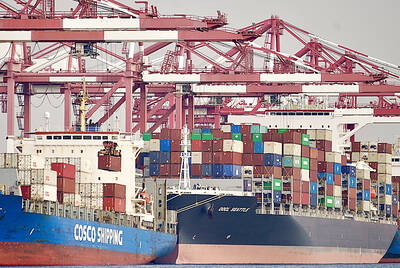
TECH WINNERS: Taiwan and South Korea reported robust trade, which suggests that they have critical advantages in the rapidly expanding AI supply chain, an official said Exports last month surged to a new high, as booming demand tied to artificial intelligence (AI) infrastructure fueled shipments of advanced technology components, underscoring the nation’s pivotal role in the global semiconductor supply chain. Outbound shipments climbed to US$80.18 billion, the highest ever for a single month, rising 61.8 percent from a year earlier and marking the 29th consecutive month of growth, the Ministry of Finance said yesterday. “The surge was driven primarily by global investment in AI infrastructure,” Department of Statistics Director-General Beatrice Tsai (蔡美娜) said. The mass production of next-generation AI computing systems has accelerated procurement across the semiconductor supply


 RSS
RSS