


The trend has already hit Sydney, Vancouver and the US. Now it is happening in Japan: busloads of real-estate buyers from China coming in, buying up homes and pushing prices higher.
Realty agencies in Beijing are organizing twice-monthly tours to Tokyo and Osaka, where 40 Chinese at a time come for three-day property shopping trips, seeking safe places to invest their cash abroad. They are being prompted by the yen’s decline to 22-year lows and excitement over the 2020 Tokyo Olympics driving up prices, as they did in Beijing in 2008. Property tours are expected to soon start from Shanghai too.
Partly as a result of nascent Chinese buying, Tokyo apartment prices have reached their highest levels since the early 1990s, up 11 percent over two years, according to the Real Estate Economic Institute Co.
“The demand is like water exploding up from a well,” said Zhou Yinan, an Osaka-based agent at Chinese brokerage SouFun Holdings Ltd (搜房), who said his Chinese buyers are about 20 percent more numerous than at this time last year. “The buyers had mainly been from Taiwan until last year, but that trend reversed since October [last year] as the yen weakened against the yuan.”
Thousands more Chinese are arriving on their own, hitting real-estate agencies in Tokyo’s Ikebukuro Chinatown district. Classified advertisements including properties for sale are piled up in free Chinese newspapers outside a Chinese supermarket that sells frozen dumplings and spicy sauces.
“There are so many Chinese buyers recently,” said Song Zhiyan, a broker at BestOne Co realty in Ikebukuro, who uses messaging app WeChat to reach thousands of potential customers in China, who can then fly to town to complete purchases. “I only work with clients who can pay cash. Why waste everyone’s time?”
She tells them to hurry: Properties are going so fast that those who try to negotiate the price find them already sold. Her transaction volume exclusively for Chinese buying in Tokyo has tripled over the past six months, Song said.
Demand is so strong that some developers have put a quota on the number of new apartments sold to foreigners, said Kenny Ho (何偉宏), Tokyo-based managing director at Sinyi Realty Inc (信義房屋), a Taiwanese brokerage with outlets in Japan. Some developers will not sell more than 20 percent of total units to foreigners, he said, declining to name the developers.
“Japan has its own way of doing things,” he said. “Some people feel that if there are too many foreigners, that may affect the quality of the living environment.”
Japan’s sluggish economy caused price gains in Tokyo to trail those in other urban centers like New York, London and Hong Kong since the 2008 global credit crisis.
Buying from China, which created about 1 million new millionaires last year, according to the Boston Consulting Group, has the potential to quickly change the dynamics of local property markets.
In the US, buyers from China, Hong Kong and Taiwan spent US$28.6 billion on homes in the 12 months through March, becoming the largest group of foreign homebuyers for the first time, according to an annual report by the US’ National Association of Realtors.
Chinese already buy almost one-quarter of new homes in Sydney, and their outlay is expected to more than double to A$60 billion (US$45.3 billion) in the six years to 2020, Credit Suisse Group AG estimated.
In Japan, sales at Sinyi Realty to Chinese and Taiwanese buyers jumped by 70 percent in the first three months of this year to ¥11.1 billion (US$90.2 million) from the same period last year. For every 100 new apartments sold, about 10 to 15 are to foreigners from Asia, according to Sinyi.
“I wouldn’t find a deal like this in China,” said Lin Huan, a 35-year programmer from China’s northeast Liaoning Province, who with help from her parents bought a three-bedroom flat in the Shinbashi area of Tokyo for investment, paying the equivalent of US$203,000.
After recently relocating to Tokyo to work for a technology company, she noticed the weaker yen was making properties cheaper. She expects to make a 5 percent return on the rent annually, whereas property in Beijing yields just 2 percent.
Chinese buyers are typically purchasing in the 1 million to 2 million yuan (US$161,090 to US$322,203) bracket, a range “tolerable to many Chinese,” Beijing-based SouFun international sales director Gui Liangjing said.
It is not as tolerable to Japanese. Prices in Tokyo have become “seriously unaffordable,” the annual Demographia International Housing Affordability Survey shows. The percentage of Japanese in the seven biggest cities who wanted to buy a home dropped to 15.4 percent in December last year, the lowest level since Recruit Sumai Co started surveying two years ago. Even though it rose to 18 percent in March, those who plan to “take action” by looking or buying declined, the survey showed.
Still, prices are lower than in comparable global cities. The average price of a three-bedroom apartment in Tokyo’s 23 wards and surrounding prefectures was ¥53.1 million in April, according to the Real Estate Economic Institute. That compares with HK$8.4 million (US$1.1 million) for a 55m2 apartment on Hong Kong Island, according to calculations based on government records, and US$554,200 for homes in New York, according to Zillow Inc.
“Prices have risen, while incomes and rents remain the same,” Nomura Research Institute Ltd senior researcher Tomohiko Taniyama said. “No regular salaryman will find apartments cheap in Tokyo.”
While the home price-to-income ratio — the cost of a home relative to a buyer’s average annual income — rose to more than 10 times in Tokyo last year, according to property appraisal company Tokyo Kantei Co, it was still below the 18 times it reached during the bubble era in the late 1980s and early 1990s.
Homes are unlikely to become more affordable, with the yen’s 41 percent decline over two-and-a-half years and investment yields higher than in some major cities abroad propelling foreigners to buy.
While Japan remains small by total transaction value compared with the US, Canada and Australia, it is now “comparable” to those markets in terms of the number of clients seeking deals, Gui said.
“Properties in Tokyo are cheap and the returns are relatively high,” Taniyama said. “The quality of buildings is high, while investment opportunities are abundant, unlike Singapore or Hong Kong, where the number of available properties is limited. In that sense, Tokyo is one of the best destinations for investment.”
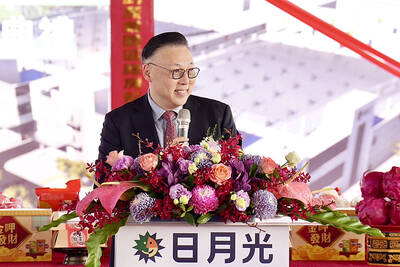
ENERGY ISSUES: The TSIA urged the government to increase natural gas and helium reserves to reduce the impact of the Middle East war on semiconductor supply stability Chip testing and packaging service provider ASE Technology Holding Co (日月光投控) yesterday said it planned to invest more than NT$100 billion (US$3.15 billion) in building a new advanced chip testing facility in Kaohsiung to keep up with customer demand driven by the artificial intelligence (AI) boom. That would be included in the company’s capital expenditure budget next year, ASE said. There is also room to raise this year’s capital spending budget from a record-high US$7 billion estimated three months ago, it added. ASE would have six factories under construction this year, another record-breaking number, ASE chief operating officer Tien Wu

The EU and US are nearing an agreement to coordinate on producing and securing critical minerals, part of a push to break reliance on Chinese supplies. The potential deal would create incentives, such as minimum prices, that could advantage non-Chinese suppliers, according to a draft of an “action plan” seen by Bloomberg. The EU and US would also cooperate on standards, investments and joint projects, as well as coordinate on any supply disruptions by countries like China. The two sides are additionally seeking other “like-minded partners” to join a multicountry accord to help create these new critical mineral supply chains, which feed into

For weeks now, the global tech industry has been waiting for a major artificial intelligence (AI) launch from DeepSeek (深度求索), seen as a benchmark for China’s progress in the fast-moving field. More than a year has passed since the start-up put Chinese AI on the map in early last year with a low-cost chatbot that performed at a similar level to US rivals. However, despite reports and rumors about its imminent release, DeepSeek’s next-generation “V4” model is nowhere in sight. Speculation is also swirling over the geopolitical implications of which computer chips were chosen to train and power the new
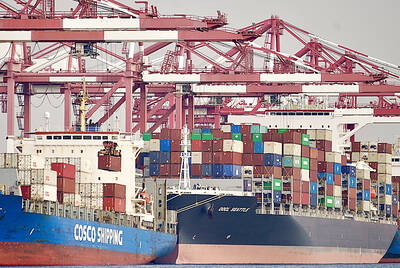
TECH WINNERS: Taiwan and South Korea reported robust trade, which suggests that they have critical advantages in the rapidly expanding AI supply chain, an official said Exports last month surged to a new high, as booming demand tied to artificial intelligence (AI) infrastructure fueled shipments of advanced technology components, underscoring the nation’s pivotal role in the global semiconductor supply chain. Outbound shipments climbed to US$80.18 billion, the highest ever for a single month, rising 61.8 percent from a year earlier and marking the 29th consecutive month of growth, the Ministry of Finance said yesterday. “The surge was driven primarily by global investment in AI infrastructure,” Department of Statistics Director-General Beatrice Tsai (蔡美娜) said. The mass production of next-generation AI computing systems has accelerated procurement across the semiconductor supply


 RSS
RSS