


European Central Bank (ECB) President Mario Draghi urged Greece to work quickly toward an agreement with its creditors to curb a deepening financial crisis and quash doubts over its membership in the eurozone.
Even as he cautioned investors against dumping the single currency, Draghi said Greek Prime Minister Alexis Tsipras’ government must do “much more work” to show it can satisfy the terms of its 240 billion euro (US$259.3 billion) bailout program.
“It is urgent,” Draghi told reporters in Washington on Saturday during IMF meetings. “We all want Greece to succeed. The answer is in the hands of the Greek government.”
Draghi made his call after Greek government bonds suffered their worst week since Tsipras’ election in January. The Greek government’s anti-austerity talk clashes with demands from Europe to take more steps to revamp its economy before receiving more aid.
At stake is Greece’s ability to avoid defaulting on its debts and stay in the 19-nation eurozone. The brinkmanship overshadowed the IMF talks, as delegates from outside of the eurozone urged a speedy resolution.
“We have been clear in our conversations with all parties [that] there is an urgent need to come together around a comprehensive approach,” US Secretary of the Treasury Jack Lew said on Friday.
Eurozone finance ministers are to discuss Greek progress on Friday in Riga, Latvia.
A deal is unlikely to be ready by then, Dutch Minister of Finance and Eurogroup President Jeroen Dijsselbloem told reporters in Washington on Friday.
For all the strains, Draghi cautioned investors not to bet against the 16-year-old single currency.
“It is pointless to go short on the euro,” he said. “Do it.”
He also said that Greek banks continue to meet the requirements for emergency liquidity assistance (ELA), a financial lifeline the ECB decides on each week.
“ELA will continue to be given to the banks if they are judged to be solvent and if they have adequate collateral, which is the case now,” Draghi said.
The aid will have to end eventually, ECB Governing Council member Christian Noyer said. He said it is consistent with ECB rules and not a substitute for long-term actions.
“Emergency assistance is by definition not meant to last indefinitely,” Noyer said. “There will have to be a solution to the fundamental problems. If deposits continue to drop, banks will find it difficult to get refinancing.”
In Washington, ECB Governing Council member Vitas Vasiliauskas said the central bank should not extend its aid beyond the summer.
“The situation in Greece means that we should have a limit until summer for ELA,” Vasiliauskas said on Saturday. “Everyone understands what ELA means; it is a temporary measure to give the banks liquidity.”
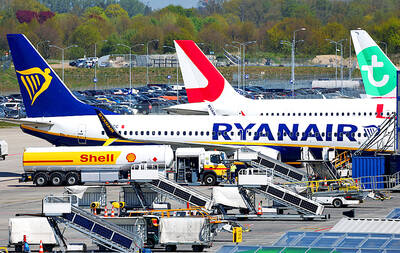
Ryanair, Transavia, Volotea and other low-cost airlines are feeling the financial pain from high jet fuel prices as a result of the Middle East war and are cutting flights. The closure of the Strait of Hormuz has taken a huge chunk of oil supplies off the market, sending the price of jet fuel soaring and triggering fears of shortages that could force airlines to cancel flights. Airlines are not waiting for a lack of supplies to react. “Travel alert: Airlines are cutting thousands of flights right now,” Travel Therapy host Karen Schaler said in an Instagram reel this past weekend.
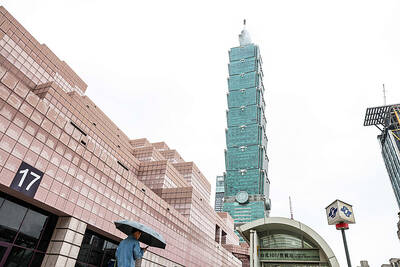
MANAGING RISKS: Taiwan has secured LNG sufficient to cover 95 percent of electricity demand for next month, UBS said, describing the government’s approach as proactive UBS Group AG has raised its forecast for Taiwan’s economic growth this year to 8 percent, up from 6.9 percent previously, and said expansion could reach as high as 8.6 percent if external energy shocks are avoided. The upgrade reflects a stronger-than-expected first-quarter performance and sustained momentum in artificial intelligence (AI)-driven exports, which UBS said are providing a firm foundation for growth despite geopolitical and energy risks. Taiwan’s GDP expanded 13.69 percent year-on-year in the first quarter, the fastest growth since the second quarter of 1987, the Directorate-General of Budget, Accounting and Statistics (DGBAS) reported on Thursday. On a seasonally
The Fair Trade Commission’s (FTC) ongoing review of Grab Holdings Ltd’s US$600 million acquisition of Foodpanda Taiwan’s operations, announced on March 23, has taken on fresh urgency as industry experts warn that the transaction could embed significant Chinese cybersecurity vulnerabilities into Taiwan’s digital infrastructure through Grab’s deep ties to autonomous-driving firm WeRide (文遠知行). Less than 16 months after the FTC blocked Uber Eats’ direct attempt to acquire Foodpanda Taiwan — citing potential combined market shares of 80 to 90 percent — the emergence of Grab as the buyer has prompted questions about whether the same competitive harm is simply being rerouted

The list of Asian stocks that benefit from business partnership with Nvidia Corp is getting longer, as the region further integrates into the artificial intelligence (AI) chip giant’s business ecosystem. Just in the past week, South Korea’s LG Electronics Inc, Taiwan’s Nanya Technology Corp (南亞科技), as well as China’s Huizhou Desay SV Automotive Co (德賽西威) and Pateo Connect Technology Shanghai Corp (博泰車聯) have become the latest to rally on news of tie-ups, supply-chain participation or product collaboration with the US chip designer. Asian suppliers account for about 90 percent of Nvidia’s production costs, up from about 65 percent last year, data compiled


 RSS
RSS