


Taiwan’s manufacturing activity continued expanding for the 14th straight month last month as the country’s economy steadily recovered, which prompted increases in new orders from companies and overall production, the Chung-Hua Institution for Economic Research (CIER, 中華經濟研究院) said yesterday.
The institute said its purchasing managers’ index (PMI) reached 60.2 last month, down 0.4 points from 60.6 in March.
A reading of 50 and above represents expansion in production from the manufacturing sector, while less than 50 shows a contraction.
The index — a leading indicator of the economic outlook over the next three to six months — comprises five sub-indices: new orders, production, employment, inventories and supplier deliveries.
“The PMI for the first time stayed above 60 for two consecutive months since it was first released in July of 2012,” CIER president Wu Chung-shu (吳中書) told a press conference. “The result of the index indicates the country’s economy continued improving, which is encouraging news.”
Wu attributed the mild decline in last month’s PMI to a higher benchmark, saying that the institute did not expect the index to remain above 60 last month based on local manufacturers’ guidance.
Wu said the index was sustained at its high level mainly because sub-indices on new orders and production respectively rose 1.4 points and 2.2 points to 67.1 and 66.8 last month.
However, inventories remained at a relatively low level of 52.6 last month, compared with 57.9 a month earlier, mainly because the inventories of manufacturers’ client firms continued contracting, Wu said.
The institute said the PMI reading should be interpreted as a trend rather than as an absolute figure. The seasonally adjusted monthly PMI has showed a slow and steady upward trend since October last year, the institute said.
Supply Management Institute in Taiwan (中華採購與供應管理協會) executive director Steve Lai (賴樹鑫) said at the press conference that if the PMI can maintain levels of between 55 and 60 over the coming two months, it would indicate that the economy is in good shape.
Meanwhile, a separate survey by the institute shows that the inventories of local manufacturers’ client firms have been shrinking for nine months in a row, as a sub-index on the specific item resulted in 41.6, compared with 47.2 in March, he added.
By industry, manufacturing activities within the nation’s optical-electronic sector outgrew other sectors last month, with an index of 63.3, the report said.
Manufacturing in the food and textile sector also expanded last month, with an index of 61.6, while raw materials, machinery, chemicals and transportation sectors all increased, with indices ranging from 51.9 to 58.4, the report showed.
Citing a survey by CIER, Wu said up to 66 percent of firms polled forecast the country’s economy would become better in the following six months, more than the 63.7 percent observed in March.
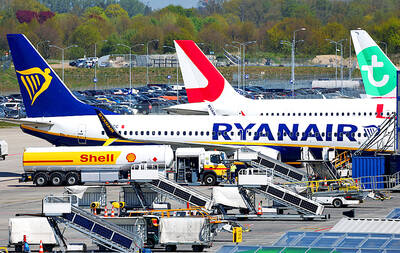
Ryanair, Transavia, Volotea and other low-cost airlines are feeling the financial pain from high jet fuel prices as a result of the Middle East war and are cutting flights. The closure of the Strait of Hormuz has taken a huge chunk of oil supplies off the market, sending the price of jet fuel soaring and triggering fears of shortages that could force airlines to cancel flights. Airlines are not waiting for a lack of supplies to react. “Travel alert: Airlines are cutting thousands of flights right now,” Travel Therapy host Karen Schaler said in an Instagram reel this past weekend.
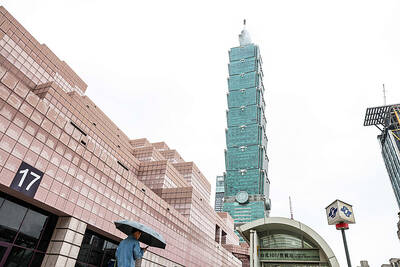
MANAGING RISKS: Taiwan has secured LNG sufficient to cover 95 percent of electricity demand for next month, UBS said, describing the government’s approach as proactive UBS Group AG has raised its forecast for Taiwan’s economic growth this year to 8 percent, up from 6.9 percent previously, and said expansion could reach as high as 8.6 percent if external energy shocks are avoided. The upgrade reflects a stronger-than-expected first-quarter performance and sustained momentum in artificial intelligence (AI)-driven exports, which UBS said are providing a firm foundation for growth despite geopolitical and energy risks. Taiwan’s GDP expanded 13.69 percent year-on-year in the first quarter, the fastest growth since the second quarter of 1987, the Directorate-General of Budget, Accounting and Statistics (DGBAS) reported on Thursday. On a seasonally

The Fair Trade Commission’s (FTC) ongoing review of Grab Holdings Ltd’s US$600 million acquisition of Foodpanda Taiwan’s operations, announced on March 23, has taken on fresh urgency as industry experts warn that the transaction could embed significant Chinese cybersecurity vulnerabilities into Taiwan’s digital infrastructure through Grab’s deep ties to autonomous-driving firm WeRide (文遠知行). Less than 16 months after the FTC blocked Uber Eats’ direct attempt to acquire Foodpanda Taiwan — citing potential combined market shares of 80 to 90 percent — the emergence of Grab as the buyer has prompted questions about whether the same competitive harm is simply being rerouted

The list of Asian stocks that benefit from business partnership with Nvidia Corp is getting longer, as the region further integrates into the artificial intelligence (AI) chip giant’s business ecosystem. Just in the past week, South Korea’s LG Electronics Inc, Taiwan’s Nanya Technology Corp (南亞科技), as well as China’s Huizhou Desay SV Automotive Co (德賽西威) and Pateo Connect Technology Shanghai Corp (博泰車聯) have become the latest to rally on news of tie-ups, supply-chain participation or product collaboration with the US chip designer. Asian suppliers account for about 90 percent of Nvidia’s production costs, up from about 65 percent last year, data compiled


 RSS
RSS