


London’s landmark Gherkin office tower has been placed into receivership by its creditors, accountancy firm and joint receivers Deloitte said on Thursday, paving the way for a possible partial sale of the skyscraper.
Germany’s IVG Immobilien, which co-owns the 40-story tower with Evans Randall Ltd, filed for insolvency last year after years of cost overruns and mounting debt.
One of Germany’s best known property firms, IVG sought protection last year from its creditors after failing to reach an agreement over the restructuring of its debt. It has since agreed a debt-for-equity swap with its creditors.
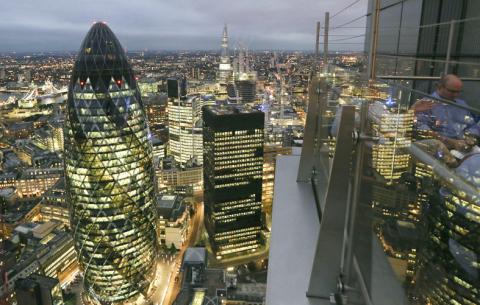
Photo: Bloomberg
Co-owner Evans Randall said on Thursday it was ready to invest further equity into the building, but the company had been unable to agree on a new financial structure with IVG due to the German partner’s financial situation.
“The Gherkin is a strong, well-let asset and one that we are firmly minded to continue our involvement in,” a Evans Randall spokesman said, adding that discussions were continuing.
Deloitte said that adverse interest rate and currency movements had caused the Gherkin’s total debt, which is held in multiple currencies such as the Swiss franc, to increase materially since it was first issued.
“The senior lenders were reluctant to appoint a receiver, but felt they had no choice due to the ongoing defaults, which have remained uncured for over five years,” joint receiver and Deloitte partner Neville Kahn said.
There were also “concerns that the borrowers’ lack of equity in the transaction had caused their incentives to become misaligned with the lenders,” he said.
An icon of London’s skyline with its distinctive curved glass shape, which gave it its Gherkin nickname, the skyscraper was built by reinsurer Swiss Re in 2004 and was sold to IVG and Evans Randall in 2007 for £600 million (US$1 billion). In 2012, IVG said it was valued at £470 million to £531 million.
The building remains well-leased and in “trophy condition,” Deloitte said.
Shares of contract chipmaker Taiwan Semiconductor Manufacturing Co (TSMC, 台積電) came under pressure yesterday after a report that Apple Inc is looking to shift some orders from the Taiwanese company to Intel Corp. TSMC shares fell NT$55, or 2.4 percent, to close at NT$2,235 on the local main board, Taiwan Stock Exchange data showed. Despite the losses, TSMC is expected to continue to benefit from sound fundamentals, as it maintains a lead over its peers in high-end process development, analysts said. “The selling was a knee-jerk reaction to an Intel-Apple report over the weekend,” Mega International Investment Services Corp (兆豐國際投顧) analyst Alex Huang
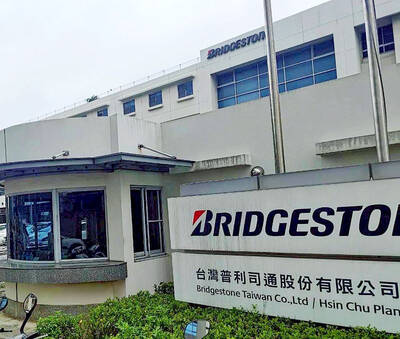
TRANSITION: With the closure, the company would reorganize its Taiwanese unit to a sales and service-focused model, Bridgestone said Bridgestone Corp yesterday announced it would cease manufacturing operations at its tire plant in Hsinchu County’s Hukou Township (湖口), affecting more than 500 workers. Bridgestone Taiwan Co (台灣普利司通) said in a statement that the decision was based on the Tokyo-based tire maker’s adjustments to its global operational strategy and long-term market development considerations. The Taiwanese unit would be reorganized as part of the closure, effective yesterday, and all related production activities would be concluded, the statement said. Under the plan, Bridgestone would continue to deepen its presence in the Taiwanese market, while transitioning to a sales and service-focused business model, it added. The Hsinchu
Taiwan Semiconductor Manufacturing Co (TSMC, 台積電) has approved a capital budget of US$31.28 billion for production expansion to meet long-term development needs during the artificial intelligence (AI) boom. The company’s board meeting yesterday approved the capital appropriation plan for purposes such as the installation of advanced technology capacity and fab construction, the world’s largest contract chipmaker said in a statement. At an earnings conference last month, TSMC forecast that its capital expenditure for this year would be at the higher end of the US$52 billion to US$56 billion range it forecast in January in response to robust demand for 5G, AI and
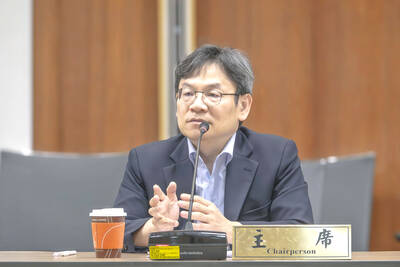
Taiwan Semiconductor Manufacturing Co’s (TSMC, 台積電) investment project in Arizona has progressed better than expected, but it still faces challenges such as water and labor shortages, National Development Council (NDC) Minister Yeh Chun-hsien (葉俊顯) said yesterday. Speaking with reporters after visiting TSMC’s Arizona hub and attending the SelectUSA Investment Summit in Maryland last week, Yeh said TSMC’s Arizona site turned a profit of NT$16.14 billion (US$514 million) last year in its first full year of mass production. “TSMC told me it was surprised by the smooth trial run of the first fab, which has left the company optimistic about the project’s outlook,”


 RSS
RSS