


Ireland exited its three-year bailout program yesterday, becoming the first eurozone nation to do so, but authorities warned of further austerity to ensure economic recovery.
Dublin turned to the IMF and EU in November 2010 for an 85 billion euro (US$115 billion) rescue package after a banking crash and one of history’s worst housing bubbles.
After painful belt-tightening, Ireland is returning unaided to the international lending markets — while eurozone strugglers Greece, Portugal and Cyprus remain locked into the bailout process.
“It’s an important moment for Ireland and for our people,” Irish Prime Minister Enda Kenny told the Irish Times newspaper in an interview published on Friday. “Our credibility is being restored internationally and our name is in good standing.”
Kenny was to deliver a state of the nation-type address on Irish television yesterday, just the sixth time a Taoiseach has done so in Irish history, other than during elections.
The end of the bailout means Dublin will now have greater control over economic decisionmaking after three years of stringent oversight by the EU, IMF and the European Central Bank — the so-called troika of lenders.
The troika insisted on tax rises, structural reforms and the sale of state assets in exchange for the bailout, and assessed Ireland’s progress every three months.
Ireland has returned to growth, unemployment is falling and the banking sector has been reduced to a more appropriate scale to match the size of the economy, but analysts agree the banks remain a risk.
The IMF approved the 12th and last review of Ireland’s progress on Friday, allowing a final US$890 million payout.
To mark the end of the bailout program, IMF managing director Christine Lagarde praised Ireland’s “steadfast policy implementation.”
However, Lagarde warned of “significant economic challenges” ahead.
“Unemployment is too high, public debt sustainability remains fragile and heavy private sector debts and banks’ slow progress in resolving nonperforming loans weigh on domestic demand,” Lagarde said in a statement.
Later this week, Dublin will publish a medium-term economic strategy outlining its post-bailout policies.
“This isn’t the end of the road. We must continue with the same types of policies as the deficit is too high,” Irish Minister of Finance Michael Noonan said.
As in Greece, Portugal and Cyprus, high unemployment levels are one of the major risks to economic recovery in Ireland.
Irish unemployment is falling, but remained at a high level of 12.8 percent at the end of the third quarter, a drop from 13.6 percent over three months.
“It’s a combination of focusing in on fixing the things that were broken in our competitiveness, offering and driving the transition into exporting sectors,” Irish Minister for Jobs Richard Bruton said. “I think it’s showing that effort is delivering well but there’s still a long way to go.”

Taiwanese firms have increased investment in the Philippines in recent years as Manila’s ties with Washington deepen and global supply chains continue to shift away from China, an expert at the Chung-Hua Institution for Economic Research (CIER, 中華經濟研究院) said yesterday. The Philippines had not been among Taiwanese investors’ top choices in Southeast Asia, CIER Taiwan ASEAN Studies Center director Kristy Hsu (徐遵慈) said at a seminar in Taipei. However, Taiwan’s investment in the country has grown significantly since the COVID-19 pandemic, reaching US $257 million last year, a high in recent years, she said. Although Taiwan’s total investment in the Philippines still lags

Intel Corp regards Taiwan Semiconductor Manufacturing Co (TSMC, 台積電) as a longstanding partner, as the US chipmaker would continue outsourcing production of advanced chips to TSMC, Intel chief executive officer Lip-Bu Tan (陳立武) said yesterday. “I don’t look at people as competitors. I look at the collaboration... Nvidia is also, you know, a good friend,” Tan told a news conference following his keynote speech at the Computex trade show in Taipei. “It’s a very trusted partnership for us... We are a big, top customer for them, and we’re going to continue doing that,” he said, referring to TSMC, the world’s largest foundry

Hon Hai Precision Industry Co (鴻海精密) yesterday said it would work with US chipmaker Intel Corp to jointly develop and deploy next-generation artificial intelligence (AI) infrastructure and intelligent computing platforms in a move to capture booming demand for AI computing systems. Hon Hai, also known as Foxconn Technology Group (富士康), said in a statement that the partnership would combine its global manufacturing scale, system integration expertise and AI data center deployment capabilities with Intel’s strengths in processor architecture, silicon technologies and software ecosystem. The companies said they plan to work on equipment used in AI data centers, including server racks powered by
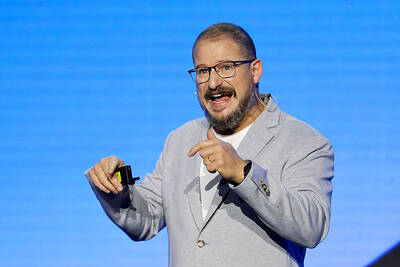
Artificial intelligence (AI) agents would supplant smartphones as the center of people’s digital lives, fundamentally reshaping personal devices and driving a major computing upgrade cycle, Qualcomm Inc CEO Cristiano Amon said yesterday. In his keynote speech for this year’s Computex trade show in Taipei, Amon said that the rise of "agentic AI" — AI systems capable of reasoning, planning and carrying out tasks autonomously — would transform how people interact with technology across phones, PCs, vehicles and wearable devices. Describing the technology as the next major evolution in computing, Amon said that "2026 is the year of agents.” For decades, smartphones have sat


 RSS
RSS