


Several academics and industry representatives yesterday called on the government to open the wind turbine market to the private sector, which would create jobs in Taiwan and help state-run Taiwan Power Co (Taipower, 台電) generate renewable energy more efficiently, but others said they doubt that wind power can replace nuclear power in the near future.
Taipower had set up a total of 450 wind turbines in Taiwan as of this month and aims to build 4,000 units by 2030, the Bureau of Energy said.
“The fact is that many local electronics manufacturers have skills in designing and producing wind turbines, so it should not be a problem to liberalize the market if most technological issues have been resolved,” motor maker Teco Electric and Machinery Co (東元) chairman Liu Chao-kai (劉兆凱) told a forum in Taipei.
Once the market is open, Taipower will be able to work with local firms to increase installation of wind turbines or to upgrade equipment more quickly, rather than spending time and resources looking for professional maintenance skills from foreign suppliers, Liu said.
Liu said that the government should also act more aggressively to implement energy policies, because clean energy currently accounts for only 0.1 percent of Taiwan’s total annual electricity consumption.
It is possible to create more than 200,000 jobs if the proportion of renewable energy increasese to 10 percent, he said.
Chung-Hua Institution for Economic Research chairman Liang Chi-yuan (梁啟源) said it would be difficult for Taiwan to phase out the use of nuclear power.
Even if Taiwan operates up to 4,000 wind turbines generating 2 megawatt of electricity, it still requires more than 6,070 hectares of land for the installation of wind turbines, equivalent to about 60 percent of Taipei, Liang said.
In addition, Taiwan’s geographic conditions remain the biggest challenge for the installation of wind turbines, and Taipower will continue to need to operate coal-powered plants and generate back-up electricity due to wind power’s unstable supply of electricity, he said.
Taiwan Institute of Economic Research (TIER, 台灣經濟研究院) president David Hong (洪德生) also said during the forum that nuclear power plants remain import to Taiwan in view of the nation’s high annual electricity consumption.
He also suggested Taipower to expand its smart grid, a digital net connecting households and indicating to electricity generators local electricity supply and demand, in the country to inform citizens how much of energy each has consumed.
In response, Jerry Ou (歐嘉瑞), head of the Bureau of Energy, said that Taipower had already built a smart grid that connects 20,000 households and now plans to expand the net to 100,000 households.

Taiwan Semiconductor Manufacturing Co (TSMC, 台積電) has approved a capital budget of US$31.28 billion for production expansion to meet long-term development needs during the artificial intelligence (AI) boom. The company’s board meeting yesterday approved the capital appropriation plan for purposes such as the installation of advanced technology capacity and fab construction, the world’s largest contract chipmaker said in a statement. At an earnings conference last month, TSMC forecast that its capital expenditure for this year would be at the higher end of the US$52 billion to US$56 billion range it forecast in January in response to robust demand for 5G, AI and

PORTFOLIO REBALANCING: The adjustments in three global equity indices reflect rising investor appetite for semiconductor and artificial intelligence-related stocks Taiwan’s weighting in major global equity indices compiled by MSCI Inc is to rise modestly following the latest quarterly review, underscoring the market’s expanding role in emerging-market portfolios, as global investors continue to favor the nation’s technology sector. Taiwan’s weighting in the MSCI Emerging Markets Index is to increase by 0.30 percentage points to 23.76 percent, after the changes take effect at the close of the May 29 session. Its weighting in the MSCI All-Country Asia ex-Japan Index is to rise 0.37 percentage points to 27.16 percent, while that in the MSCI All Country World Index is to edge up slightly to

NEW MARKET: The partnership opens up India to the Dutch company, which already has a strong hold in the semiconductor market of South Korea, Taiwan and China ASML Holding NV entered into a partnership agreement with Tata Electronics Pvt Ltd aimed at ramping up India’s goal to develop domestic chip-manufacturing capabilities. The Dutch company’s technology would help power Tata Electronics’ planned 300 millimeter (mm) semiconductor foundry in Gujarat, according to a joint statement from the two companies on Saturday. The signing of a memorandum of understanding coincides with a visit by Indian Prime Minister Narendra Modi to the Netherlands, which is looking to deepen bilateral relations with New Delhi. ASML, whose top customers include Taiwan Semiconductor Manufacturing Co (台積電) and Samsung Electronics Co, makes lithography machines that can print
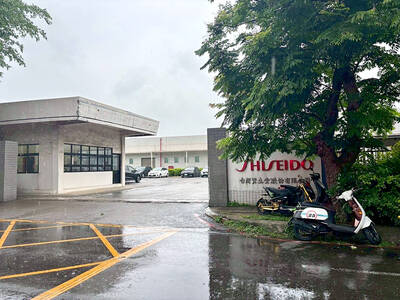
The Hsinchu County Government’s Labor Affairs Department yesterday said that it has received a plan from cosmetics brand Taiwan Shiseido Co (台灣資生堂) detailing mass layoffs at its plant in Hukou Township (湖口). While the labor authorities did not disclose the number of employees to be laid off, Japanese news media earlier in the day reported that the closure of the company’s factory in Hukou would result in 170 employees losing their jobs. Shiseido followed the law by reporting its layoff plan, the department said, adding that authorities would closely monitor negotiations between the management and affected employees and step in if any


 RSS
RSS