


Smartphone vendor HTC Corp (宏達電) yesterday posted its first quarterly loss since the fourth quarter of 1999 of NT$2.97 billion (US$101.13 million), a much greater loss than the NT$677 million estimated by analysts.
The figure reflected a reversion from net profits of NT$1.25 billion in the previous quarter, and net profits of NT$3.9 billion during the same period last year, according to data collected by the Taiwan Stock Exchange.
“HTC is ramping up production of its mid-end and entry-level smartphone products, but the pace remains too slow for the company to expand its market share in emerging markets in the near term,” Horizon Securities Co (宏遠證券) analyst Cheng Kai-ming (鄭開明) said by telephone yesterday.
“HTC either needs to develop more innovative high-end smartphone products in the Western markets, or adopt pricing strategies and sacrifice its gross margin in order to compete against Chinese rivals including Xiaomi Corp (小米), Huawei Technologies Co Ltd (華為) and ZTE Corp (中興),” Cheng said.
Last quarter, revenues contracted 32.78 percent quarter-on-quarter, or 32.97 percent year-on-year, to NT$47.05 billion last quarter, falling short of its forecast range from NT$50 billion to NT$60 billion.
During the July to September period, HTC suffered an operating loss of NT$3.5 billion, with a negative operating margin of 7.43 percent, HTC said in the statement. HTC has expected operating margin to fall between 0 and minus-8 percent.
As the smartphone market is reaching saturation point, lukewarm demand for high-end smartphone models dragged down HTC’s profitability last quarter to a net loss of NT$2.97 billion, or loss per share of NT$3.58, according to the statement.
Cheng was skeptical about HTC chief executive officer Peter Chou’s (周永明) remark at a teleconference held in July, in which Chou said HTC’s profitability might bottom out last quarter
before recovering this quarter.
Cheng said HTC needs to adopt effective product strategies in response to saturating smartphone markets in the US and Europe, as well as intense competition in China’s smartphone market.
This quarter, despite HTC’s plan to roll out a larger-sized smartphone, dubbed HTC One Max, later this month to boost year-end sales, the launch of new smartphone and tablet products by Samsung Electronics Co, Sony Corp and Apple Inc may dilute market demand and weaken HTC’s sales, Taishin Securities Investment Advisory Co (台新投信) chairman Andy Wu (吳火生) said by telephone yesterday.
“Based on the company’s sales performance during the first nine months of the year, it is going to be very likely to see HTC post a net loss for this year,” Wu said.
Asked if HTC is better following Nokia Ojy’s and BlackBerry Ltd’s lead and considering mergers with or acquisitions by other firms, Wu said “that will be a great pity and the worst scenario for HTC to end up at,” suggesting that HTC must soon act before its value shrinks or make efforts to secure its brand image.
HTC yesterday said it has spent NT$1.03 billion buying back 7.79 million HTC shares on the local stock market, according to a company filing to the Taiwan Stock Exchange. The company plans to cancel those shares, it said.

Taiwanese firms have increased investment in the Philippines in recent years as Manila’s ties with Washington deepen and global supply chains continue to shift away from China, an expert at the Chung-Hua Institution for Economic Research (CIER, 中華經濟研究院) said yesterday. The Philippines had not been among Taiwanese investors’ top choices in Southeast Asia, CIER Taiwan ASEAN Studies Center director Kristy Hsu (徐遵慈) said at a seminar in Taipei. However, Taiwan’s investment in the country has grown significantly since the COVID-19 pandemic, reaching US $257 million last year, a high in recent years, she said. Although Taiwan’s total investment in the Philippines still lags

Intel Corp regards Taiwan Semiconductor Manufacturing Co (TSMC, 台積電) as a longstanding partner, as the US chipmaker would continue outsourcing production of advanced chips to TSMC, Intel chief executive officer Lip-Bu Tan (陳立武) said yesterday. “I don’t look at people as competitors. I look at the collaboration... Nvidia is also, you know, a good friend,” Tan told a news conference following his keynote speech at the Computex trade show in Taipei. “It’s a very trusted partnership for us... We are a big, top customer for them, and we’re going to continue doing that,” he said, referring to TSMC, the world’s largest foundry
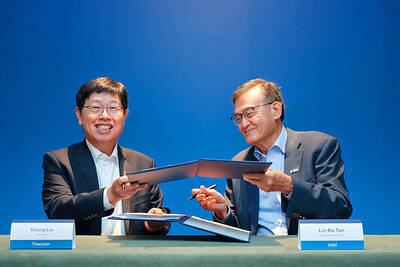
Hon Hai Precision Industry Co (鴻海精密) yesterday said it would work with US chipmaker Intel Corp to jointly develop and deploy next-generation artificial intelligence (AI) infrastructure and intelligent computing platforms in a move to capture booming demand for AI computing systems. Hon Hai, also known as Foxconn Technology Group (富士康), said in a statement that the partnership would combine its global manufacturing scale, system integration expertise and AI data center deployment capabilities with Intel’s strengths in processor architecture, silicon technologies and software ecosystem. The companies said they plan to work on equipment used in AI data centers, including server racks powered by
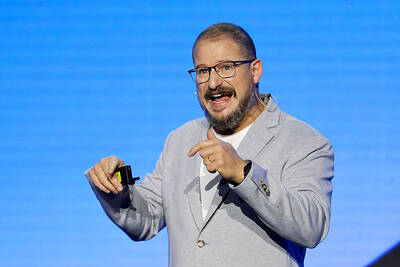
Artificial intelligence (AI) agents would supplant smartphones as the center of people’s digital lives, fundamentally reshaping personal devices and driving a major computing upgrade cycle, Qualcomm Inc CEO Cristiano Amon said yesterday. In his keynote speech for this year’s Computex trade show in Taipei, Amon said that the rise of "agentic AI" — AI systems capable of reasoning, planning and carrying out tasks autonomously — would transform how people interact with technology across phones, PCs, vehicles and wearable devices. Describing the technology as the next major evolution in computing, Amon said that "2026 is the year of agents.” For decades, smartphones have sat


 RSS
RSS