


Apple chief executive officer Tim Cook sought to reassure shareholders worried about the company’s sagging stock price that it is on the verge of inventing more breakthrough products that will prove it has not lost its creative edge.
“The company is working as hard as ever, and we have some great stuff coming,” Cook told shareholders on Wednesday during Apple Inc’s annual meeting at its Cupertino, California, headquarters.
True to Apple’s secretive nature, Cook did not provide any further product details, although at one point he said the company is considering entering other categories besides its popular line of digital music players, smartphones and tablet computers.
There has been speculation that Apple is working on an Internet-connected watch or TV that will be introduced later this year. One shareholder at Wednesday’s meeting threw a new idea for Apple to ponder — a computerized bicycle. Cook, an avid bicyclist, chuckled at the suggestion, along with the rest of the audience.
Although there were more moments of levity, Wednesday’s meeting was less celebratory than the events in past years, when Apple’s stock price was soaring to the delight of its shareholders.
Since hitting an all-time high of US$705.07 in September last year, Apple’s stock has plunged by 37 percent. The decline has wiped out collective shareholder wealth totaling US$240 billion.
That amount exceeds the total market value of Microsoft Corp, which reigned as the most influential company in personal computing until Apple ushered in an era of mobile devices.
Cook, who became chief executive officer shortly before Apple co-founder Steve Jobs died in October 2011, has a huge incentive to get the company’s stock price strong again.
The 1.1 million Apple shares he owns are worth about US$300 million less than they were last year.
Although Apple is selling more gadgets than ever before, the company’s profits and sales are not growing as robustly because of fiercer competition from a multitude of other smartphones and tablet computers. Apple’s biggest headaches have been caused by Android, a mobile operating system that Google Inc supplies to a long list of device makers led by Samsung Electronics Co.
There are now an estimated 600 million devices running on Android, giving it a lead over Apple.
Cook said Apple remains more interested in the quality of its products than the quantity sold.
“We want to make the best,” Cook said. “That’s why we are here.”
Cook’s pep talk evidently did not inspire many investors. Apple’s stock shed another US$4.40 to close on Wednesday at US$444.57.
Shareholders still affirmed their confidence in Cook at the meeting. Preliminary results showed Cook was re-elected to Apple’s eight-member board of directors with 99 percent of the vote.
Wall Street may have been disappointed that Cook did not provide any further clarity on whether Apple might distribute some of its US$137 billion in cash to shareholders in the form of a dividend increase or a special one-time payment.
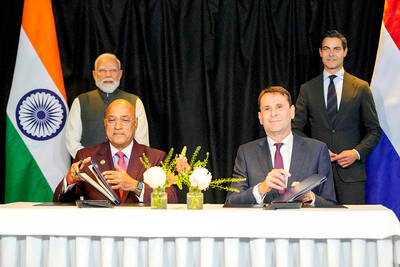
NEW MARKET: The partnership opens up India to the Dutch company, which already has a strong hold in the semiconductor market of South Korea, Taiwan and China ASML Holding NV entered into a partnership agreement with Tata Electronics Pvt Ltd aimed at ramping up India’s goal to develop domestic chip-manufacturing capabilities. The Dutch company’s technology would help power Tata Electronics’ planned 300 millimeter (mm) semiconductor foundry in Gujarat, according to a joint statement from the two companies on Saturday. The signing of a memorandum of understanding coincides with a visit by Indian Prime Minister Narendra Modi to the Netherlands, which is looking to deepen bilateral relations with New Delhi. ASML, whose top customers include Taiwan Semiconductor Manufacturing Co (台積電) and Samsung Electronics Co, makes lithography machines that can print
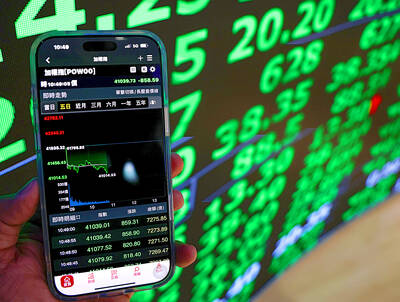
PORTFOLIO REBALANCING: The adjustments in three global equity indices reflect rising investor appetite for semiconductor and artificial intelligence-related stocks Taiwan’s weighting in major global equity indices compiled by MSCI Inc is to rise modestly following the latest quarterly review, underscoring the market’s expanding role in emerging-market portfolios, as global investors continue to favor the nation’s technology sector. Taiwan’s weighting in the MSCI Emerging Markets Index is to increase by 0.30 percentage points to 23.76 percent, after the changes take effect at the close of the May 29 session. Its weighting in the MSCI All-Country Asia ex-Japan Index is to rise 0.37 percentage points to 27.16 percent, while that in the MSCI All Country World Index is to edge up slightly to
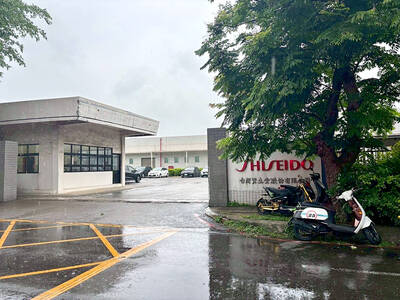
The Hsinchu County Government’s Labor Affairs Department yesterday said that it has received a plan from cosmetics brand Taiwan Shiseido Co (台灣資生堂) detailing mass layoffs at its plant in Hukou Township (湖口). While the labor authorities did not disclose the number of employees to be laid off, Japanese news media earlier in the day reported that the closure of the company’s factory in Hukou would result in 170 employees losing their jobs. Shiseido followed the law by reporting its layoff plan, the department said, adding that authorities would closely monitor negotiations between the management and affected employees and step in if any
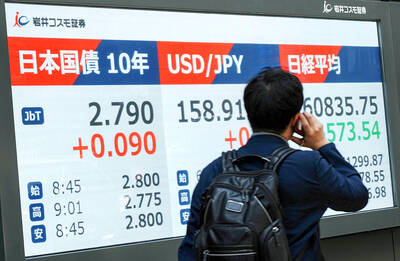
ROUGH RECORDS: Bonds in Japan, as well is in New Zealand, Australia and the US, are seeing the effects of a nervy market as stock exchanges across Asia edge down A deepening slump in Japanese government bonds added fuel to the selloff in global debt markets as rising oil prices stoked inflation fears and pushed yields to multi-decade highs. Japan’s 30-year yield yesterday surged as much as 20 basis points to the highest level since the tenor’s debut in 1999, before paring some of the move. Shorter-maturity Japanese debt was also under pressure, underscored by weak demand at a sale of five-year notes that offered a record-high coupon of 2 percent. Concerns over inflation and government spending rippling through markets including the US, Australia and New Zealand are being amplified in Japan,


 RSS
RSS