


HTC Corp (宏達電), the world’s No. 5 smartphone maker, yesterday reported it made NT$60 billion (US$2.06 billion) of consolidated revenue in the fourth quarter of last year, the lowest level since 2004, with net consolidated profit of NT$1.1 billion and earnings per share (EPS) of NT$1.21.
The Taoyuan-based company’s quarterly consolidated revenue, which was the lowest since 2004, was in accordance with its expectations at an investors’ conference on Oct. 26, and a 40.84 percent decrease compared with NT$101.42 billion during the same period a year ago.
On a quarterly basis, HTC’s consolidated revenue fell by 14 percent last quarter, and its EPS fell by 74.25 percent from NT$4.7 in the third quarter, and up to 90.78 percent from NT$13.13 in the same period last year.
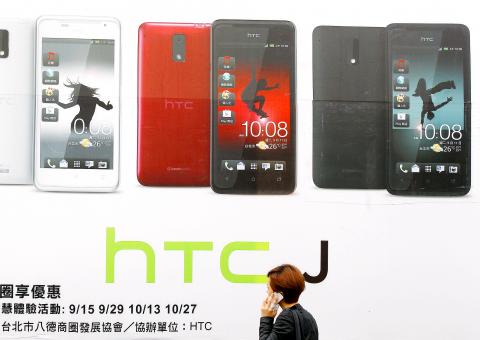
Photo: Pichi Chuang, Reuters
For the whole of last year, the firm’s EPS fell by 72.53 percent from NT$73.32 in 2011 to NT$20.14, the lowest level since 2004 when it posted EPS of NT$14.21.
Last month, HTC posted sales of about NT$21.57 billion, up 1.6 percent month-on-month, but down 18.18 percent year-on-year.
However, the company’s fourth-quarter EPS was higher than its forecast of less than NT$1, mainly because it lent money to Beats Electronics LLC in July last year and charged the company a high interest rate, Jeff Pu (蒲得宇), an equity research analyst at Fubon Securities Co (富邦證券), said by telephone.
“HTC’s sales figures for last quarter were in line with their own forecast,” Pu said.
“The company posted a higher-than-expected EPS mainly because of a stronger euro and additional income from the interest rate it charged Beats,” he added.
HTC forecast sales would fall to a record low level in the last quarter of last year although it would continue to increase spending in marketing to promote brand awareness.
Cheng Kai-ming (鄭開明), an analyst with Horizon Securities (宏遠證券), said that although HTC’s operating margin has hit its record low level, it is expected to bounce back this quarter as it plans to launch a new flagship high-end smartphone model — rumored to be named the “M7” — which is expected to be in strong demand, as well as launching new low-end models in emerging martkets to expand its market share.
Cheng forecast that the firm’s smartphone shipments would increase by 15 percent this quarter, driven by strong demand for its Butterfly model and the upcoming M7 series.
“HTC is expected to regain its market share as it has adopted new product and marketing strategies,” Cheng said by telephone.
“There is a likelihood that HTC could perform well this year if the market reacts positively toward its new products and the brand as a whole. As the penetration rate of high-end smartphones is increasing at a slower pace, implementing the correct strategies for low-end models is also very important because emerging markets have strong demand and can help HTC gain back market share,” he added.
HTC’s shares closed up 0.35 percent at NT$288 in Taipei trading yesterday, outperforming the broader market, which fell 0.65 percent. For the whole of last year, HTC’s shares fell by 39.54 percent.
Shares of contract chipmaker Taiwan Semiconductor Manufacturing Co (TSMC, 台積電) came under pressure yesterday after a report that Apple Inc is looking to shift some orders from the Taiwanese company to Intel Corp. TSMC shares fell NT$55, or 2.4 percent, to close at NT$2,235 on the local main board, Taiwan Stock Exchange data showed. Despite the losses, TSMC is expected to continue to benefit from sound fundamentals, as it maintains a lead over its peers in high-end process development, analysts said. “The selling was a knee-jerk reaction to an Intel-Apple report over the weekend,” Mega International Investment Services Corp (兆豐國際投顧) analyst Alex Huang
Taiwan Semiconductor Manufacturing Co (TSMC, 台積電) is expected to remain Apple Inc’s primary chip manufacturing partner despite reports that Apple could shift some orders to Intel Corp, industry experts said yesterday. The comments came after The Wall Street Journal reported on Friday that Apple and Intel had reached a preliminary agreement following more than a year of negotiations for Intel to manufacture some chips for Apple devices. Taiwan Institute of Economic Research (台灣經濟研究院) economist Arisa Liu (劉佩真) said TSMC’s advanced packaging technologies, including integrated fan-out and chip-on-wafer-on-substrate, remain critical to the performance of Apple’s A-series and M-series chips. She said Intel and Samsung
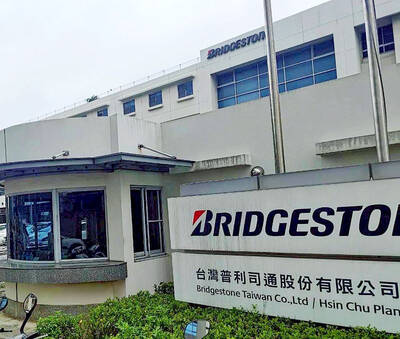
TRANSITION: With the closure, the company would reorganize its Taiwanese unit to a sales and service-focused model, Bridgestone said Bridgestone Corp yesterday announced it would cease manufacturing operations at its tire plant in Hsinchu County’s Hukou Township (湖口), affecting more than 500 workers. Bridgestone Taiwan Co (台灣普利司通) said in a statement that the decision was based on the Tokyo-based tire maker’s adjustments to its global operational strategy and long-term market development considerations. The Taiwanese unit would be reorganized as part of the closure, effective yesterday, and all related production activities would be concluded, the statement said. Under the plan, Bridgestone would continue to deepen its presence in the Taiwanese market, while transitioning to a sales and service-focused business model, it added. The Hsinchu
Taiwan Semiconductor Manufacturing Co (TSMC, 台積電) has approved a capital budget of US$31.28 billion for production expansion to meet long-term development needs during the artificial intelligence (AI) boom. The company’s board meeting yesterday approved the capital appropriation plan for purposes such as the installation of advanced technology capacity and fab construction, the world’s largest contract chipmaker said in a statement. At an earnings conference last month, TSMC forecast that its capital expenditure for this year would be at the higher end of the US$52 billion to US$56 billion range it forecast in January in response to robust demand for 5G, AI and


 RSS
RSS