


Rays of the winter sun bounce off gleaming mirrors on the tiny lake of Colignola in Italy, where engineers have built a cost-effective prototype for floating, rotating solar panels.
“You are standing on a photovoltaic floating plant which tracks the sun, it’s the first platform of its kind in the world!” said Marco Rosa-Clot, a professor at Florence University, proudly showing off his new project.
Rosa-Clot and his team say they are revolutionizing solar power and that their floating flower-petal-like panels soaking up the Tuscan sun have already attracted a lot of interest from international buyers.
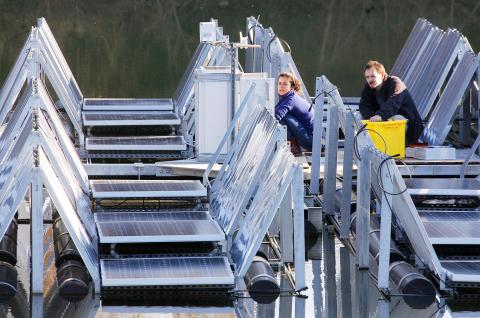
Photo: AFP
Standard solar panels on buildings or in fields have been criticized for taking up valuable agricultural land, being unsightly and losing energy through overheating — issues the floating plants would resolve.
The Floating Tracking Cooling Concentrator (FTCC) system is designed to exploit unused areas of artificial reservoirs or disused quarries.
While the water keeps the panels at low temperatures, reflectors are positioned to maximize solar capture at different times of day, making it more efficient than a traditional installation, Rosa-Clot said.
The head of Scintec, a small family business which produces a variety of renewable energy and industrial devices, Rosa-Clot said the pilot plant set up on the lake near Pisa, Tuscany, was a model of efficiency.
“It’s a small-scale design, 30 kilowatts, which would suffice for a dozen or so families. The standard is set at 3kW per apartment,” he said.
At an estimated price of about 1,600 euros (US$2,149) per kW including installation, a plant the size of Colignola could cost about 48,000 euros.
Scintec says its system costs 20 percent less than ground-based structures.
The flat panels are winged by reflectors and sit on raft-like structures, which are anchored to the lakebed with a pylon.
Decked out in jeans and jacket, the engineer explained the benefit that a place like sun-kissed Sicily with its 75km2 of artificial reservoirs and lakes could draw from the system.
“If we covered just 10 percent of that area with floating photovoltaic panels, we would have one gigawatt of power installed,” he said — enough to power 10 million 100-watt light bulbs.
Engineer Raniero Cazzaniga, who works on the project, said that some people think classic solar installations are spoiling the landscape.
“Our system is designed for low-lying quarries. The installation is only about a meter high and usually you can’t see it until you get to the water’s edge. It is not at all intrusive,” he said.
Their cost-efficient project has sparked international interest.
“Reactions from abroad have been very positive. Some Koreans came to Pisa to see us and we signed a three-year contract giving them a license to build this sort of installation in South Korea,” Rosa-Clot said.
The Korean company Techwin has built a floating photovoltaic plant using the FTCC technology, and in Italy the Terra Moretti group has installed one on an irrigation reservoir at its winery near Livorno.
Rosa-Clot and his team are in talks with “Germans, French and Italian companies” hoping to stay ahead of the curve on water-based solar energy.
“There is no miraculous solution to the energy problem,” he said. “Our project will make it possible to have a far greater number of photovoltaic installations at an ever lower cost.”
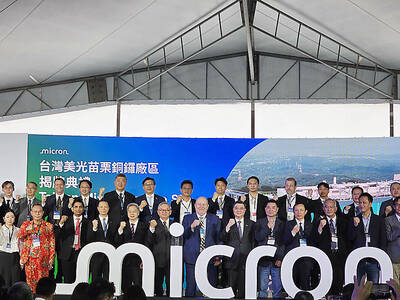
UNPRECEDENTED PACE: Micron Technology has announced plans to expand manufacturing capabilities with the acquisition of a new chip plant in Miaoli Micron Technology Inc unveiled a newly acquired chip plant in Miaoli County yesterday, as the company expands capacity to meet growing demand for advanced DRAM chips, including high-bandwidth memory chips amid the artificial intelligence boom. The plant in Miaoli County’s Tongluo Township (銅鑼), which Micron acquired from Powerchip Semiconductor Manufacturing Corp (力積電) for US$1.8 billion, is expected to make a sizeable capacity contribution to the company from fiscal 2028, the company said in a statement. It would be an extended production site of Micron’s large-scale manufacturing hub in Taichung, the company said. As the global semiconductor industry is racing to reach US$1 trillion
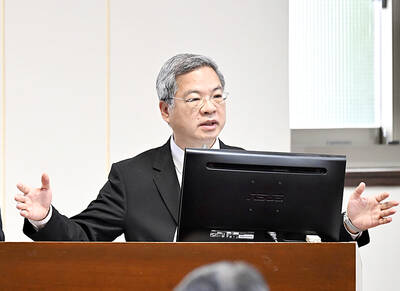
ABOVE LEGAL REQUIREMENT: The Ministry of Economic Affairs is prepared if LNG supply is disrupted, with more than the legal requirement of 11 days of inventory Taiwan has largely secured liquefied natural gas (LNG) supplies through May and arranged about half of June’s supply, Minister of Economic Affairs Kung Ming-hsin (龔明鑫) said yesterday. Since the Middle East conflict began on Feb. 28, Taiwan’s LNG inventories have remained more than 12 days, exceeding the legal requirement of 11 days, indicating no major supply concerns for domestic gas and electricity, Kung said at a meeting of the legislature’s Economics Committee in Taipei. The ministry aims to increase the figure to 14 days by the end of next year, he said. While one or two LNG or crude oil shipments for May

Taiwan’s food delivery market could undergo a major shift if Singapore-based Grab Holdings Ltd completes its planned acquisition of Delivery Hero SE’s Foodpanda business in Taiwan, industry experts said. Grab on Monday last week announced it would acquire Foodpanda’s Taiwan operations for US$600 million. The deal is expected to be finalized in the second half of this year, with Grab aiming to complete user migration to its platform by the first half of next year. A duopoly between Uber Eats and Foodpanda dominates Taiwan’s delivery market, a structure that has remained intact since the Fair Trade Commission (FTC) blocked Uber Technologies Inc’s

Singapore-based ride-hailing and delivery giant Grab Holdings Ltd has applied for regulatory approval to acquire the Taiwan operations of Germany-based Delivery Hero SE's Foodpanda in a deal valued at about US$600 million. Grab submitted the filing to the Fair Trade Commission on Friday last week, with the transaction subject to regulatory review and approval, the company said in a statement yesterday. Its independent governance structure would help foster a healthy and competitive market in Taiwan if the deal is approved, Grab said. Grab, which is listed on the NASDAQ, said in the filing that US-based Uber Technologies Inc holds about 13 percent of


 RSS
RSS