


Despite rising downside risks, the chances of a double-dip recession hitting the US or the global economy are slim, analysts said yesterday.
“The latest economic indicators in the US and the recent proceedings in the eurozone’s debt crisis show that the probability of a double-dip recession hitting the global economy is declining,” Liang Kuo-yuan (梁國源), president of Taipei-based Polaris Research Institute (寶華綜合經濟研究院), said during a conference held by Taiwan Academy of Banking and Finance (TABF, 台灣金融研訓院).
Although the US economy is facing headwinds, such as lingering high unemployment and a weak housing market, the current situation is better than during the 2008 global financial crisis because the US financial market does not have the same systemic risks, Liang said.
The US economy might only be in for a mid-cycle pause — which means growth momentum would slow, but the economy would not post continued declines — instead of a double-dip recession, he added.
Du Ying-tzyong (杜英宗), a vice chairman at Nan Shan Life Insurance Co (南山人壽), put the probability of a double-dip recession striking the global economy at 15 percent.
“Since most of the research institutes still forecast 2 percent economic growth next year in US, one of the most important economies in the world, we should not panic, even with the recent market volatility, which has been a roller coaster,” Du said.
INFLATION
Du said he was more worried about inflation than a double-dip recession at the moment because inflationary pressures could rise anytime because of increasing demand for raw materials from large emerging markets such as China and India.
However, TABF chairman Shea Jia-dong (許嘉棟) said he did not foresee a positive global outlook because solving current economic troubles would be far harder than the scenario in 2008.
“It was the cooperation among major economies that helped quickly solve the financial tsunami in 2008, but the fundamentals are different now,” Shea said
He said some countries now lack the financial capability to deal with the current problems, while others are devoid of new and effective ideas.
To manage these rising downside risks, Taiwan should focus more on deepening intra-regional trade and promoting its tourism sector to enhance domestic demand, Chung-Hua Institution for Economic Research (中華經濟研究院) president Wu Chung-shu (吳中書) said.
The government should also guard against the slowing global economy’s negative impact on exports by encouraging companies to invest in Taiwan, where liquidity remains abundant, Wu said.
SECOND-RATE: Models distilled from US products do not perform the same as the original and undo measures that ensure the systems are neutral, the US’ cable said The US Department of State has ordered a global push to bring attention to what it said are widespread efforts by Chinese companies, including artificial intelligence (AI) start-up DeepSeek (深度求索), to steal intellectual property from US AI labs, according to a diplomatic cable. The cable, dated Friday and sent to diplomatic and consular posts around the world, instructs diplomatic staff to speak to their foreign counterparts about “concerns over adversaries’ extraction and distillation of US AI models.” Distillation is the process of training smaller AI models using output from larger, more expensive ones to lower the costs of training a powerful new
Shares of Taiwan Semiconductor Manufacturing Co (TSMC, 台積電) have repeatedly hit new highs, but an equity analyst said the stock’s valuation remains within a reasonable range and any pullback would likely be technical. The contract chipmaker’s historical price-to-earnings (P/E) ratio has ranged between 20 and 30, Cathay Futures Consultant Co (國泰證期) analyst Tsai Ming-han (蔡明翰) told Central News Agency. With market consensus projecting that TSMC would post earnings per share of about NT$100 (US$3.17) this year, supported by strong global demand for artificial intelligence (AI) applications, and the stock currently trading at a P/E ratio of below 25, Tsai said the valuation
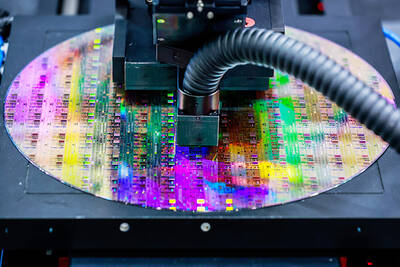
The artificial intelligence (AI) boom has triggered a seismic reshuffling of global equity markets, with Taiwan and South Korea muscling past European nations one by one. With its stock market now valued at nearly US$4.3 trillion, Taiwan surpassed the UK, Europe’s biggest market, earlier this month, data compiled by Bloomberg showed. South Korea is about US$140 billion away from doing the same. The tech-heavy Asian markets have shot past Germany and France in the past seven months. The shift is largely down to massive gains in shares of three companies that provide essential hardware for AI: Taiwan Semiconductor Manufacturing Co (TSMC, 台積電),
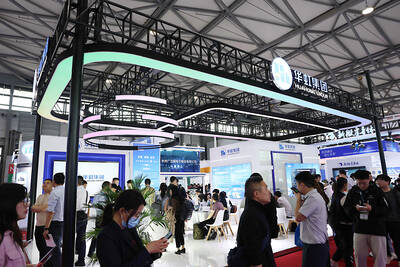
The US Department of Commerce last week ordered multiple chip equipment companies to halt shipments of certain tools to China’s second-largest chipmaker, Hua Hong Semiconductor Ltd (華虹半導體), its latest action to slow the country’s development of advanced chips, two people familiar with the matter said. The department sent letters to at least a handful of companies informing them of restrictions on tools and other materials destined for two Hua Hong facilities US officials believe make China’s most sophisticated chips, the people said. Top US chip equipment companies Lam Research Corp, Applied Materials Inc and KLA Corp, each of which has significant


 RSS
RSS