


Taipei Times (TT): You have been Chinatrust Commercial Bank (中國信託商業銀行) chief economist since March. What made you decide to accept the offer to head up the Chung-hua Institution for Economic Research (CIER, 中華經濟研究院) so soon?
Wu Chung-shu: (吳中書): The global economy is changing faster than ever before, so the nation needs a platform to provide the government with pragmatic proposals after integrating ideas from industry, government and academia.
Throughout my research career the nation has provided me with a lot of resources and opportunities and so I felt that by joining the CIER I was repaying the debt to some extent.
TT: What kind of factors are contributing to the changing global economy?
Wu: In terms of economic choices, things used to be much easier for the government because it only had to focus on economic expansion.
In contrast, the current economy has multiple aspects to consider — including environmental protection and energy saving — sometimes forcing the government to make different economic choices. That is why it urgently needs such an integrated platform.
TT: You just mentioned you expect the institution to become a communications platform expressing different opinions. How do you expect to realize this goal? Do you plan to adopt any different strategies from your predecessor Diagee Shaw (蕭代基)?
Wu: First of all, I will seek out more opportunities to cooperate with international economic research institutes, in the hope of both deepening and broadening the the research undertaken by CIER. This will ensure that we are not pigeonholed as an institute that mainly researches cases delegated by government agencies.
Second, the institute needs to better understand the priorities of government policy if it is to provide practical and executable proposals. Inviting more experts — from industry, government and academia — to discuss the institute’s annual white paper on policy proposals would be one way of clarifying this priority.
TT: Could you elaborate a little about the current priorities of the government’s policies?
Wu: As I said earlier, “green concepts” are very popular with governments the world over recently, including Taiwan’s, and the increased importance of natural resources has resulted in important changes in economic structure.
In addition, I think financial sector policy is another area the government should pay more attention to, especially in terms of risk management and the industry’s entry into the China market. This was also one of the reasons I joined Chinatrust, and while there I learned a great deal about how the firm thought.
The two points I just elaborated on are likely to become focuses for CIER research in the not too distant future.
TT: Government agencies are facing a great deal of reorganization next year. Could this undermine your plan for CIER to provide more useful policy proposals?
Wu: Personally, I do not think that this will be a problem for CIER, as the institute also needs time to collect related information and draft the most appropriate proposals.
In addition, CIER prefers to undertake research on long-term and high-level issues with a neutral attitude, which is to say that government re-engineering or even the changing of governments does not impact the basic role of the institution.
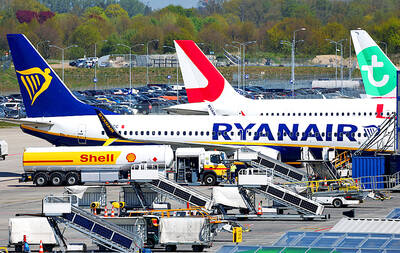
Ryanair, Transavia, Volotea and other low-cost airlines are feeling the financial pain from high jet fuel prices as a result of the Middle East war and are cutting flights. The closure of the Strait of Hormuz has taken a huge chunk of oil supplies off the market, sending the price of jet fuel soaring and triggering fears of shortages that could force airlines to cancel flights. Airlines are not waiting for a lack of supplies to react. “Travel alert: Airlines are cutting thousands of flights right now,” Travel Therapy host Karen Schaler said in an Instagram reel this past weekend.

MANAGING RISKS: Taiwan has secured LNG sufficient to cover 95 percent of electricity demand for next month, UBS said, describing the government’s approach as proactive UBS Group AG has raised its forecast for Taiwan’s economic growth this year to 8 percent, up from 6.9 percent previously, and said expansion could reach as high as 8.6 percent if external energy shocks are avoided. The upgrade reflects a stronger-than-expected first-quarter performance and sustained momentum in artificial intelligence (AI)-driven exports, which UBS said are providing a firm foundation for growth despite geopolitical and energy risks. Taiwan’s GDP expanded 13.69 percent year-on-year in the first quarter, the fastest growth since the second quarter of 1987, the Directorate-General of Budget, Accounting and Statistics (DGBAS) reported on Thursday. On a seasonally
The Fair Trade Commission’s (FTC) ongoing review of Grab Holdings Ltd’s US$600 million acquisition of Foodpanda Taiwan’s operations, announced on March 23, has taken on fresh urgency as industry experts warn that the transaction could embed significant Chinese cybersecurity vulnerabilities into Taiwan’s digital infrastructure through Grab’s deep ties to autonomous-driving firm WeRide (文遠知行). Less than 16 months after the FTC blocked Uber Eats’ direct attempt to acquire Foodpanda Taiwan — citing potential combined market shares of 80 to 90 percent — the emergence of Grab as the buyer has prompted questions about whether the same competitive harm is simply being rerouted
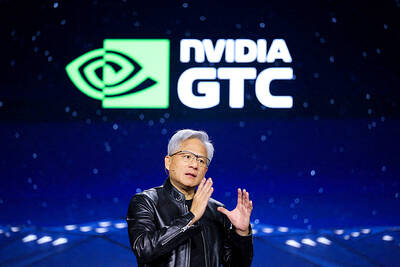
The list of Asian stocks that benefit from business partnership with Nvidia Corp is getting longer, as the region further integrates into the artificial intelligence (AI) chip giant’s business ecosystem. Just in the past week, South Korea’s LG Electronics Inc, Taiwan’s Nanya Technology Corp (南亞科技), as well as China’s Huizhou Desay SV Automotive Co (德賽西威) and Pateo Connect Technology Shanghai Corp (博泰車聯) have become the latest to rally on news of tie-ups, supply-chain participation or product collaboration with the US chip designer. Asian suppliers account for about 90 percent of Nvidia’s production costs, up from about 65 percent last year, data compiled


 RSS
RSS