


South Korea was kept as an emerging market at MSCI Inc as the index provider skipped the nation for an upgrade for a second year. Taiwan, under a similar review, also retained its status as a developing market.
MSCI left South Korea’s status unchanged in June last year and said it would evaluate the nation for an upgrade as a developed market this year.
The latest review again cited the “rigidity” of its investor identification system and the lack of an active offshore market for the country’s currency, as well as anti-competitive practices relating to stock market data.
The decision means the nation will lose out on purchases of equities in Asia’s sixth-biggest market by investors who are restricted to developed-nation equities because of their perceived lower risk. The South Korean market was assigned “developed” status by FTSE Group, a rival index compiler, in September last year.
The benchmark KOSPI closed 0.47 percent, or 8.2 points, lower at 1,731.48 in Seoul yesterday.
‘IRRELEVANT’
“On the stock data issue raised by MSCI, we believe that’s an irrelevant issue for upgrading the nation to developed status,” Kong Do-hyun, a spokesman for Korea Exchange Inc, said by telephone yesterday. “Korea Exchange will continue its consultation with MSCI in a direction that will help further develop [the] South Korean market.”
MSCI indexes are tracked by investors with an estimated US$5.2 trillion in assets, compared with about US$4 trillion for FTSE gauges, according to a May 26 report by Shinhan Investment Corp.
South Korea represents 13.2 percent of the MSCI Emerging Market Index, the third-largest after China and Brazil, according to a May 19 report by Morgan Stanley.
South Korea is better off staying as an emerging market as its weighting among developed markets will be “very small,” Credit Suisse Group said.
BIG FISH, SMALL POND
“It’s better to be a big fish in a small pond,” Sakthi Siva, an analyst at Credit Suisse who is the top-ranked Asia strategist in Institutional Investor’s poll this year, said in a briefing in Seoul yesterday.
MSCI said it would review South Korea for a possible upgrade next year. Countries that were elevated to developed market status by MSCI in recent years include Greece and Israel.
Taiwan will also stay under review for a potential upgrade to developed status next year, the index provider said. The United Arab Emirates and Qatar, which retained their frontier markets status, will remain under review for a potential reclassification to emerging markets, it said.
The so-called frontier markets typically have less-developed economies and financial markets than emerging markets, and have more restrictions on foreign stock ownership.
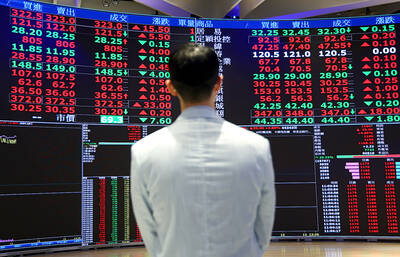
Shares in Taiwan closed at a new high yesterday, the first trading day of the new year, as contract chipmaker Taiwan Semiconductor Manufacturing Co (TSMC, 台積電) continued to break records amid an artificial intelligence (AI) boom, dealers said. The TAIEX closed up 386.21 points, or 1.33 percent, at 29,349.81, with turnover totaling NT$648.844 billion (US$20.65 billion). “Judging from a stronger Taiwan dollar against the US dollar, I think foreign institutional investors returned from the holidays and brought funds into the local market,” Concord Securities Co (康和證券) analyst Kerry Huang (黃志祺) said. “Foreign investors just rebuilt their positions with TSMC as their top target,
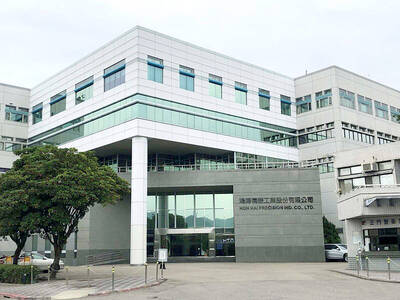
REVENUE PERFORMANCE: Cloud and network products, and electronic components saw strong increases, while smart consumer electronics and computing products fell Hon Hai Precision Industry Co (鴻海精密) yesterday posted 26.51 percent quarterly growth in revenue for last quarter to NT$2.6 trillion (US$82.44 billion), the strongest on record for the period and above expectations, but the company forecast a slight revenue dip this quarter due to seasonal factors. On an annual basis, revenue last quarter grew 22.07 percent, the company said. Analysts on average estimated about NT$2.4 trillion increase. Hon Hai, which assembles servers for Nvidia Corp and iPhones for Apple Inc, is expanding its capacity in the US, adding artificial intelligence (AI) server production in Wisconsin and Texas, where it operates established campuses. This
H200 CHIPS: A source said that Nvidia has asked the Taiwanese company to begin production of additional chips and work is expected to start in the second quarter Nvidia Corp is scrambling to meet demand for its H200 artificial intelligence (AI) chips from Chinese technology companies and has approached contract manufacturer Taiwan Semiconductor Manufacturing Co (TSMC, 台積電) to ramp up production, sources said. Chinese technology companies have placed orders for more than 2 million H200 chips for this year, while Nvidia holds just 700,000 units in stock, two of the people said. The exact additional volume Nvidia intends to order from TSMC remains unclear, they said. A third source said that Nvidia has asked TSMC to begin production of the additional chips and work is expected to start in the second
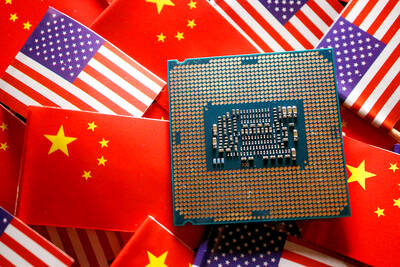
US President Donald Trump on Friday blocked US photonics firm HieFo Corp’s US$3 million acquisition of assets in New Jersey-based aerospace and defense specialist Emcore Corp, citing national security and China-related concerns. In an order released by the White House, Trump said HieFo was “controlled by a citizen of the People’s Republic of China” and that its 2024 acquisition of Emcore’s businesses led the US president to believe that it might “take action that threatens to impair the national security of the United States.” The order did not name the person or detail Trump’s concerns. “The Transaction is hereby prohibited,”


 RSS
RSS