


Amid intensifying political opposition at home, the government plans to release a cross-strait free-trade study by Chung-Hua Institution for Economic Research (中經院) in the middle of this month, Minister of Economic Affairs Yiin Chii-ming (尹啟銘) said yesterday.
Yiin said that when the ministry publicizes the economic cooperation framework agreement (ECFA) study, “the two sides will be ready to engage in meaningful academic dialogue to discuss cross-strait collaboration both through official as well as unofficial channels.”
Yiin did not reveal a timetable for the signing of the trade pact.
But Deputy Minister of Economic Affairs John Deng (鄧振中) told the Taiwan Foreign Correspondents’ Club yesterday that Taiwan and China were in informal talks at an “academic level” on preparing the ECFA.
“We hope that we can start the formal process as soon as possible,” Deng said at the briefing. “We are ready, it’s Beijing; if they want to talk, we can talk.”
President Ma Ying-jeou (馬英九) said in May he hoped to sign an ECFA with China to ease restrictions on trade. The agreement may be similar to an accord China has with Hong Kong, which waives tariffs and gives preferential market access to its financial industry.
“There are informal exchanges of views on the academic level,” Deng said.
While Taiwan has requested formal talks, the timing has not been decided, he said.
Since Ma took office in May last year, the issue of signing an ECFA as well as Ma’s pro-China policies have been a subject of contention between the ruling and opposition parties.
On Tuesday, the ministry said it would open 100 sectors in the manufacturing industry, service industry and public infrastructure to Chinese investment.
To block the progress of the government’s proposed trade pact with China, as well as to jump- start its preparations for the year-end elections, the Democratic Progressive Party (DPP) plans to host more than 500 grassroots tea parties throughout the nation starting this month, ,the Chinese-language Liberty Times (the Taipei Times’ sister newspaper) reported yesterday.
Taiwan will hold elections for country and city government heads and councilors before the end of year, presenting a crucial opportunity for the DPP to regain power.
The newspaper said the DPP had collected more than 136,000 signatures calling for a public referendum on ECFA. The party said it would continue to build opposition momentum by exposing the negative impacts an ECFA would have on employment opporturnities and the local business sector.
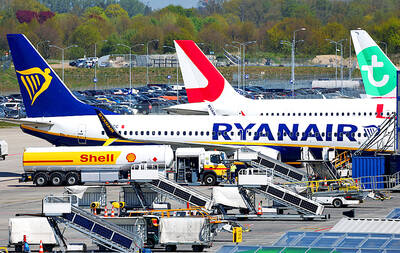
Ryanair, Transavia, Volotea and other low-cost airlines are feeling the financial pain from high jet fuel prices as a result of the Middle East war and are cutting flights. The closure of the Strait of Hormuz has taken a huge chunk of oil supplies off the market, sending the price of jet fuel soaring and triggering fears of shortages that could force airlines to cancel flights. Airlines are not waiting for a lack of supplies to react. “Travel alert: Airlines are cutting thousands of flights right now,” Travel Therapy host Karen Schaler said in an Instagram reel this past weekend.
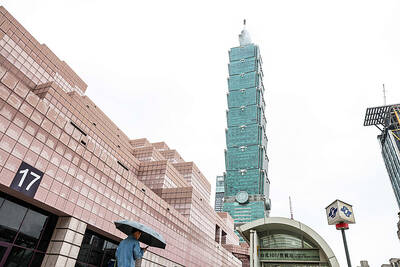
MANAGING RISKS: Taiwan has secured LNG sufficient to cover 95 percent of electricity demand for next month, UBS said, describing the government’s approach as proactive UBS Group AG has raised its forecast for Taiwan’s economic growth this year to 8 percent, up from 6.9 percent previously, and said expansion could reach as high as 8.6 percent if external energy shocks are avoided. The upgrade reflects a stronger-than-expected first-quarter performance and sustained momentum in artificial intelligence (AI)-driven exports, which UBS said are providing a firm foundation for growth despite geopolitical and energy risks. Taiwan’s GDP expanded 13.69 percent year-on-year in the first quarter, the fastest growth since the second quarter of 1987, the Directorate-General of Budget, Accounting and Statistics (DGBAS) reported on Thursday. On a seasonally
The Fair Trade Commission’s (FTC) ongoing review of Grab Holdings Ltd’s US$600 million acquisition of Foodpanda Taiwan’s operations, announced on March 23, has taken on fresh urgency as industry experts warn that the transaction could embed significant Chinese cybersecurity vulnerabilities into Taiwan’s digital infrastructure through Grab’s deep ties to autonomous-driving firm WeRide (文遠知行). Less than 16 months after the FTC blocked Uber Eats’ direct attempt to acquire Foodpanda Taiwan — citing potential combined market shares of 80 to 90 percent — the emergence of Grab as the buyer has prompted questions about whether the same competitive harm is simply being rerouted

The list of Asian stocks that benefit from business partnership with Nvidia Corp is getting longer, as the region further integrates into the artificial intelligence (AI) chip giant’s business ecosystem. Just in the past week, South Korea’s LG Electronics Inc, Taiwan’s Nanya Technology Corp (南亞科技), as well as China’s Huizhou Desay SV Automotive Co (德賽西威) and Pateo Connect Technology Shanghai Corp (博泰車聯) have become the latest to rally on news of tie-ups, supply-chain participation or product collaboration with the US chip designer. Asian suppliers account for about 90 percent of Nvidia’s production costs, up from about 65 percent last year, data compiled


 RSS
RSS