


Asian stocks tumbled yesterday, as a fresh round of jitters about the health of major banks eclipsed any optimism ahead of Barack Obama’s inauguration as US president. European markets opened higher following a sell-off the day before.
Positive sentiment from hopes an Obama administration would act aggressively to bolster the faltering US economy faded amid an onslaught of bad news overnight.
Royal Bank of Scotland forecast a £28 billion (US$41.3 billion) loss for last year, the British government announced plans for a second banking bailout, and the European Commission said the euro-zone economy will shrink 1.9 percent this year. US markets were closed on Monday for the Martin Luther King Jr holiday.
Investors were now bracing for a second wave of banking crises, fearing that many ailing banks have grown “too big” for governments to effectively handle, said Francis Lun (藺常念), general manager at Fulbright Securities (富昌證券) in Hong Kong.
“The results by Citigroup, Bank of America and RBS send a wake-up call to the treasury secretaries of the world that nothing really worked,” Lun said, referring to already announced measures to prop up lenders. “Now we’re almost back to square one.”
Japan’s Nikkei 225 stock average lost 2.3 percent to 8,065.79, paring losses in the afternoon after dipping under the key 8,000-level during the morning session.
“RBS was always seen as one of the weaker banks, and investor fears about its health were reconfirmed,” said Hideaki Higashi, equity strategist at SMBC Friend Securities in Tokyo. “This in turn renewed concerns about the banking system.”
Elsewhere, Hong Kong’s Hang Seng index lost 2.9 percent and Australia’s S&P/ASX200 fell 3.1 percent. Benchmarks in South Korea and Singapore also retreated.
As European markets opened, Britain’s FTSE 100 jumped 1.7 percent, Germany’s DAX rose 1.12 percent and France’s CAC-40 was up 1.1 percent.
US stock futures suggested a weaker open on Wall Street. Dow futures were down 38 points, or 0.5 percent, at 8,205 and S&P500 futures fell 3.8, or 0.5 percent, to 844.80.
Chinese shares bucked the trend in Asia on hopes the government would soon release its stimulus plan for the petrochemical sector.
The benchmark Shanghai Composite Index closed up 1.4 percent, buoyed by steel producers and medical issues, which surged after China reported several bird flu death cases recently.
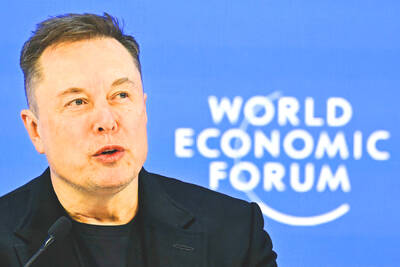
Elon Musk’s lieutenants have reached out to chip industry suppliers, including Applied Materials Inc, Tokyo Electron Ltd and Lam Research Corp, for his envisioned Terafab, early steps in an audacious and likely arduous attempt to break into the production of cutting-edge chips. Staff working for the joint venture between Tesla Inc and Space Exploration Technologies Corp (SpaceX) have sought price quotes and delivery times for an array of chipmaking gear, people familiar with the matter said. In past weeks, they’ve contacted makers of photomasks, substrates, etchers, depositors, cleaning devices, testers and other tools, according to the people, who asked not to
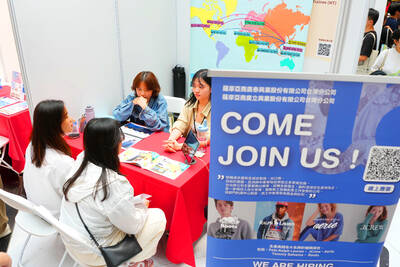
Taiwan is attracting a growing number of foreign jobseekers as companies increasingly recruit overseas talent to ease labor shortages and expand global reach, recruitment platform 104 Job Bank (104人力銀行) said yesterday. More than 40,000 foreign nationals searched for jobs in Taiwan through the platform last year, a 28 percent increase from a year earlier, the company said. Malaysians accounted for the largest share of overseas jobseekers at 12.2 percent, followed by Indonesians at 11.9 percent and Vietnamese at 10.8 percent. Indonesian applicants surged more than 50 percent year-on-year, while Vietnamese jobseekers rose by more than 30 percent. Applicants from the
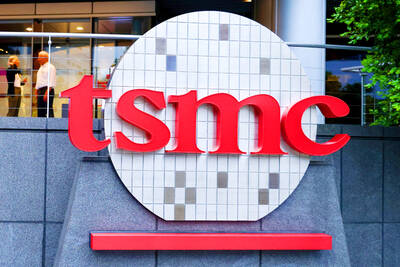
NO SHORTCUTS: Asked about Elon Musk’s Terafab initiative, TSMC CEO C.C. Wei said it takes two to three years to build a fab and another one to two to ramp it up Taiwan Semiconductor Manufacturing Co (TSMC, 台積電) yesterday raised its revenue growth forecast for this year to above 30 percent, up from the 25 percent it estimated three months earlier, citing extremely robust artificial intelligence (AI)-related chip demand. “Our customers and customers’ customers, who are mainly cloud service providers, continue to send us very positive signals and outlook,” TSMC chairman and CEO C.C. Wei (魏哲家) said at an earnings conference. The company also hiked its capital expenditure for this year toward the higher end of its forecast, or US$56 billion, as it aims to step up advanced chip capacity expansions, such as
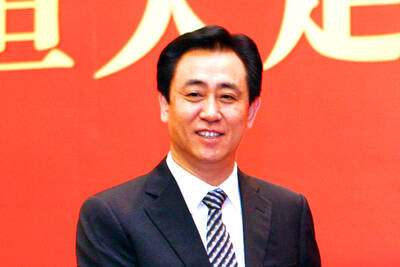
The founder of Chinese property giant Evergrande Group (恆大集團) has pleaded guilty to charges of fraud and bribery, a court said yesterday, the latest blow for what was once the country’s leading developer. Evergrande’s rise was propelled by decades of rapid urbanization and rising living standards, but in 2020, its access to credit dramatically narrowed when the government introduced curbs on excessive borrowing and speculation. The company defaulted in 2021 after struggling to repay creditors. Founder Xu Jiayin (許家印), 67, known as Hui Ka Yan in Cantonese, was reportedly held by police in 2023, with Evergrande saying he had been subjected to


 RSS
RSS