


Billionaire investor activist Carl Icahn stepped up his battle to win a seat on Motorola Inc's board, telling shareholders in a letter released on Friday that the "passive and reactive" current directors are partly to blame for the company's problems.
Motorola responded that Icahn's background does not qualify him for the post.
Icahn, who controls a 2.9 percent stake in the world's No. 2 cellphone maker, said he had hoped to avoid the distraction of a proxy fight with the company, which is trying to keep him off the board.
"However, I am willing to expend the time, effort and money necessary to seek election through this proxy contest so that all of us will have a shareholder voice on the Motorola board," he said in a letter filed with the Securities and Exchange Commission.
Icahn and his affiliates have recently bought up more than 68 million shares of Motorola stock, currently worth about US$1.2 billion.
He said in January that he bought shares because they were cheap and that he wanted to use a board position to increase the company's debt level and return more cash to investors.
In the letter to shareholders, however, he said the company's struggles must be resolved before anything else happens.
"Clearly our board members' top priority should be to hold management accountable for fixing Motorola's current operational problems -- and if I am elected to the board I will do so," he wrote.
"Until our operational problems are corrected, buybacks and other transactions that might have looked appropriate earlier need to take a back seat. Otherwise I come to Motorola with no preconceived notions," Icahn wrote.
Icahn said that he will reduce his membership on the boards of public companies to less than six if elected at the May 7 annual meeting.
An "engaged" board of directors at Motorola, he said, should have been able to help the company "avoid the missteps that currently plague its business" or at least have identified and addressed the problems earlier.
Motorola's top two board officers, chairman and chief executive Ed Zander and lead director Samuel Scott III, responded in their own letter to shareholders late on Friday. They said that they did not judge Icahn's qualifications earned in industries other than technology to be "additive to the strength to the board" and would not simply add him to avoid a proxy fight.
"Your board's nominees are actively engaged and keenly aware of their duties to stockholders," they wrote.
"Along with management, they continuously review strategies for improving stockholder value and have been proactive in implementing changes where those changes would advance that objective," they added.
Motorola reports first-quarter earnings on Wednesday.
Shares in the company rose US$0.22, or 1.3 percent, to close at US$17.74 on the New York Stock Exchange. They have lost a third of their value in the past six months, reflecting turmoil and mistakes in strategy and pricing involving its handset business.
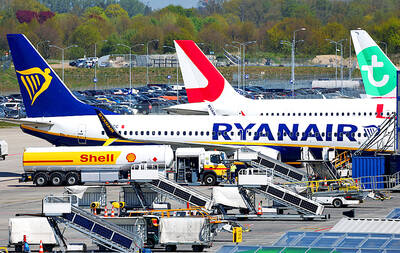
Ryanair, Transavia, Volotea and other low-cost airlines are feeling the financial pain from high jet fuel prices as a result of the Middle East war and are cutting flights. The closure of the Strait of Hormuz has taken a huge chunk of oil supplies off the market, sending the price of jet fuel soaring and triggering fears of shortages that could force airlines to cancel flights. Airlines are not waiting for a lack of supplies to react. “Travel alert: Airlines are cutting thousands of flights right now,” Travel Therapy host Karen Schaler said in an Instagram reel this past weekend.
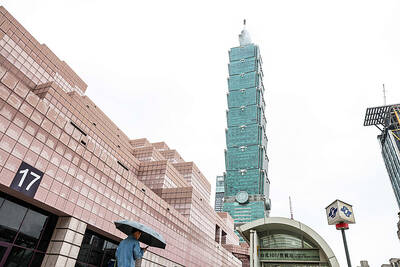
MANAGING RISKS: Taiwan has secured LNG sufficient to cover 95 percent of electricity demand for next month, UBS said, describing the government’s approach as proactive UBS Group AG has raised its forecast for Taiwan’s economic growth this year to 8 percent, up from 6.9 percent previously, and said expansion could reach as high as 8.6 percent if external energy shocks are avoided. The upgrade reflects a stronger-than-expected first-quarter performance and sustained momentum in artificial intelligence (AI)-driven exports, which UBS said are providing a firm foundation for growth despite geopolitical and energy risks. Taiwan’s GDP expanded 13.69 percent year-on-year in the first quarter, the fastest growth since the second quarter of 1987, the Directorate-General of Budget, Accounting and Statistics (DGBAS) reported on Thursday. On a seasonally
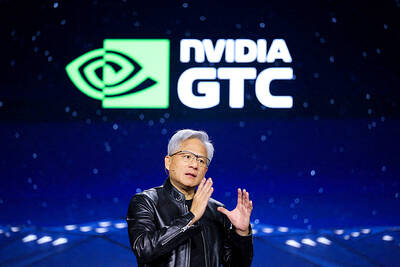
The list of Asian stocks that benefit from business partnership with Nvidia Corp is getting longer, as the region further integrates into the artificial intelligence (AI) chip giant’s business ecosystem. Just in the past week, South Korea’s LG Electronics Inc, Taiwan’s Nanya Technology Corp (南亞科技), as well as China’s Huizhou Desay SV Automotive Co (德賽西威) and Pateo Connect Technology Shanghai Corp (博泰車聯) have become the latest to rally on news of tie-ups, supply-chain participation or product collaboration with the US chip designer. Asian suppliers account for about 90 percent of Nvidia’s production costs, up from about 65 percent last year, data compiled
The Fair Trade Commission’s (FTC) ongoing review of Grab Holdings Ltd’s US$600 million acquisition of Foodpanda Taiwan’s operations, announced on March 23, has taken on fresh urgency as industry experts warn that the transaction could embed significant Chinese cybersecurity vulnerabilities into Taiwan’s digital infrastructure through Grab’s deep ties to autonomous-driving firm WeRide (文遠知行). Less than 16 months after the FTC blocked Uber Eats’ direct attempt to acquire Foodpanda Taiwan — citing potential combined market shares of 80 to 90 percent — the emergence of Grab as the buyer has prompted questions about whether the same competitive harm is simply being rerouted


 RSS
RSS