


Japan's central bank will decide next week to end the country's zero-percent interest rate policy, paving the way for an increase to 0.25 percent, the Bank of Japan's first hike in nearly six years, news reports said yesterday.
The long-awaited decision symbolizes a dramatic shift for the world's second-largest economy, which for years has kept interest rates at zero to jump-start a struggling economy beleaguered by tumbling stocks, rising unemployment and a trough of deflation -- a continuous spiral of falling prices -- that ate away at workers' paychecks and company profits.
But an increase by Japan would also come at a sensitive time for the world economy, when the two other big economic zones -- the US and Europe -- are on a similar monetary tightening trend.
Last Thursday, the European Central Bank held its key interest rate steady at 2.75 percent, but signaled that an increase could come in early August, far earlier than analysts had expected.
The US Federal Reserve, meanwhile, has increased interest rates 17 times, the latest last week, bringing its key rate to 5.25 percent.
Japan's decision to raise rates will come at a two-day Bank of Japan policy board meeting that starts on July 13, the Asahi and Mainichi newspapers reported, without divulging how they got the information.
The first increase will be from zero percent to 0.25 percent, but neither paper gave a timeline for the hike. The reports said central bankers were confident that Japan's economic rebound was solid enough to sustain the increase, despite the concern of some politicians and business leaders that higher borrowing costs could stifle the comeback.
Earlier this week, however, banking and economy minister Kaoru Yosano indicated resistance is fading, when he said the economic, price and market conditions were beginning to fall into place to allow the bank to lift rates.
"Whether it is in July or August, the Bank of Japan will make its decision as an independent institution of the nation. I believe that it will make its decision responsibly and with discernment," Yosano said.
Prime Minister Junichiro Koizumi also said the timing of a policy change was "something that the BOJ should decide, with a close eye" on price movements, suggesting he would respect the central bank's decision.
Speculation that the BOJ will soon raise interest rates has been spurred by recent economic data.
The bank's closely watched tankan survey showed that companies are more optimistic about the future, while price data has shown consistently rising prices after years of deflation -- a state of downward spiraling prices.
Japan's stock market has rallied over the past year, with unemployment and economic growth also showing improvement. The Bank of Japan last raised interest rates in August 2000, when it raised the overnight call rate to 0.25 percent from zero. The bank lowered that to 0.15 percent in February 2001, and then made it zero in March 2001, where it has stayed since.
Prior to August 2000, the Bank of Japan also had another period of zero rates -- from February 1999 until August 2000.
Taiwan Semiconductor Manufacturing Co (TSMC, 台積電) has approved a capital budget of US$31.28 billion for production expansion to meet long-term development needs during the artificial intelligence (AI) boom. The company’s board meeting yesterday approved the capital appropriation plan for purposes such as the installation of advanced technology capacity and fab construction, the world’s largest contract chipmaker said in a statement. At an earnings conference last month, TSMC forecast that its capital expenditure for this year would be at the higher end of the US$52 billion to US$56 billion range it forecast in January in response to robust demand for 5G, AI and
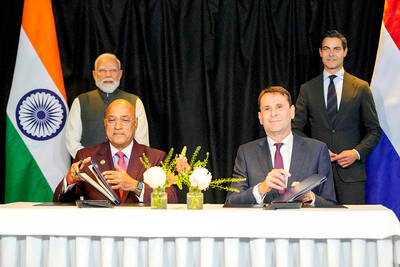
NEW MARKET: The partnership opens up India to the Dutch company, which already has a strong hold in the semiconductor market of South Korea, Taiwan and China ASML Holding NV entered into a partnership agreement with Tata Electronics Pvt Ltd aimed at ramping up India’s goal to develop domestic chip-manufacturing capabilities. The Dutch company’s technology would help power Tata Electronics’ planned 300 millimeter (mm) semiconductor foundry in Gujarat, according to a joint statement from the two companies on Saturday. The signing of a memorandum of understanding coincides with a visit by Indian Prime Minister Narendra Modi to the Netherlands, which is looking to deepen bilateral relations with New Delhi. ASML, whose top customers include Taiwan Semiconductor Manufacturing Co (台積電) and Samsung Electronics Co, makes lithography machines that can print
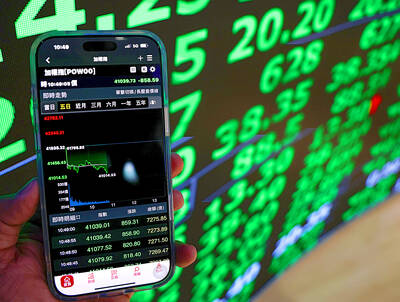
PORTFOLIO REBALANCING: The adjustments in three global equity indices reflect rising investor appetite for semiconductor and artificial intelligence-related stocks Taiwan’s weighting in major global equity indices compiled by MSCI Inc is to rise modestly following the latest quarterly review, underscoring the market’s expanding role in emerging-market portfolios, as global investors continue to favor the nation’s technology sector. Taiwan’s weighting in the MSCI Emerging Markets Index is to increase by 0.30 percentage points to 23.76 percent, after the changes take effect at the close of the May 29 session. Its weighting in the MSCI All-Country Asia ex-Japan Index is to rise 0.37 percentage points to 27.16 percent, while that in the MSCI All Country World Index is to edge up slightly to
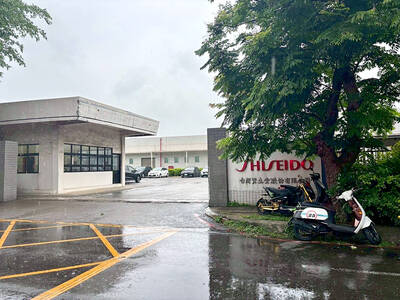
The Hsinchu County Government’s Labor Affairs Department yesterday said that it has received a plan from cosmetics brand Taiwan Shiseido Co (台灣資生堂) detailing mass layoffs at its plant in Hukou Township (湖口). While the labor authorities did not disclose the number of employees to be laid off, Japanese news media earlier in the day reported that the closure of the company’s factory in Hukou would result in 170 employees losing their jobs. Shiseido followed the law by reporting its layoff plan, the department said, adding that authorities would closely monitor negotiations between the management and affected employees and step in if any


 RSS
RSS