


Corning Inc, the world's biggest maker of glass substrates for liquid-crystal-display (LCD) screens, yesterday said it is set to supply local customers with glass by the end of this year from a new plant in central Taiwan.
The US glassmaker said it has received the necessary government certificates to begin shipping LCD glass substrates from its Taichung manufacturing facility, according to a company statement yesterday.
"The Taichung facility will allow us to maintain pace and support our customers' demand for large LCD glass substrates," said James Clappin, president of Corning Display Technologies.
Corning's Taichung factory will manufacture Generation 5.5, Generation 6, Generation 7.5 and larger glass substrates to meet the continued strong demand for desktop monitors and the emerging growth in LCD televisions, Corning said.
The company's board recently approved an additional capital expenditure plan of US$425 million for the third-phase expansion of the Taichung facility, bringing the total capital expenditure for the new plant to about US$1.5 billion, Corning said.
The majority of the additional expenditure will be incurred next year and in 2007.
Corning is scheduled to hold an official grand opening ceremony for the new plant next month. The US firm has another plant valued at US$1 billion in Tainan, southern Taiwan.
Corning is a major supplier of LCD glass-substrates to Taiwanese makers of LCD panels for computers and televisions, including AU Optronics Corp (友達光電) and Chi Mei Optoelectronics Corp (奇美電子). Local panel makers also buy their glass from Japanese companies such as Asahi Glass Co and Nippon Electric Glass Co.
According to statistics provided by the Industrial Economics and Knowledge Center under the Industrial Technology Research Institute, the output value of the nation's flat-panel displays is estimated at NT$840.6 billion (US$25.3 billion) this year, up 17.6 percent from a year earlier. The figure for next year will exceed the NT$1 trillion mark, the center forecast.
To meet growing demand for glass substrates here, Asahi Glass, Japan's top glassmaker, also planned to invest NT$20 billion in expanding its production facilities in Taiwan, according to the Ministry of Economic Affairs.
Asahi Glass Fine Techno Taiwan Co (
The glassmaker is renting 8 hectares of land at an industrial park in Yunlin County and is planning to build two furnaces to make glass substrates for LCD displays to satisfy local demand, according to the company.
Asahi Glass Fine Techno Taiwan is scheduled to make an initial investment of NT$5 billion to complete a furnace by the first quarter of 2007 with an estimated annual output of 4 million square meters for all sizes of LCD displays, the ministry said.
Currently, Asahi Glass Fine Techno Taiwan makes 8 million square meters of LCD substrates a year at two furnaces, representing an investment of NT$27 billion. The Japanese company supplies the nation's five LCD flat-panel makers.
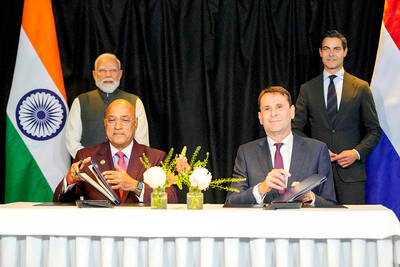
NEW MARKET: The partnership opens up India to the Dutch company, which already has a strong hold in the semiconductor market of South Korea, Taiwan and China ASML Holding NV entered into a partnership agreement with Tata Electronics Pvt Ltd aimed at ramping up India’s goal to develop domestic chip-manufacturing capabilities. The Dutch company’s technology would help power Tata Electronics’ planned 300 millimeter (mm) semiconductor foundry in Gujarat, according to a joint statement from the two companies on Saturday. The signing of a memorandum of understanding coincides with a visit by Indian Prime Minister Narendra Modi to the Netherlands, which is looking to deepen bilateral relations with New Delhi. ASML, whose top customers include Taiwan Semiconductor Manufacturing Co (台積電) and Samsung Electronics Co, makes lithography machines that can print
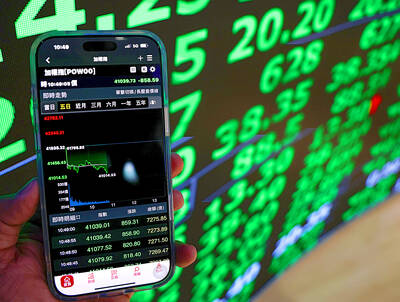
PORTFOLIO REBALANCING: The adjustments in three global equity indices reflect rising investor appetite for semiconductor and artificial intelligence-related stocks Taiwan’s weighting in major global equity indices compiled by MSCI Inc is to rise modestly following the latest quarterly review, underscoring the market’s expanding role in emerging-market portfolios, as global investors continue to favor the nation’s technology sector. Taiwan’s weighting in the MSCI Emerging Markets Index is to increase by 0.30 percentage points to 23.76 percent, after the changes take effect at the close of the May 29 session. Its weighting in the MSCI All-Country Asia ex-Japan Index is to rise 0.37 percentage points to 27.16 percent, while that in the MSCI All Country World Index is to edge up slightly to
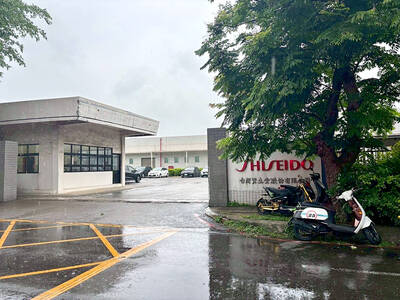
The Hsinchu County Government’s Labor Affairs Department yesterday said that it has received a plan from cosmetics brand Taiwan Shiseido Co (台灣資生堂) detailing mass layoffs at its plant in Hukou Township (湖口). While the labor authorities did not disclose the number of employees to be laid off, Japanese news media earlier in the day reported that the closure of the company’s factory in Hukou would result in 170 employees losing their jobs. Shiseido followed the law by reporting its layoff plan, the department said, adding that authorities would closely monitor negotiations between the management and affected employees and step in if any
Hon Hai Precision Industry Co (鴻海精密) on Tuesday confirmed a cyberattack targeting some of its North American facilities, but said the affected factories were gradually returning to normal. The company, known globally as Foxconn Technology Group (富士康科技集團), said that its cybersecurity team “activated the response mechanism and implemented operational measures to ensure the continuity of production and delivery.” “The affected factories are resuming normal production,” the company said in a statement. Hon Hai had previously described it as a “technical issue,” when news of the cyberattack first surfaced. The confirmation followed media reports of a large-scale information technology system incident that broke out at


 RSS
RSS