


Citigroup Inc plans to sell or split off its US$10 billion Citi private equity unit, expanding the list of money-management businesses the US bank is disposing of to reduce debt, people familiar with the matter said.
Citi private equity, which takes minority stakes in companies and invests in other buyout funds, oversees about US$2 billion of Citigroup’s money, said the people, who declined to be identified because the sale talks are private. The rest is from outside investors.
Managers of the decade-old unit, led by Todd Benson and Darren Friedman, have discussed buying it for themselves alongside new partners or with other financing, one person said.
Citigroup, 27 percent owned by the government following a bailout in 2008, is selling almost a third of its US$1.86 trillion assets under regulatory pressure to shrink. Chief executive officer Vikram Pandit plans to keep a smaller buyout unit the bank bought in late 2007, a few months after he joined, the people said.
“Citi has been going in and out of these different investing vehicles, both private equity and hedge funds,” said Steven Kaplan, a professor at the University of Chicago Booth School of Business who studies the private-equity industry. “It’s been a game of musical chairs.”
Benson and Friedman stepped in as co-heads of Citi private equity after departure of John Barber — who had led the unit for nine years — in January last year. Neither of the co-heads returned calls for comment, and Citigroup spokeswoman Shannon Bell declined to comment.
Other money-management units marked for sale or closure include the Citi property investors’ real-estate unit, which oversees US$12.5 billion; and the hedge fund management group, which allocates money to hedge funds on behalf of its own investors, the people said.
Citigroup plans to keep Metalmark Capital LLC, a buyout firm the bank agreed to buy for an undisclosed sum in December 2007. Headed by former Morgan Stanley executive Howard Hoffen, Metalmark oversees almost US$3.8 billion in several funds, one person said. It invests in energy, healthcare, financial and industrial companies, Metalmark’s Web site said.
Pandit, 53, decided to keep Metalmark because he preferred its management and strategy to those of Citi private equity, three people said.
Pandit and John Havens, who heads the trading and investment-banking division, worked with Hoffen at Morgan Stanley from the late 1980s through the early 2000s.
The bank is also keeping another fund, Citi Venture Capital International, which focuses on China, India, Central and Eastern Europe and Latin America.
Citi capital advisers has about US$14 billion under management, a figure that excludes the funds earmarked for disposal, people familiar with the matter said.
At the end of 2007, the division oversaw US$73 billion. More than a dozen funds were shuttered or frozen, including Pandit’s Old Lane Partners fund, which Citigroup bought in 2007 for US$800 million.
The bank stopped reporting the alternative-investing division’s results after the first quarter of 2008, when it had a net loss of US$509 million.
The decision to sell Citi private equity was made last year, before US President Barack Obama on Jan. 21 proposed banks be forced to divest their private-equity firms and hedge funds, the people familiar with the matter said.
Ownership of such businesses can expose taxpayers to the risk of further bank bailouts, the White House said.

SILENCING CRITICS: In addition to blocking Taiwan, China aimed to prevent rights activists from speaking out against authoritarian states, a Cabinet department said The Ministry of Foreign Affairs (MOFA) yesterday condemned transnational repression by Beijing after RightsCon, a major digital human rights conference scheduled to be held in Zambia this week, was abruptly canceled due to Chinese pressure over Taiwanese participation. This year’s RightsCon, the world’s largest conference discussing issues “at the intersection of human rights and technology,” was scheduled to take place from tomorrow to Friday in Lusaka, and expected to draw 2,600 in-person attendees from 150 countries, along with 1,100 online participants. However, organizers were forced to cancel the event due to behind-the-scenes pressure from China, the ministry said, expressing its “strongest condemnation”
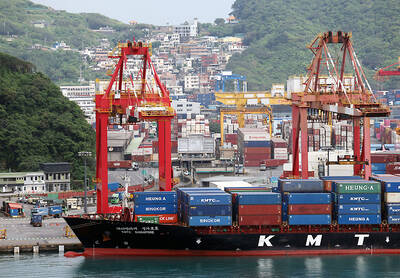
Taiwan’s economy grew far faster than expected in the first quarter, as booming demand for artificial intelligence (AI) applications drove a surge in exports, spilling over into investment and consumption, the Directorate-General of Budget, Accounting and Statistics (DGBAS) said yesterday. GDP growth was 13.69 percent year-on-year during the January-to-March period, beating the DGBAS’ February forecast by 2.23 percentage points and marking the most robust growth in nearly four decades, DGBAS senior official Chiang Hsin-yi (江心怡) told a news conference in Taipei. The result was powered by exports, which remain the backbone of Taiwan’s economy, Chiang said. Outbound shipments jumped 51.12 percent year-on-year to
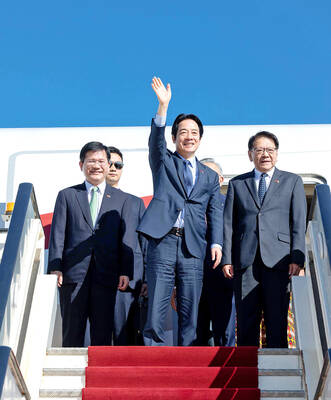
DELAYED BUT DETERMINED: The president’s visit highlights Taiwan’s right to international engagement amid regional pressure from China President Willaim Lai (賴清德) yesterday arrived in Eswatini, more than a week after his planned visit to Taiwan’s sole African ally was suspended because of revoked overflight permits. “The visit, originally scheduled for April 22, was postponed due to unforeseen external factors,” Lai wrote on social media. “After several days of careful arrangements by our diplomatic and national security teams, we successfully arrived today.” Lai said he looked forward to further deepening Taiwan-Eswatini relations through closer cooperation in the economy, agriculture, culture and education, as well as advancing the nation’s international partnerships. The president was initially scheduled to arrive in time to celebrate

Iran’s Islamic Revolutionary Guard Corp (IRGC) yesterday said the US faced a choice between an “impossible” military operation or a “bad deal” with Tehran, after US President Donald Trump disparaged Iran’s latest peace proposal. Negotiations between the two countries have been deadlocked since a ceasefire came into effect on April 8, with only one round of direct peace talks held so far. Iran’s Tasnim and Fars news agencies reported that Tehran had submitted a 14-point proposal to mediator Pakistan, but Trump was quick to cast doubt on it. “I will soon be reviewing the plan that Iran has just sent to us, but


 RSS
RSS