


Matsushita will scrap its Japanese brand name “National” and start a marketing blitz called “Hello Panasonic” in an ambitious drive to boost market share, company officials said yesterday.
Matsushita Electric Industrial Co, a major Japanese electronics maker that rivals Sony Corp, is changing its company name to Panasonic Corp next month, dropping the name of its founder, Konosuke Matsushita, one of Japan’s pioneering entrepreneurs credited with leading the country’s modernization after World War II.
The move symbolizes the company’s growing international stature and ambitions. Panasonic has long been its brand name abroad.

PHOTO: AFP
The end of the National name also highlights the firm’s break from its past, when it built its customer base in Japan through an army of electronics salesman-cum-repairman at small National stores around the country.
Under its new marketing blitz, Matsushita will push products that connect digitally —such as audiovisual products that link with each other and home security gadgets that link with car navigation equipment, it said.
Products will also become more green to respond to growing public concerns about global warming, it said. Sixty percent of electricity consumed in a household is from appliances, Matsushita said.
Company executive vice president Shunzo Ushimaru said that Matsishita’s market share had risen from 20 percent in 2001, to 28 percent this year, and hoped to lift that further.
Although cars tend to be viewed as one of the biggest household purchases, the combined value of electronics products bought by a family is about ¥2.9 million (US$28,000) — more than the average price of a car, he said.
“We hope to have greater impact on homes with our products by unifying our brand into Panasonic,” Ushimaru said at a Tokyo hotel.
The firm will embark on a major advertising campaign, changing National showrooms’ names to Panasonic, airing TV commercials and starting a mobile Web site to promote the Panasonic brand, Ushimaru said.
Matsushita showed an energy-saving air conditioner, refrigerator, washer-dryer and vacuum cleaner. The products go on sale next month in Japan.

SILENCING CRITICS: In addition to blocking Taiwan, China aimed to prevent rights activists from speaking out against authoritarian states, a Cabinet department said The Ministry of Foreign Affairs (MOFA) yesterday condemned transnational repression by Beijing after RightsCon, a major digital human rights conference scheduled to be held in Zambia this week, was abruptly canceled due to Chinese pressure over Taiwanese participation. This year’s RightsCon, the world’s largest conference discussing issues “at the intersection of human rights and technology,” was scheduled to take place from tomorrow to Friday in Lusaka, and expected to draw 2,600 in-person attendees from 150 countries, along with 1,100 online participants. However, organizers were forced to cancel the event due to behind-the-scenes pressure from China, the ministry said, expressing its “strongest condemnation”
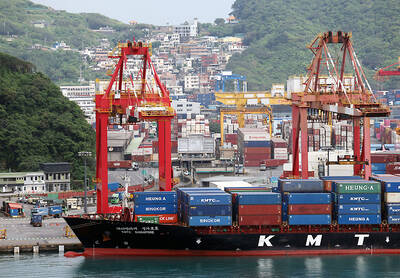
Taiwan’s economy grew far faster than expected in the first quarter, as booming demand for artificial intelligence (AI) applications drove a surge in exports, spilling over into investment and consumption, the Directorate-General of Budget, Accounting and Statistics (DGBAS) said yesterday. GDP growth was 13.69 percent year-on-year during the January-to-March period, beating the DGBAS’ February forecast by 2.23 percentage points and marking the most robust growth in nearly four decades, DGBAS senior official Chiang Hsin-yi (江心怡) told a news conference in Taipei. The result was powered by exports, which remain the backbone of Taiwan’s economy, Chiang said. Outbound shipments jumped 51.12 percent year-on-year to
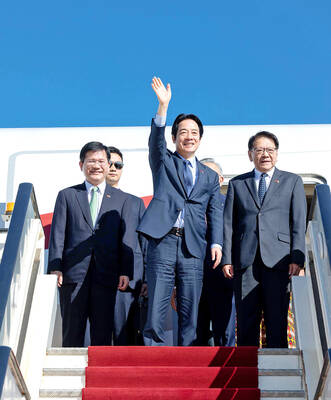
DELAYED BUT DETERMINED: The president’s visit highlights Taiwan’s right to international engagement amid regional pressure from China President Willaim Lai (賴清德) yesterday arrived in Eswatini, more than a week after his planned visit to Taiwan’s sole African ally was suspended because of revoked overflight permits. “The visit, originally scheduled for April 22, was postponed due to unforeseen external factors,” Lai wrote on social media. “After several days of careful arrangements by our diplomatic and national security teams, we successfully arrived today.” Lai said he looked forward to further deepening Taiwan-Eswatini relations through closer cooperation in the economy, agriculture, culture and education, as well as advancing the nation’s international partnerships. The president was initially scheduled to arrive in time to celebrate
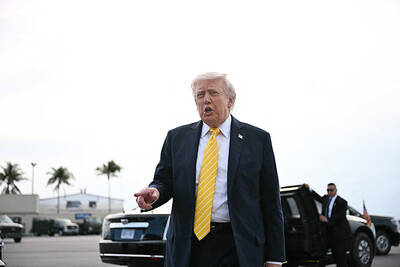
Iran’s Islamic Revolutionary Guard Corp (IRGC) yesterday said the US faced a choice between an “impossible” military operation or a “bad deal” with Tehran, after US President Donald Trump disparaged Iran’s latest peace proposal. Negotiations between the two countries have been deadlocked since a ceasefire came into effect on April 8, with only one round of direct peace talks held so far. Iran’s Tasnim and Fars news agencies reported that Tehran had submitted a 14-point proposal to mediator Pakistan, but Trump was quick to cast doubt on it. “I will soon be reviewing the plan that Iran has just sent to us, but


 RSS
RSS