


Chinese and EU leaders launched a high-level dialogue yesterday on tensions over China’s swelling trade surplus with Europe and disagreements over how to tackle climate change.
“Our meeting today marks a significant step towards the strengthening of the strategic partnership between China and Europe,” European Commission President Jose Manuel Barroso told Premier Wen Jiabao (溫家寶) during their meeting in Beijing.
The EU is stepping up pressure on Beijing for action over its trade surplus, market barriers and currency controls — areas where Washington long took the lead.
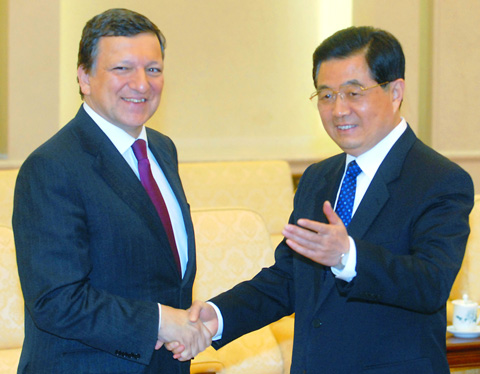
PHOTO: AP
China’s trade surplus with the EU surged 23 percent to US$34.1 billion in the first quarter of the year, surpassing the gap with the US, government data showed.
Barroso gave no details but said the sides agreed to work on narrowing that gap.
“But there are major imbalances and we both agree on the necessity to rebalance our bilateral trade,” he said.
European businesses say China keeps its currency undervalued, giving their Chinese competitors an unfair price advantage. Europe also echoes US complaints about Chinese product piracy, saying 80 percent of counterfeit goods seized at its ports originated in China.
Barroso said that Chinese and EU officials had discussed cooperation on fighting climate change and other environmental issues.
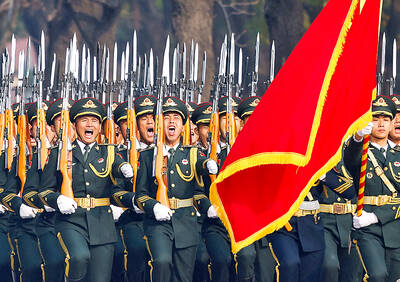
Conflict with Taiwan could leave China with “massive economic disruption, catastrophic military losses, significant social unrest, and devastating sanctions,” a US think tank said in a report released on Monday. The German Marshall Fund released a report titled If China Attacks Taiwan: The Consequences for China of “Minor Conflict” and “Major War” Scenarios. The report details the “massive” economic, military, social and international costs to China in the event of a minor conflict or major war with Taiwan, estimating that the Chinese People’s Liberation Army (PLA) could sustain losses of more than half of its active-duty ground forces, including 100,000 troops. Understanding Chinese
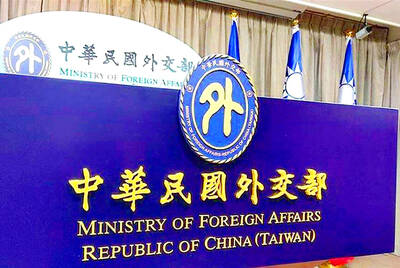
The Ministry of Foreign Affairs (MOFA) yesterday said it is closely monitoring developments in Venezuela, and would continue to cooperate with democratic allies and work together for regional and global security, stability, and prosperity. The remarks came after the US on Saturday launched a series of airstrikes in Venezuela and kidnapped Venezuelan President Nicolas Maduro, who was later flown to New York along with his wife. The pair face US charges related to drug trafficking and alleged cooperation with gangs designated as terrorist organizations. Maduro has denied the allegations. The ministry said that it is closely monitoring the political and economic situation

UNRELENTING: China attempted cyberattacks on Taiwan’s critical infrastructure 2.63 million times per day last year, up from 1.23 million in 2023, the NSB said China’s cyberarmy has long engaged in cyberattacks against Taiwan’s critical infrastructure, employing diverse and evolving tactics, the National Security Bureau (NSB) said yesterday, adding that cyberattacks on critical energy infrastructure last year increased 10-fold compared with the previous year. The NSB yesterday released a report titled Analysis on China’s Cyber Threats to Taiwan’s Critical Infrastructure in 2025, outlining the number of cyberattacks, major tactics and hacker groups. Taiwan’s national intelligence community identified a large number of cybersecurity incidents last year, the bureau said in a statement. China’s cyberarmy last year launched an average of 2.63 million intrusion attempts per day targeting Taiwan’s critical
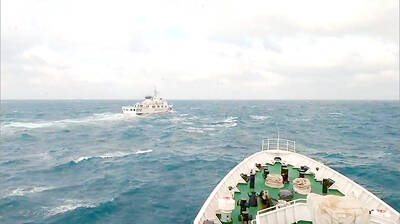
‘SLICING METHOD’: In the event of a blockade, the China Coast Guard would intercept Taiwanese ships while its navy would seek to deter foreign intervention China’s military drills around Taiwan this week signaled potential strategies to cut the nation off from energy supplies and foreign military assistance, a US think tank report said. The Chinese People’s Liberation Army (PLA) conducted what it called “Justice Mission 2025” exercises from Monday to Tuesday in five maritime zones and airspace around Taiwan, calling them a warning to “Taiwanese independence” forces. In a report released on Wednesday, the Institute for the Study of War said the exercises effectively simulated blocking shipping routes to major port cities, including Kaohsiung, Keelung and Hualien. Taiwan would be highly vulnerable under such a blockade, because it


 RSS
RSS