


With her pinstripe trouser suit and US-style management speak, 32-year-old sales director Larisa Malyasova is one of the many pioneers spreading a shopping revolution across Russia.
She heads a network of mobile phone shops in Ivanovo — a run-down region 300km northeast of Moscow — for Euroset, one of the Russian retail giants that are rivaling Europe’s most established names.
Sitting in a cafe in the brand new Silver City shopping center, a converted textile factory, she outlines a career made on the back of a consumer spending boom that is reaching the furthest corners of Russia.
“No one’s producing anything any more here but everyone’s buying,” said Malyasova, as fashionably-dressed teenagers strolled through the pristine shopping center — a welcome contrast to the mud-caked streets outside.
She started out by opening four shops in Ivanovo for Euroset in 2004. Now she runs a network of 40 that extends into farming villages and towns of a region that regularly ranks as one of the poorest in Russia.
A growing number of Russians are snapping up high-end electronic goods, sipping cappuccinos or buying chic clothes in chain stores, bucking a consumer spending downturn in Europe and the US.
Some of the big names of Russian retail now have networks that overshadow European ones. Carphone Warehouse, Europe’s biggest mobile phone retailer, has 2,200 stores — Euroset has more than 4,000 outlets.
A report by Russian investment bank Troika Dialog last November predicted Russia would overtake Germany to become Europe’s largest consumer market this year thanks to rising incomes because of oil-fuelled economic growth.
The report estimated that this year some 85 million Russians will have a monthly disposable income per capita after household costs of US$350, giving them access to many consumer goods.
“There used to be a big difference between buyers in Moscow and the regions. That’s evened out now,” said Pavel Talamanov, 29, regional director in Ivanovo for Eldorado, one of Russia’s biggest electronic goods chain.
“Buyers have a lot more cash,” Talamanov said.
Eldorado opened its biggest store in Ivanovo last week where the most popular items are plasma screen televisions and high-end computer games.
The expansion of retail chain stores is even changing the urban landscape in Russia’s regions. Their garish facades often appear alongside wooden homes in suburbs or among gray Soviet apartment buildings in city centers.
They are also bringing Western standards of service and a dazzling array of goods to places that in the not so distant past had empty shelves because of the distribution breakdown during the Soviet Union’s collapse at the turn of the 1990s.
“They’re developing very actively in the regions, particularly in cities,” said Vitaly Kupeyev, consumer markets analyst at Alfa Bank in Moscow.
“There won’t be an end to this boom in the near future,” he said.
But Kupeyev also pointed out that there are still big differences between Moscow and the regions — especially in Siberia — and that modern-style retail in large shopping centers only makes up about 15 percent of the market.
The sector has also come under a cloud after Russian tax authorities last month warned they would focus on retail firms. One of the first targets appears to be Eldorado, whose Moscow office was raided by armed officers on Apr. 2.
At the Ivanovo shopping mall, Euroset shop assistant Sergei Maximov said he was just happy that one of the big chain stores had made it to his city of 400,000 people, long considered a backwater despite its proximity to Moscow.
Pointing to a display of fancy mobile phones, Maximov, 22, who sported one of the company’s yellow polo shirts and a name badge, said: “I like working for a big company. I can make a good career here.”
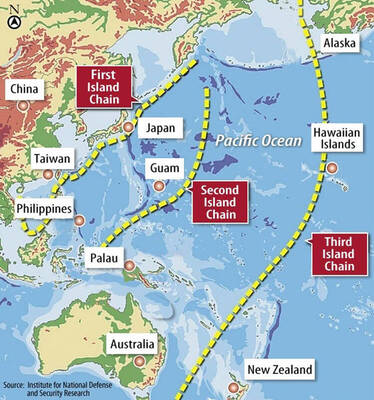
The US government has signed defense cooperation agreements with Japan and the Philippines to boost the deterrence capabilities of countries in the first island chain, a report by the National Security Bureau (NSB) showed. The main countries on the first island chain include the two nations and Taiwan. The bureau is to present the report at a meeting of the legislature’s Foreign Affairs and National Defense Committee tomorrow. The US military has deployed Typhon missile systems to Japan’s Yamaguchi Prefecture and Zambales province in the Philippines during their joint military exercises. It has also installed NMESIS anti-ship systems in Japan’s Okinawa

‘WIN-WIN’: The Philippines, and central and eastern European countries are important potential drone cooperation partners, Minister of Foreign Affairs Lin Chia-lung said Minister of Foreign Affairs Lin Chia-lung (林佳龍) in an interview published yesterday confirmed that there are joint ventures between Taiwan and Poland in the drone industry. Lin made the remark in an exclusive interview with the Chinese-language Liberty Times (the Taipei Times’ sister paper). The government-backed Taiwan Excellence Drone International Business Opportunities Alliance and the Polish Chamber of Unmanned Systems on Wednesday last week signed a memorandum of understanding in Poland to develop a “non-China” supply chain for drones and work together on key technologies. Asked if Taiwan prioritized Poland among central and eastern European countries in drone collaboration, Lin

NO CONFIDENCE MOTION? The premier said that being toppled by the legislature for defending the Constitution would be a democratic badge of honor for him Premier Cho Jung-tai (卓榮泰) yesterday announced that the Cabinet would not countersign the amendments to the local revenue-sharing law passed by the Legislative Yuan last month. Cho said the decision not to countersign the amendments to the Act Governing the Allocation of Government Revenues and Expenditures (財政收支劃分法) was made in accordance with the Constitution. “The decision aims to safeguard our Constitution,” he said. The Constitution stipulates the president shall, in accordance with law, promulgate laws and issue mandates with the countersignature of the head of the Executive Yuan, or with the countersignatures of both the head of the Executive Yuan and ministers or

BACK TO WORK? Prosecutors said they are considering filing an appeal, while the Hsinchu City Government said it has applied for Ann Kao’s reinstatement as mayor The High Court yesterday found suspended Hsinchu mayor Ann Kao (高虹安) not guilty of embezzling assistant fees, reducing her sentence to six months in prison commutable to a fine from seven years and four months. The verdict acquitted Kao of the corruption charge, but found her guilty of causing a public official to commit document forgery. The High Prosecutors’ Office said it is reviewing the ruling and considering whether to file an appeal. The Taipei District Court in July last year sentenced Kao to seven years and four months in prison, along with a four-year deprivation of civil rights, for contravening the Anti-Corruption


 RSS
RSS