


The High Court yesterday found suspended Hsinchu mayor Ann Kao (高虹安) not guilty of embezzling assistant fees, reducing her sentence to six months in prison commutable to a fine from seven years and four months.
The verdict acquitted Kao of the corruption charge, but found her guilty of causing a public official to commit document forgery.
The High Prosecutors’ Office said it is reviewing the ruling and considering whether to file an appeal.
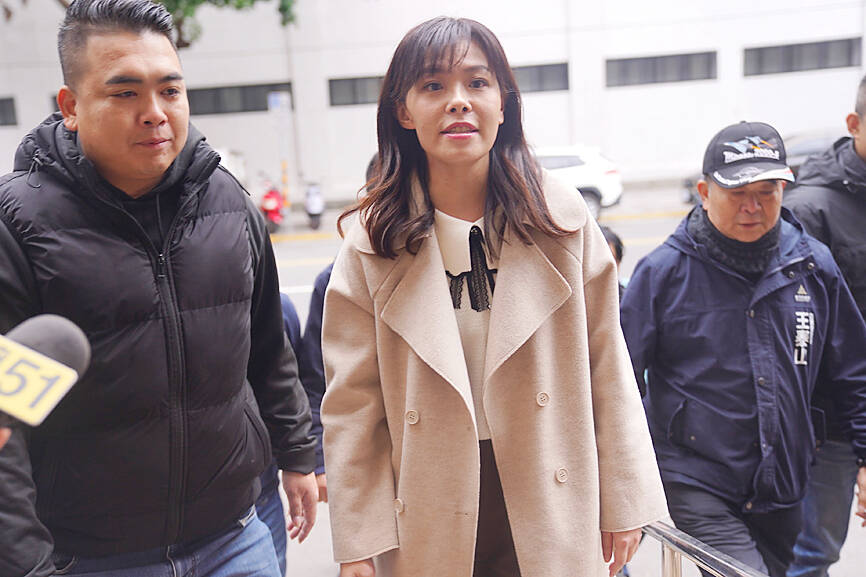
Photo: CNA
The Taipei District Court in July last year sentenced Kao to seven years and four months in prison, along with a four-year deprivation of civil rights, for contravening the Anti-Corruption Act (貪污治罪條例) and the Criminal Code, a ruling that led to her suspension.
The district court found that Kao, who served as a legislator representing the Taiwan People’s Party (TPP) from Feb. 1, 2020, to Dec. 25, 2022, had inflated assistant salaries and overtime pay claims, obtaining NT$116,514 in illicit gains.
Kao quit as a member of the TPP following her suspension as mayor.
Both Kao and prosecutors appealed, leading to the trial at the High Court, which yesterday overturned the corruption conviction and revised it to a forgery-related offense under the Criminal Code.
During the trial, Kao argued that she did not line her own pockets and had not engaged in corruption, and appealed for an acquittal.
The High Court said Kao was acquitted as the case does not constitute a crime of fraudulently obtaining property through the use of one’s position under Article 5, Section 1, Clause 2 of the Anti-Corruption Act.
This is because, according to Article 32 of the Organic Act of the Legislative Yuan (立法院組織法), the legislative intent and budgetary nature of assistant fees are considered “substantial subsidies with flexible allocation,” the High Court said.
Moreover, the Legislative Yuan’s response to the court’s inquiry stated that the allocation of public assistant funds for legislators is intended to supplement the financial resources needed for legislative duties, and its nature is essentially that of a subsidy for legislators, it said.
As for the conviction for forgery of documents, Kao and her assistants reported NT$80,000 in overtime fees to the Legislative Yuan, but the assistants were only paid NT$70,000, with the remaining NT$10,000 going to an office fund, the High Court said.
The discrepancy between the two amounts constitutes the crime of “making false entries by a public servant” under Article 214 of the Criminal Code, the verdict said.
TPP Chairman Huang Kuo-chang (黃國昌) said the acquittal on corruption charges finally cleared Kao’s name, calling it “justice delayed.”
TPP Secretary-General Chou Yu-shiu (周榆修) said the ruling showed that Kao had not engaged in corruption and urged authorities to end what he described as judicial persecution.
The Ministry of the Interior said Kao is eligible to apply for reinstatement and may resume office before the end of her term if her application for reinstatement is approved.
The Hsinchu City Government said in a statement that it had submitted an application to the ministry for Kao’s reinstatement in accordance with regulations.
Hsinchu Acting Mayor Chiu Chen-yuan (邱臣遠) said that city departments have begun preparing for the handover and urged the ministry to approve the reinstatement as soon as possible.
Under the Local Government Act (地方制度法), a county or city mayor who is suspended after being convicted at a trial of first instance of corruption-related offenses may be reinstated if the conviction is overturned on appeal before the end of the term.
The Democratic Progressive Party said that it “respects the judiciary.”
The Chinese Nationalist Party (KMT) also said it respects the ruling, adding that the verdict allowed “the unjust suffering to be avenged.”

Japan has deployed long-range missiles in a southwestern region near China, the Japanese defense minister said yesterday, at a time when ties with Beijing are at their lowest in recent years. The missiles were installed in Kumamoto in the southern region of Kyushu, as Japan is attempting to shore up its military capacity as China steps up naval activity in the East China Sea. “Standoff defense capabilities enable us to counter the threat of enemy forces attempting to invade our country ... while ensuring the safety of our personnel,” Japanese Minister of Defense Shinjiro Koizumi said. “This is an extremely important initiative for

The nation’s fastest supercomputer, Nano 4 (晶創26), is scheduled to be launched in the third quarter, and would be used to train large language models in finance and national defense sectors, the National Center for High-Performance Computing (NCHC) said. The supercomputer, which would operate at about 86.05 petaflops, is being tested at a new cloud computing center in the Southern Taiwan Science Park in Tainan. The exterior of the server cabinet features chip circuitry patterns overlaid with a map of Taiwan, highlighting the nation’s central position in the semiconductor industry. The center also houses Taiwania 2, Taiwania 3, Forerunner 1 and

MORE POPULAR: Taiwan Pass sales increased by 59 percent during the first quarter compared with the same period last year, the Tourism Administration said The Tourism Administration yesterday said that it has streamlined the Taiwan Pass, with two versions available for purchase beginning today. The tourism agency has made the pass available to international tourists since 2024, allowing them to access the high-speed rail, Taiwan Railway Corp services, four MRT systems and four Taiwan Tourist Shuttles. Previously, five types of Taiwan Pass were available, but some tourists have said that the offerings were too complicated. The agency said only two types of Taiwan Pass would be available, starting from a three-day pass with the high-speed rail and a three-day pass with Taiwan Railway Corp. The former costs NT$2,800
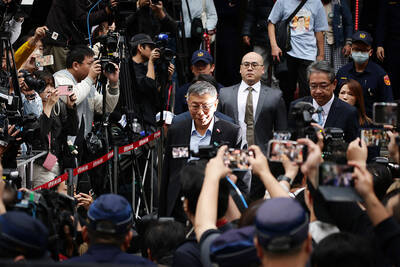
FIRST TRIAL: Ko’s lawyers sought reduced bail and other concessions, as did other defendants, but the bail judge denied their requests, citing the severity of the sentences Former Taipei mayor Ko Wen-je (柯文哲) was yesterday sentenced to 17 years in prison and had his civil rights suspended for six years over corruption, embezzlement and other charges. Taipei prosecutors in December last year asked the Taipei District Court for a combined 28-year, six-month sentence for the four cases against Ko, who founded the Taiwan People’s Party (TPP). The cases were linked to the Core Pacific City (京華城購物中心) redevelopment project and the mismanagement of political donations. Other defendants convicted on separate charges included Chinese Nationalist Party (KMT) Taipei City Councilor Angela Ying (應曉薇), who was handed a 15-year, six-month sentence; Core Pacific


 RSS
RSS