


Premier Cho Jung-tai (卓榮泰) yesterday announced that the Cabinet would not countersign the amendments to the local revenue-sharing law passed by the Legislative Yuan last month.
Cho said the decision not to countersign the amendments to the Act Governing the Allocation of Government Revenues and Expenditures (財政收支劃分法) was made in accordance with the Constitution.
“The decision aims to safeguard our Constitution,” he said.
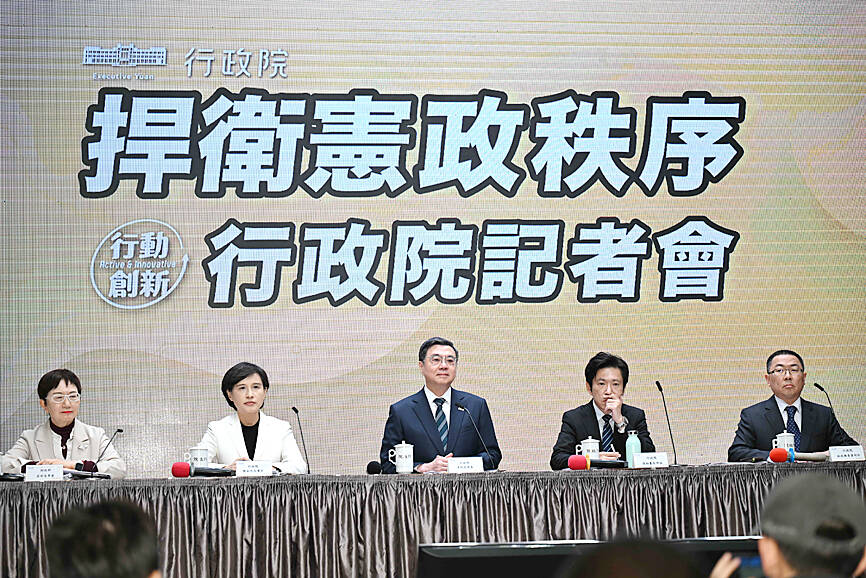
Photo: Chen Yi-kuan, Taipei Times
The Constitution stipulates the president shall, in accordance with law, promulgate laws and issue mandates with the countersignature of the head of the Executive Yuan, or with the countersignatures of both the head of the Executive Yuan and ministers or chairpersons of commissions concerned.
Although the decision marks the first time the Cabinet has ever refused to countersign legislation, the Democratic Progressive Party (DPP) government said that it is not in violation of the Constitution.
The announcement came after the 113-seat Legislative Yuan — in which the opposition Chinese Nationalist Party (KMT), the Taiwan People’s Party (TPP) and independent lawmakers aligned with the KMT hold a combined majority — on Dec. 5 rejected a Cabinet request to reconsider the approved amendments.

Photo courtesy of the Presidential Office via CNA
The amendments state that local governments would receive a larger share of central government revenue each year.
In its request for a reconsideration, the Executive Yuan said the amendments would strain the central government’s finances and force it to take on an additional NT$264.6 billion (US$8.43 billion) in debt next year, exceeding the annual borrowing cap of 15 percent of total expenditure.
The Cabinet last month asked the legislature to revisit the amendments, but the request was rejected by a vote of 59-50.
Cho yesterday said the opposition had forced the legislation through without proper consultation.
Cho said his decision to not countersign the amendments represents the executive's final means to correct what it considers legislative wrongdoing.
Cho argued that the Legislature had become an "autocratic political branch" by expanding its authority to secure more funding, undermining the constitutional system.
Cho stressed that his decision did not amount to authoritarianism or executive overreach. He noted that the Legislature retains a constitutional check, as it can still initiate a no-confidence vote against the premier if it disagrees with the Cabinet's actions.
He said that lawmakers could pass a no confidence motion to remove him if they wanted, as he would not countersign the legislation, paving the way for its enactment.
“As premier, if I am brought down by a legislature and political parties that trample on the Constitution and throw governance into chaos, that would be a democratic badge of honor for me,” he said.
If a no confidence motion were passed, Cho would have 10 days to submit his resignation to Lai, or he could ask the president to dissolve the legislature, which would lead to new elections within 60 days.
Later last night, the Presidential Office released a statement stating that President William Lai (賴清德) had issued a directive saying that the revisions could undermine fiscal sustainability.
The president wrote that the revisions would further weaken central finances, distort vertical and horizontal revenue allocations, hinder key policy implementation, and strain the government’s ability to safeguard national security and respond to natural disasters, Presidential Office spokesperson Karen Kuo (郭雅慧) said in the statement.
Earlier yesterday morning, Lai hosted a tea gathering with the heads of the Executive Yuan and Examination Yuan to discuss next year’s budget.
All ministries and agencies should implement legislation on a constitutionally sound basis to ensure the integrity of the constitutional system, Lai said after the meeting.
The Legislative Yuan passed amendments to the Constitutional Court Procedure Act (憲法訴訟法), effectively paralyzing the functioning of the court, he said.
Since then, the legislature has pushed through several bills with which the Executive Yuan and Examination Yuan disagree, including the revenue-allocation bill and halting pension cuts, he said.
The Constitutional Court, which currently only has eight sitting judges, has not been able to operate since January, when the legislature passed a bill requiring a quorum of 10 grand justices to participate in deliberations and nine to rule on the constitutionality of cases brought before it.
Additional reporting by Reuters and Chen Yu-fu
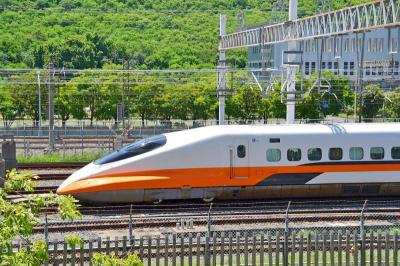
A signaling system malfunction disrupted high-speed rail (HSR) services beginning at 8am today, with trains temporarily reduced to three northbound and three southbound trains per hour as authorities conduct inspections. The malfunction occurred on a section of track in Miaoli County during pre-operation checks early this morning, forcing northbound and southbound trains to use a single track, the HSR operator said. The regular schedule has been replaced with three hourly trains offering only nonreserved seating in each direction, stopping at every station, it said, adding that business class cars would still have reserved seating. Departures from terminal stations are scheduled at the top

Taiwan is still in the process of assessing the possibility of recruiting workers from Eswatini, the Ministry of Foreign Affairs said yesterday, adding that its goal is to help Eswatini upgrade its vocational training centers. If there are plans to recruit workers from Eswatini, safeguarding national security, protecting public health and ensuring the employment rights of Taiwanese would be prerequisites, Department of West Asian and African Affairs Director-General Yen Chia-liang (顏嘉良) told a news conference. Key considerations would also include filling labor shortages in specific industries, and fostering bilateral professional and technical exchanges, he said. Yen was asked about the progress of labor
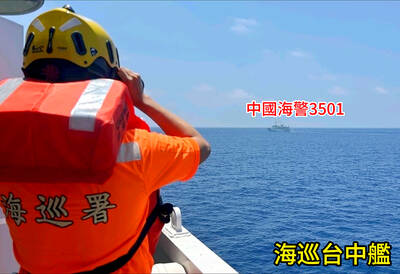
VERBOSE VESSELS: A CGA cutter and a China Coast Guard exchanged verbal barbs for more than a day in Taiwanese-controlled waters before the Chinese vessel left The Taiwanese and Chinese coast guards had a standoff near the strategically located Pratas Islands (Dongsha Islands, 東沙群島) in the north of the South China Sea, the Coast Guard Administration (CGA) said yesterday. The two sides engaged in intense radio exchanges over sovereignty claims during the 33-hour standoff. China Coast Guard vessel 3501 eventually left the restricted waters, 26.6 nautical miles (49.2km) west of the Pratas Islands, at 5pm yesterday, the CGA said. Lying approximately between southern Taiwan and Hong Kong, the Taiwan-controlled Pratas are seen by some security experts as vulnerable to Chinese attack due to their distance — more than
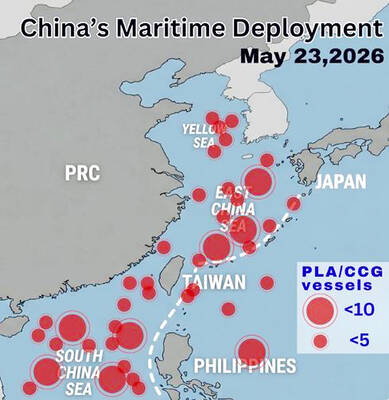
WARNING: China should stop engaging in actions that undermine regional peace and stability, as it would only build resentment among people across the Strait, the CGA said China has deployed more than 100 navy, coast guard and other vessels in waters from the Yellow Sea to the South China Sea and the western Pacific since US President Donald Trump and Chinese President Xi Jinping (習近平) met in Beijing, National Security Council Secretary-General Joseph Wu (吳釗燮) said yesterday. “In this part of the world, #China is the one & only PROBLEM wrecking the #StatusQuo & threatening regional peace & stability,” Wu wrote on X. In a separate post, he said Beijing was coercing Taiwan’s maritime domain, calling it illegal and provocative, after the Coast Guard Administration (CGA) expelled a


 RSS
RSS