


A South Korean court ruled yesterday that US private equity group Lone Star Funds and the head of its South Korean operations were guilty of stock price manipulation.
The Seoul Central District Court found the fund and Paul Yoo, its country head, manipulated the stock price of the credit card unit of Korea Exchange Bank (KEB), in which the fund owns a controlling stake, court spokesman Lee Dong-keun said.
Lone Star and Yoo, who was sentenced to five years in prison by the court, were accused of conspiring to lower the price of KEB's credit card unit in 2003 by spreading false information.
Prosecutors had sought 10 years in prison for Yoo.
Dallas, Texas-based Lone Star has come under intense scrutiny in South Korea over its business activities amid local unease over the role of foreign investors in the economy.
The fund wants to sell its controlling stake in KEB, the country's sixth-largest lender. The effort has been stymied by various legal and tax disputes, including the stock price manipulation case, as well as negative sentiment toward foreign investors that profit after taking stakes in distressed South Korean companies.
South Korean authorities have said the sale cannot be approved until legal issues are resolved.
Lone Star Chairman John Grayken, who was not on trial, visited South Korea last month to testify in the trial, telling the court that both Yoo and Lone Star were innocent of the charges.
The chairman, however, was slapped with a travel ban and questioned for 10 days by prosecutors regarding Lone Star's 2003 acquisition of KEB before being allowed to leave the country.
The fund has also battled suspicions that it was able to purchase the bank at a bargain price after colluding with government officials to understate the bank's financial health.
Lone Star has denied any wrongdoing and has countered that its rehabilitation of the once financially strapped KEB has been good for South Korea's economy.
Last year, HSBC Holdings PLC announced plans to acquire Lone Star's 51 percent stake in KEB for as much as US$6.3 billion pending regulatory and government approval.
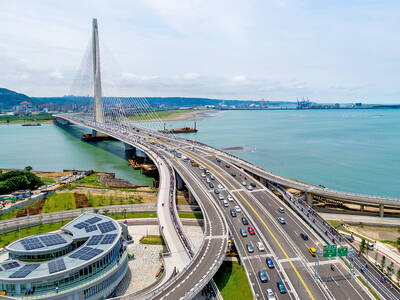
The Ministry of Transportation and Communications yesterday inaugurated the Danjiang Bridge across the Tamsui River in New Taipei City, saying that the structure would be an architectural icon and traffic artery for Taiwan. Feted as a major engineering achievement, the Danjiang Bridge is 920m long, 211m tall at the top of its pylon, and is the longest single-pylon asymmetric cable-stayed bridge in the world, the government’s Web site for the structure said. It was designed by late Iraqi-British architect Zaha Hadid. The structure, with a maximum deck of 70m, accommodates road and light rail traffic, and affords a 200m navigation channel for boats,
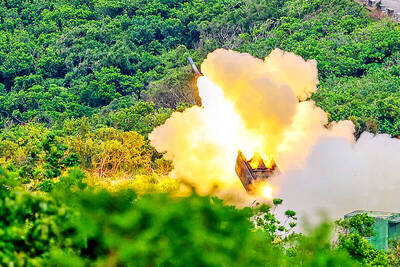
PRECISION STRIKES: The most significant reason to deploy HIMARS to outlying islands is to establish a ‘dead zone’ that the PLA would not dare enter, a source said A High Mobility Artillery Rocket System (HIMARS) would be deployed to Penghu County and Dongyin Island (東引) in Lienchiang County (Matsu) to force the Chinese military to retreat at least 100km from the coastline, a military source said yesterday. Taiwan has been procuring HIMARS and Army Tactical Missile Systems (ATACMS) from the US in batches. Once all batches have been delivered, Taiwan would possess 111 HIMARS units and 504 ATACMS, which have a range of 300km. Considering that “offense is the best defense,” the military plans to forward-deploy the systems to outlying islands such as Penghu and Dongyin so that
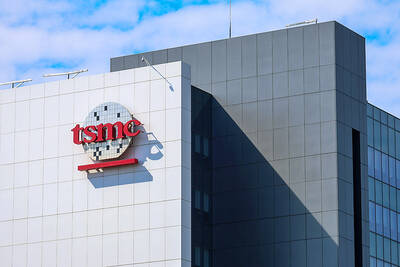
Taiwan Semiconductor Manufacturing Co (TSMC, 台積電), the world’s largest foundry service provider, yesterday said that global semiconductor revenue is projected to hit US$1.5 trillion in 2030, after the figure exceeds US$1 trillion this year, as artificial intelligence (AI) demand boosts consumption of token and compute power. “We are still at the beginning of the AI revolution, but we already see a significant impact across the whole semiconductor ecosystem,” TSMC deputy cochief operating officer Kevin Zhang (張曉強) said at the company’s annual technology symposium in Hsinchu City. “It is fair to say that in the past decade, smartphones and other mobile devices were
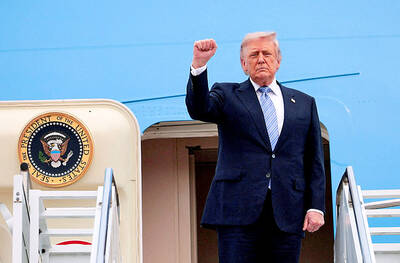
US-CHINA SUMMIT: MOFA welcomed US reassurance of no change in its Taiwan policy; Trump said he did not comment when Xi talked of opposing independence US President Donald Trump yesterday said he has not made a decision on whether to move forward with a major arms package for Taiwan after hearing concerns about it from Chinese President Xi Jinping (習近平). Trump’s comments on Taiwan came as he flew back to Washington after wrapping up critical talks in which both leaders said important progress was made in stabilizing US-China relations even as deep differences persist between the world’s two biggest powers on Iran and Taiwan. “I will make a determination,” Trump said, adding: “I’ll be making decisions. But, you know, I think the last thing we need right


 RSS
RSS