


Japanese electronics maker Matsu-shita Electric Industrial Co said yesterday it will drop the founder's name and become Panasonic Corp to strengthen its global image under one name.
The name change was approved at a board meeting yesterday and will become effective Oct. 1 upon approval at a shareholders' meeting in June, Matsushita said in a statement.
The move signals the importance of brand recognition amid intensifying global competition -- and makes sense given that the Osaka-based company is far better known outside Japan as Panasonic, one of its brand names, than as Matsushita.
The company, founded in 1918, will also drop its local brand, National, for products such as rice cookers, washing machines and refrigerators, by March 31, 2010.
Matsushita said the decision was to "unify its global brand," but said it will continue to run its business based on the philosophy of its founder, Konosuke Matsushita.
Matsushita has been mulling changing its name to Panasonic for some time to avoid consumer confusion.
Brand power is increasingly critical. A rapid decline in prices for gadgets has hurt profits and consumers tend to be willing to pay more for products from companies with strong reputations like Sony and Panasonic.
Konosuke Matsushita's rags-to-riches story and humanitarian views have been the pillar of the company.
Like Akio Morita, the founder of arch-rival Sony Corp, Matsushita is one of a number of charismatic entrepreneurs credited with leading Japan's modernization and economic success after its defeat in World War II.
Matsushita, who died in 1989 at 94, has inspired Japanese corporate culture with his unpretentious view on life and work, and for insisting only good companies that contribute to social well-being can hope to succeed.
Known in Japan as "the god of management," he is famous for quotations such as "Business is people," and "Every person has a path to follow." He began his career as an apprentice at a brazier store when he was just nine years old after his landowner family lost its fortune.
Although he was self-taught, the disarming Matsushita wrote books, founded a major publisher and became an award-winning philanthropist.
Despite the name change, the company is not dropping his ideas.
In his New Year's greeting earlier this week, Fumio Ohtsubo, the current president, said this marks marks the 90th anniversary of the firm's founding and reminded employees to stay true to the spirit of corporate ethics, social contribution and daily innovation. A copy of the speech was released to some reporters.
"Each and every one of us must do our utmost on the job, always asking our conscience whether we have strayed from the path, while continuously pursuing profitability," Ohtsubo said.
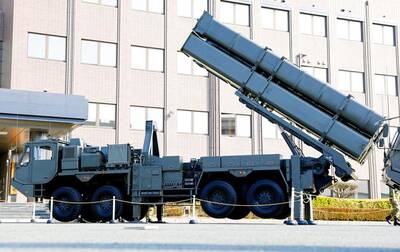
Japan has deployed long-range missiles in a southwestern region near China, the Japanese defense minister said yesterday, at a time when ties with Beijing are at their lowest in recent years. The missiles were installed in Kumamoto in the southern region of Kyushu, as Japan is attempting to shore up its military capacity as China steps up naval activity in the East China Sea. “Standoff defense capabilities enable us to counter the threat of enemy forces attempting to invade our country ... while ensuring the safety of our personnel,” Japanese Minister of Defense Shinjiro Koizumi said. “This is an extremely important initiative for

The nation’s fastest supercomputer, Nano 4 (晶創26), is scheduled to be launched in the third quarter, and would be used to train large language models in finance and national defense sectors, the National Center for High-Performance Computing (NCHC) said. The supercomputer, which would operate at about 86.05 petaflops, is being tested at a new cloud computing center in the Southern Taiwan Science Park in Tainan. The exterior of the server cabinet features chip circuitry patterns overlaid with a map of Taiwan, highlighting the nation’s central position in the semiconductor industry. The center also houses Taiwania 2, Taiwania 3, Forerunner 1 and
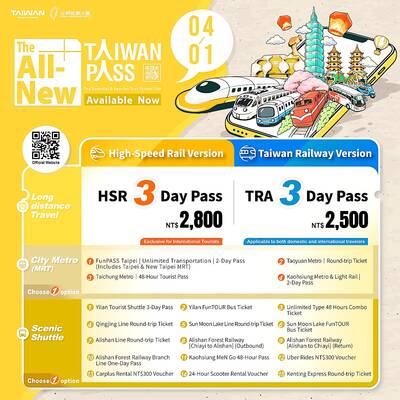
MORE POPULAR: Taiwan Pass sales increased by 59 percent during the first quarter compared with the same period last year, the Tourism Administration said The Tourism Administration yesterday said that it has streamlined the Taiwan Pass, with two versions available for purchase beginning today. The tourism agency has made the pass available to international tourists since 2024, allowing them to access the high-speed rail, Taiwan Railway Corp services, four MRT systems and four Taiwan Tourist Shuttles. Previously, five types of Taiwan Pass were available, but some tourists have said that the offerings were too complicated. The agency said only two types of Taiwan Pass would be available, starting from a three-day pass with the high-speed rail and a three-day pass with Taiwan Railway Corp. The former costs NT$2,800
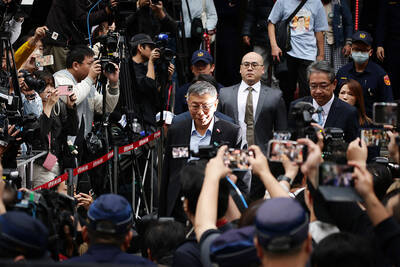
FIRST TRIAL: Ko’s lawyers sought reduced bail and other concessions, as did other defendants, but the bail judge denied their requests, citing the severity of the sentences Former Taipei mayor Ko Wen-je (柯文哲) was yesterday sentenced to 17 years in prison and had his civil rights suspended for six years over corruption, embezzlement and other charges. Taipei prosecutors in December last year asked the Taipei District Court for a combined 28-year, six-month sentence for the four cases against Ko, who founded the Taiwan People’s Party (TPP). The cases were linked to the Core Pacific City (京華城購物中心) redevelopment project and the mismanagement of political donations. Other defendants convicted on separate charges included Chinese Nationalist Party (KMT) Taipei City Councilor Angela Ying (應曉薇), who was handed a 15-year, six-month sentence; Core Pacific


 RSS
RSS