


Google will begin selling advertisements across all of the stations of Clear Channel Communications, the No.1 radio station owner in the US, at the end of June, the companies said on Sunday.
Google has been working for months to expand its ad sales operation into traditional media like newspapers, radio and television. To do so, it needs traditional media companies to allow it to sell some of their ads, and it had seemed to be making little progress in radio.
But the partnership with Clear Channel represents a step forward for Google. The deal will run for several years and will give Google access to just under 5 percent of Clear Channel's commercial time. That will include 30-second spots on all of Clear Channel's 675 stations during all programs and all times of the day, executives at both companies said in interviews on Sunday.
The companies did not disclose the financial details of the arrangement, except to say that Clear Channel would receive the majority of the ad revenue.
"It represents an opportunity to put what is arguably the hottest sales organization in the world to work selling our inventory, and we're very excited about that," Clear Channel chief executive John Hogan said.
Hogan said Google would bring new advertisers to his stations and would work with those companies rather than with Clear Channel's existing advertisers. But, he said, the Google advertisers would have access to premium inventory -- in contrast to some of Google's deals with newspapers that allow Google to sell only leftover ad space. And, he left the door open for a broader deal.
"If it is a success, we would want to replicate it and expand it," Hogan said.
Google has already signed on to sell ads for 800 stations nationwide, but they tend to be in smaller markets, said Tim Armstrong, Google's president for North American advertising and commerce.
"Everybody from top to bottom at Google is excited about this partnership," Armstrong said.
The deal will most likely stir more fear among the media executives who are wary of Google's encroachment. Google may have an easier time becoming dominant in radio because of the importance of local advertisers there, said Gene DeWitt, chairman of DeWitt Media Strategies, a firm that buys ads.
"Most mediums tend to be driven by national advertisers, but not radio," DeWitt said. "It's the national advertising community that has kind of been keeping Google at arm's length. These advertisers -- on radio -- may very likely be more willing and interested."
DeWitt said radio buying and selling generally had the most cumbersome processes.
Google's chief executive Eric Schmidt said last year that he planned to eventually have 1,000 employees working in the company's radio unit. Google paid as much as US$1.24 billion to acquire dMarc Broadcasting early last year and used that company's systems to expand its AdSense for Audio sales system to include radio capabilities. Advertisers log on to the AdSense Web site, choose what type of ad they want and submit their bids.
Google executives have said they hope to expand the offerings on their AdSense site to include all types of advertising, online and offline. On Friday, Google agreed to pay US$3.1 billion to acquire DoubleClick, a company with display ad knowledge that Google hopes will help it move beyond the text and search ads that generate most of its revenue.
Google also recently started selling ads for the 125 national satellite channels on EchoStar Communications' DISH Network. It is also testing ad sales for papers like the Chicago Tribune, the New York Times and newspaper chains.
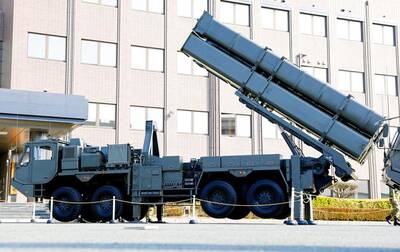
Japan has deployed long-range missiles in a southwestern region near China, the Japanese defense minister said yesterday, at a time when ties with Beijing are at their lowest in recent years. The missiles were installed in Kumamoto in the southern region of Kyushu, as Japan is attempting to shore up its military capacity as China steps up naval activity in the East China Sea. “Standoff defense capabilities enable us to counter the threat of enemy forces attempting to invade our country ... while ensuring the safety of our personnel,” Japanese Minister of Defense Shinjiro Koizumi said. “This is an extremely important initiative for

The nation’s fastest supercomputer, Nano 4 (晶創26), is scheduled to be launched in the third quarter, and would be used to train large language models in finance and national defense sectors, the National Center for High-Performance Computing (NCHC) said. The supercomputer, which would operate at about 86.05 petaflops, is being tested at a new cloud computing center in the Southern Taiwan Science Park in Tainan. The exterior of the server cabinet features chip circuitry patterns overlaid with a map of Taiwan, highlighting the nation’s central position in the semiconductor industry. The center also houses Taiwania 2, Taiwania 3, Forerunner 1 and

MORE POPULAR: Taiwan Pass sales increased by 59 percent during the first quarter compared with the same period last year, the Tourism Administration said The Tourism Administration yesterday said that it has streamlined the Taiwan Pass, with two versions available for purchase beginning today. The tourism agency has made the pass available to international tourists since 2024, allowing them to access the high-speed rail, Taiwan Railway Corp services, four MRT systems and four Taiwan Tourist Shuttles. Previously, five types of Taiwan Pass were available, but some tourists have said that the offerings were too complicated. The agency said only two types of Taiwan Pass would be available, starting from a three-day pass with the high-speed rail and a three-day pass with Taiwan Railway Corp. The former costs NT$2,800

FIRST TRIAL: Ko’s lawyers sought reduced bail and other concessions, as did other defendants, but the bail judge denied their requests, citing the severity of the sentences Former Taipei mayor Ko Wen-je (柯文哲) was yesterday sentenced to 17 years in prison and had his civil rights suspended for six years over corruption, embezzlement and other charges. Taipei prosecutors in December last year asked the Taipei District Court for a combined 28-year, six-month sentence for the four cases against Ko, who founded the Taiwan People’s Party (TPP). The cases were linked to the Core Pacific City (京華城購物中心) redevelopment project and the mismanagement of political donations. Other defendants convicted on separate charges included Chinese Nationalist Party (KMT) Taipei City Councilor Angela Ying (應曉薇), who was handed a 15-year, six-month sentence; Core Pacific


 RSS
RSS