


The family of Muppet creator Jim Henson has succeeded in a surprise bid to repurchase the company they sold to a German media firm in 2000.
The Henson family decided only two weeks ago to bid for The Jim Henson Co, which they will buy for a fraction of what Munich-based EM.TV paid for it, according to Brian Henson, the son of the company's late founder.
Munich-based EM.TV bought the company, and the rights to characters such as Kermit the Frog and Miss Piggy, in February 2000 for US$680 million in cash and stock.
But in May 2001, it said it was considering selling the Los Angeles-based firm. It has since sold some Henson assets, including the Sesame Street rights, for about US$200 million.
On Wednesday, it said it was selling the rest of Henson for US$78 million in cash and was keeping the US$11 million that the Henson operation had on hand.
"The family has been watching on the sidelines, sadly watching as EM.TV collapsed and never even started [planning what] they were going to do, and then painfully [watched] as the company was put back on the market," Henson said Wednesday in an interview.
``Both out of concern for where the company might end up and the legacy of Jim Henson ... `enough is enough,' we decided to come back in to run the company,'' he said.
Other companies thought to have made bids included The Walt Disney Co. Disney planned to buy the company at least once before, but the deal fell apart shortly after Jim Henson's death in 1990.
Brian Henson, 39, would not say if his family's bid was prompted by concern that the Muppets would be bought by Disney.
"Disney is a terrific company," Henson said. "We only have the highest respect for Disney as a company."
Jim Henson founded his company in 1958, inventing the term "muppet" as a cross between the words marionette and puppet.
The buyers include five Henson children: Brian, a brother and three sisters. The assets they bought include The Muppets, The Muppet Babies, The Fraggles, The Hoobs, Farscape and Bear in the Big Blue House.
The sale agreement still requires approval by EM.TV shareholders. EM.TV's annual general meeting is scheduled for July 20.
Henson said his family decided to sell in 2000 because, as independent producers, they could not raise enough cash to become the kind of vertically integrated media company they felt they needed to be to survive.
"It was looking like we wouldn't even get on the air if we didn't own a TV channel," Henson said. "We decided the `grow bigger' scenario was the best for the company."
Unfortunately, Henson said, EM.TV never followed through on its promise to spend money to market the Muppet characters and produce new projects.
"Instead, the emphasis of the company went to `What can we split off and sell' as opposed to `How do we build up the Muppets,'" Henson said.

The nation’s fastest supercomputer, Nano 4 (晶創26), is scheduled to be launched in the third quarter, and would be used to train large language models in finance and national defense sectors, the National Center for High-Performance Computing (NCHC) said. The supercomputer, which would operate at about 86.05 petaflops, is being tested at a new cloud computing center in the Southern Taiwan Science Park in Tainan. The exterior of the server cabinet features chip circuitry patterns overlaid with a map of Taiwan, highlighting the nation’s central position in the semiconductor industry. The center also houses Taiwania 2, Taiwania 3, Forerunner 1 and

FIRST TRIAL: Ko’s lawyers sought reduced bail and other concessions, as did other defendants, but the bail judge denied their requests, citing the severity of the sentences Former Taipei mayor Ko Wen-je (柯文哲) was yesterday sentenced to 17 years in prison and had his civil rights suspended for six years over corruption, embezzlement and other charges. Taipei prosecutors in December last year asked the Taipei District Court for a combined 28-year, six-month sentence for the four cases against Ko, who founded the Taiwan People’s Party (TPP). The cases were linked to the Core Pacific City (京華城購物中心) redevelopment project and the mismanagement of political donations. Other defendants convicted on separate charges included Chinese Nationalist Party (KMT) Taipei City Councilor Angela Ying (應曉薇), who was handed a 15-year, six-month sentence; Core Pacific
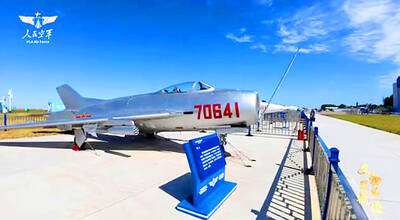
J-6 REMODEL: The converted drones are part of Beijing’s expanding mix of airpower weapons, including bombers with stand-off missiles and UAV swarms, the report said China has stationed obsolete supersonic fighters converted to attack drones at six air bases close to the Taiwan Strait, a report published this month by the Arlington, Virginia-based Mitchell Institute for Aerospace Studies said. Satellite imagery of the airfields from the institute’s “China Airpower Tracker” shows what appear to be lines of stubby, swept-winged aircraft matching the shape of J-6 fighters that first flew with the Chinese People’s Liberation Army (PLA) Air Force in the 1960s. Since their conversion to drones, the aircraft have been identified at five bases in China’s Fujian Province and one in Guangdong Province, the report said. J.

China used fake LinkedIn profiles to harvest sensitive data from NATO and EU institutions by soliciting information from staff, a European security source said on Friday. The operation, allegedly orchestrated by the Chinese Ministry of State Security, targeted dozens of employees at the military alliance or EU organizations through fictitious accounts, the source said, confirming reports in French and Belgian media. Posing as recruiters on the online professional networking platform, Chinese spies would initially request paid reports before later soliciting non-public or even classified information. One particularly active fake profile used the name “Kevin Zhang,” claiming to be the head


 RSS
RSS