


A search operation for seven villagers trapped inside a flooded cave in central Laos entered its seventh day yesterday, as rescuers encountered difficult terrain and weather as they tried to reach the group whose condition remains unknown.
The villagers entered the cave in Xaisomboun Province on May 19, but heavy rain triggered flash flooding that blocked the exit, according to Lao and Thai rescue teams involved in the operation.
Laotian organization Rescue Volunteer for People, which is working closely with the local authorities, said on social media that yesterday’s operation plan included exploring air shafts above the cave in hopes of identifying possible access points and locating the trapped people.
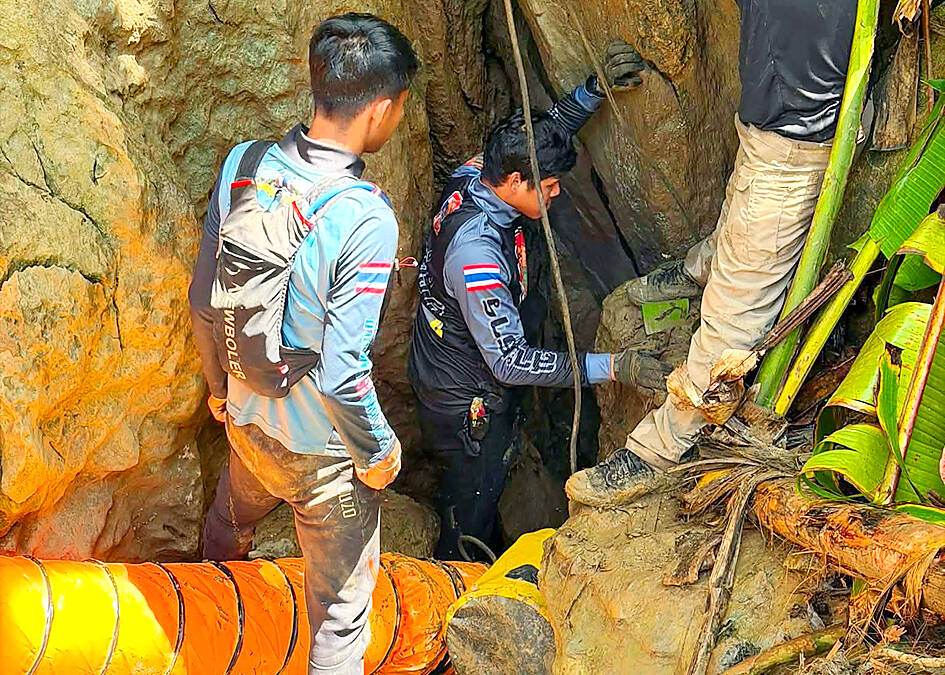
Photo: EPA, Metta Tham Kalasin Rescue
Rescuers from neighboring Thailand also arrived at the site over the weekend to assist the operation.
According to rescuers, divers have navigated about 100m into the flooded, narrow cave. They believe the villagers might be trapped about 30m beyond the furthest point currently accessible. They are working to pump water out of the cave to aid the search efforts.
The site is in a remote area in Xaisomboun Province’s Longcheng district, which is about 120km north of the capital, Vientiane.
Rescuers at the scene have detailed on social media the challenging mountainous terrain and heavy rain that is hampering the operation.
Videos shared online by Thai rescuers showed that reaching the cave’s entrance requires a steep hike on foot of about 4km. The entrance is also steep and rocky, and barely wide enough for a single person to climb through at a time.
Inside, rescuers must go through muddy passageways, flooded sections and narrow tunnels that force them to crawl forward.
There has been no official confirmation on why the villagers went into the cave, although the rescuers involved said that they went in to look for gold deposits.
Bounkham Luanglath of the Rescue Volunteer for People said that the cave was frequented by local residents looking for gold, although authorities had repeatedly warned them against entering the cave out of safety concerns.
The average per capita income in Laos of about US$2,000 to US4$,500 is among the lowest in Southeast Asia, and it is less still in underdeveloped rural areas.
Laos is not known as a major gold producer, but its mining industry is sizeable considering the country’s developing economy. The mining sector is fueled by foreign direct investment, largely from neighboring Thailand and China. Copper is a major export, and mining for rare earths, needed for most modern technologies, has become more common in Laos.
The Laotian Ministry of Foreign Affairs yesterday said that it had no official information to share with the media. The Southeast Asian nation is a one-party communist state with no organized opposition and the government keeps a tight lid on information.
The news quickly drew headlines in Thailand because of its resemblance to a dramatic 2018 cave rescue, where 12 boys and their soccer coach were trapped for more than two weeks before being safely rescued in an operation that became a global sensation. A former Thai navy SEAL diver was killed during the search-and-rescue effort.
A new tragedy occurred earlier this month, when five Italian divers were found dead after they went missing while diving into a cave in the Maldives.
A Maldivian military diver who was part of the recovery team was killed during the high-risk operation to retrieve their bodies.
A major health risk of being trapped in a cave is cold conditions quickly leading to hypothermia.
The body can cope for weeks without food, but clean water is necessary to prevent dehydration. A contaminated water supply could cause diarrhea, hastening dehydration.
Declining oxygen levels cause symptoms similar to altitude sickness, and in the long term can damage the lungs and other organs, while carbon dioxide buildup causes exhaustion and eventual unconsciousness.
Constant darkness disrupts time perception and the body’s circadian rhythms. It also causes extreme sensitivity when the eyes have to adjust again to light.
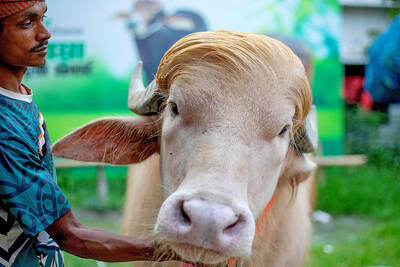
Crowds in Bangladesh are flocking to snap photographs with an unlikely social media star — an albino buffalo with flowing blond hair nicknamed “Donald Trump” that is due to be sacrificed within days. Owner Zia Uddin Mridha, 38, said his brother named the 700kg bull over its flowing helmet of hair resembling the signature look of the US president. “My younger brother picked this name because of the buffalo’s extraordinary hair,” he said at his farm in Narayanganj, just outside the capital, Dhaka. Mridha said that a constant stream of curious visitors — social media fans, onlookers and children — have come throughout

It began as a satirical online project. Now millions of young people in India are flocking to it as an outlet for their frustration. A parody political party called the Cockroach Janta Party, with the insect as its symbol, has exploded across India’s social media by turning absurdist humor into protest. Memes and short videos mocking corruption, joblessness and political dysfunction have flooded social media sites, where millions of users are embracing the cockroach — known for its ability to survive harsh conditions — as a tongue-in-cheek symbol of endurance. The online movement’s rise has been unusually rapid. The Cockroach Janta Party (CJP)
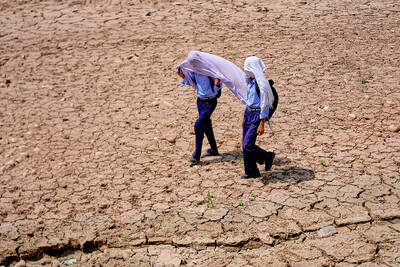
HOTTER: While Indians are accustomed to summer heat, climate change has caused northwestern India to warm faster than other parts of the country, an academic said Roads and markets have emptied during afternoons and some farmers have switched to nighttime work to avoid scorching temperatures as a heat wave grips large parts of India. The India Meteorological Department forecast maximum temperatures for yesterday of about 45°C in the capital, New Delhi, where authorities have opened temporary “cooling zones” to help people cope. The weather department warned that conditions would likely persist across several northern regions in the coming days, with temperatures staying well above seasonal averages. Authorities urged people to stay indoors during the hottest hours and take precautions against heat-related illnesses. India declares a heat wave whenever maximum temperatures
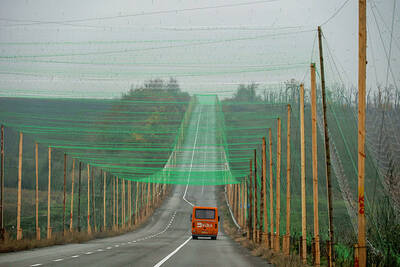
BIGGER ROLE: Beijing has said it maintains an impartial stance on the war in Ukraine, but by training Russian troops, China is far more involved than previously known China’s armed forces secretly trained about 200 Russian military personnel in China late last year, and some have since returned to fight in Ukraine, according to three European intelligence agencies and documents seen by Reuters. While China and Russia have held a number of joint military exercises since Moscow’s full-scale invasion of Ukraine in 2022, Beijing has repeatedly said that it is neutral in the conflict and presents itself as a peace mediator. The covert training sessions, which predominantly focused on the use of drones, were outlined in a dual-language Russian-Chinese agreement signed by senior Russian and Chinese officers in Beijing on


 RSS
RSS