


US forces on Monday attacked missile sites in southern Iran and ships trying to lay mines, the US Central Command said, imperiling a fragile ceasefire and casting new doubt on a deal to end the Middle East conflict.
The strikes came as top Iranian negotiators arrived in Doha for the latest round of talks to end the months-long conflict, and as the Israeli military stepped up hostilities with Iran-backed Hezbollah in southern Lebanon.
Oil prices fluctuated in the wake of the US strikes, which could threaten any agreement to reopen the Strait of Hormuz, where an Iranian blockade has throttled global fuel supplies.
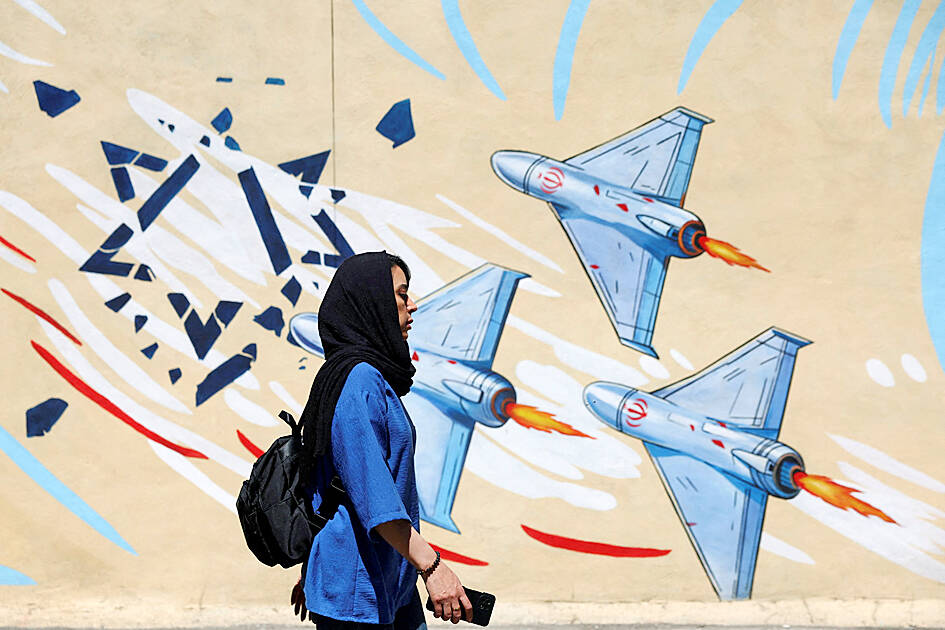
Photo: Reuters
“US forces conducted self-defense strikes in southern Iran today to protect our troops from threats posed by Iranian forces,” US Central Command spokesman Tim Hawkins said in a statement.
It gave no details of the attacks, and said only that the targets included missile launch sites and ships trying to “emplace mines.”
Despite the strikes, US Secretary of State Marco Rubio yesterday said that a deal remained within reach, but struck a firm note on the strait.
“There were some talks going on in Qatar today, so we’ll see if we can make progress. I think it’s a lot of talking back and forth going on about specific language in the initial document, so it’ll take a few days,” Rubio told reporters in India, without commenting about the impact of the strikes.
He said the strait was “going to be open one way or the other.”
“What’s happening there is unlawful, it’s illegal, it’s unsustainable for the world, it’s unacceptable,” he said.
Iran’s state-run broadcaster IRIB reported several loud explosions were heard in the vicinity of Bandar Abbas at about midnight.
It added that the situation in the southern port city was normal and local authorities were investigating the cause of the blasts.
The strikes threatened a ceasefire that began April 8 as the US and Iran struggle to reach an accord to end a conflict that has rattled the global economy with a severe disruption of energy flows.
Oil prices fluctuated yesterday morning, but remained below US$100, with West Texas Intermediate dropping more than 5 percent while international benchmark Brent crude was up.
Hopes of an accord took another blow when Israeli Prime Minister Benjamin Netanyahu vowed to “crush” Hezbollah in Lebanon.
US President Donald Trump on social media said that he expected Iran to hand over its enriched uranium to the US to be destroyed, or have it destroyed in Iran with an international witness.
The nuclear fuel “will either be immediately turned over to the United States to be brought home and destroyed or, preferably, in conjunction and coordination with the Islamic Republic of Iran, destroyed in place or, at another acceptable location, with the Atomic Energy Commission, or its equivalent, being witness to this process and event,” Trump wrote.
It was not clear whether he meant this would be part of a potential accord with Iran, and the commission he cited was abolished in 1974.
Netanyahu on Monday said that he had ordered an “even greater acceleration” of the Israeli offensive in Lebanon following Hezbollah drone attacks on Israeli forces.
He said any final deal with Iran “must eliminate the nuclear threat entirely,” a position echoed by Washington.
Iranian officials have said that, despite the longstanding US demand for an end to its uranium enrichment, talks on its nuclear program have been deferred until after an initial agreement.
Trump earlier on Monday said that it should be mandatory for Saudi Arabia, the United Arab Emirates (UAE), Qatar, Pakistan, Egypt, Turkey, Bahrain and Jordan to join the Abraham Accords, a set of agreements brokered in 2020 with nations historically hostile to Israel, as part of a peace deal with Iran.
Trump said he had spoken to the leaders of those countries on Saturday about efforts to end the war. Bahrain and the UAE have already signed the accords, along with Morocco and Sudan.
While the Abraham Accords were welcomed by some, they remain deeply unpopular in many parts of the Middle East — in part because they fail to address the Israeli-Palestinian conflict.
Gulf states such as Saudi Arabia and Qatar have said normalization with Israel depends on the creation of a Palestinian state.
Anna Jacobs of the Arab Gulf States Institute in Washington said Gulf nations were unlikely to accept Trump’s maximalist demand.
“The national security of the Gulf states has been threatened more than ever before because of President Trump’s reckless decisions, and he expects Arab states to thank him and to normalize relations with Israel, which they will not do at this stage,” she said.

Crowds in Bangladesh are flocking to snap photographs with an unlikely social media star — an albino buffalo with flowing blond hair nicknamed “Donald Trump” that is due to be sacrificed within days. Owner Zia Uddin Mridha, 38, said his brother named the 700kg bull over its flowing helmet of hair resembling the signature look of the US president. “My younger brother picked this name because of the buffalo’s extraordinary hair,” he said at his farm in Narayanganj, just outside the capital, Dhaka. Mridha said that a constant stream of curious visitors — social media fans, onlookers and children — have come throughout

It began as a satirical online project. Now millions of young people in India are flocking to it as an outlet for their frustration. A parody political party called the Cockroach Janta Party, with the insect as its symbol, has exploded across India’s social media by turning absurdist humor into protest. Memes and short videos mocking corruption, joblessness and political dysfunction have flooded social media sites, where millions of users are embracing the cockroach — known for its ability to survive harsh conditions — as a tongue-in-cheek symbol of endurance. The online movement’s rise has been unusually rapid. The Cockroach Janta Party (CJP)
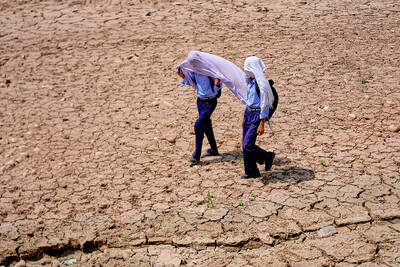
HOTTER: While Indians are accustomed to summer heat, climate change has caused northwestern India to warm faster than other parts of the country, an academic said Roads and markets have emptied during afternoons and some farmers have switched to nighttime work to avoid scorching temperatures as a heat wave grips large parts of India. The India Meteorological Department forecast maximum temperatures for yesterday of about 45°C in the capital, New Delhi, where authorities have opened temporary “cooling zones” to help people cope. The weather department warned that conditions would likely persist across several northern regions in the coming days, with temperatures staying well above seasonal averages. Authorities urged people to stay indoors during the hottest hours and take precautions against heat-related illnesses. India declares a heat wave whenever maximum temperatures

BIGGER ROLE: Beijing has said it maintains an impartial stance on the war in Ukraine, but by training Russian troops, China is far more involved than previously known China’s armed forces secretly trained about 200 Russian military personnel in China late last year, and some have since returned to fight in Ukraine, according to three European intelligence agencies and documents seen by Reuters. While China and Russia have held a number of joint military exercises since Moscow’s full-scale invasion of Ukraine in 2022, Beijing has repeatedly said that it is neutral in the conflict and presents itself as a peace mediator. The covert training sessions, which predominantly focused on the use of drones, were outlined in a dual-language Russian-Chinese agreement signed by senior Russian and Chinese officers in Beijing on


 RSS
RSS