


A rare strain of Ebola with no approved vaccine or treatment might have circulated undetected for weeks in northeastern Democratic Republic of the Congo (DR Congo) before killing dozens of people.
Laboratory testing by the National Institute for Biomedical Research in Kinshasa confirmed the outbreak is caused by the Bundibugyo strain, the WHO said on Friday.
The virus has caused only two previous known outbreaks, in Uganda in 2007 and eastern Congo in 2012.
About 246 suspected cases and 65 deaths have been reported mainly in Mongbwalu and Rwampara health zones in Ituri Province, near the Ugandan border, with additional suspected infections in Bunia, the provincial capital, the Africa Centers for Disease Control and Prevention said.
Four deaths have been confirmed among laboratory-positive cases.
Ebola is among the world’s deadliest infectious diseases, killing between roughly a quarter and almost 90 percent of infected people depending on the virus species and the medical care available.
The Zaire strain caused the devastating West African epidemic a decade ago and has received the most research funding, leading to licensed vaccines and treatments.
“Ebola Zaire is the one that got all the attention, for very good reasons,” University of Texas Medical Branch biocontainment care unit director Susan McLellan said.
The development of medical countermeasures, including monoclonal antibodies and vaccines, is less advanced for Bundibugyo, she said, but added that clinicians would likely still consider Gilead Sciences Inc’s remdesivir for Bundibugyo infections.
Laboratory research has suggested the strain might be more susceptible to the antiviral than Zaire.
Uganda has also confirmed a Bundibugyo case in a Congolese patient who died at a hospital in Kampala after traveling across the border for treatment.
The WHO said it is deploying additional epidemiologists, laboratory specialists and infection-control experts to Ituri while airlifting 5 metric tonnes of emergency supplies including testing equipment, protective gear and treatment materials.
The outbreak is unfolding in remote Mongbwalu, where insecurity, poor roads, mining-related population movement and frequent cross-border travel complicate the response. The region is also affected by armed groups and weak infrastructure, complicating efforts to deliver medical supplies and do disease surveillance and contact tracing.
“To access Mongbwalu isn’t easy,” Resource Matters Congo director Jimmy Munguriek said.
The area has only one major hospital, he said, adding that overcrowded mining settlements and constant movement of workers could accelerate transmission.
“These zones are full of people who come from everywhere to work in artisanal mining,” Munguriek said.
Armed groups active in the area and distrust of health authorities could also hamper containment efforts, he added.
The scale of the outbreak suggests the virus might have circulated undetected for weeks before being identified.
The WHO said it first received signals of a suspected outbreak on Tuesday last week and deployed a team to support investigations. Initial tests for the Zaire strain were negative, with additional testing later confirming Bundibugyo on Thursday.
Patients have presented with fever, weakness, vomiting and, in some cases, bleeding, the WHO said, adding that several people rapidly deteriorated and died.

Kouri Richins, a Utah mother who published a children’s book about grief after the death of her husband is to serve a life sentence for his murder without the possibility of parole, a judge ruled on Wednesday. Richins was convicted in March of aggravated murder for lacing a cocktail given to her husband, Eric Richins, with five times the lethal dose of fentanyl at their home near Park City in 2022. A jury also found her guilty of four other felonies, including insurance fraud, forgery and attempted murder for trying to poison her husband weeks earlier on Feb. 14, 2022, with a
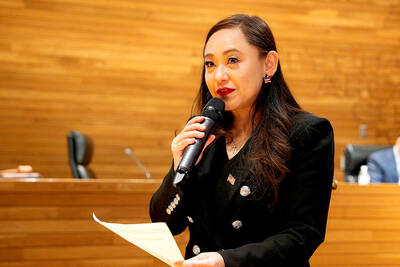
‘PERSONAL MISTAKES’: Eileen Wang has agreed to plead guilty to the felony, which comes with a maximum sentence of 10 years in federal prison A southern California mayor has agreed to plead guilty to acting as an illegal agent for the Chinese government and has resigned from her city position, officials said on Monday. Eileen Wang (王愛琳), mayor of Arcadia, was charged last month with one count of acting in the US as an illegal agent of a foreign government. She was accused of doing the bidding of Chinese officials, such as sharing articles favorable to Beijing, without prior notification to the US government as required by law. The 58-year-old was elected in November 2022 to a five-person city council, from which the mayor is selected

DELA ROSA CASE: The whereabouts of the senator, who is wanted by the ICC, was unclear, while President Marcos faces a political test over the senate situation Philippine authorities yesterday were seeking confirmation of reports that a top politician wanted by the International Criminal Court (ICC) had fled, a day after gunfire rang out at the Philippine Senate where he had taken refuge fearing his arrest. Senator Ronald “Bato” dela Rosa, the former national police chief and top enforcer of former Philippine president Rodrigo Duterte’s “war on drugs,” has been under Senate protection and is wanted for crimes against humanity, the same charges Duterte is accused of. “Several sources confirmed that the senator, Senator Bato, is no longer in the Senate premises, but we are still getting confirmation,” Presidential

HELP DENIED? The US Department of State said that the Cuban leadership refuses to allow the US to provide aid to Cubans, ‘who are in desperate need of assistance’ US Secretary of State Marco Rubio on Wednesday said that Cuba’s leadership must change, as Washington renewed an offer of US$100 million in aid if the communist nation agrees to cooperate. Cuba has been suffering severe economic tumult led by an energy shortage that plunged 65 percent of the country into darkness on Tuesday. Cuba’s leaders have blamed US sanctions, but Rubio, a Cuban American and critic of the government established by Fidel Castro, said the system was to blame, including corruption by the military. “It’s a broken, nonfunctional economy, and it’s impossible to change it. I wish it were different,” he told


 RSS
RSS