


Russian drone strikes killed at least two people in the Ukrainian city of Odesa overnight into yesterday, local authorities reported, ahead of a proposed ceasefire for Orthodox Easter.
A further two people were wounded in the attack on the Black Sea port city, when drones hit a residential area, damaging apartment buildings, houses and a kindergarten.
The Ukrainian air force said Russia targeted Ukraine with 160 drones overnight, of which 133 were shot down or intercepted, hours before a proposed Easter ceasefire was due to come into force.
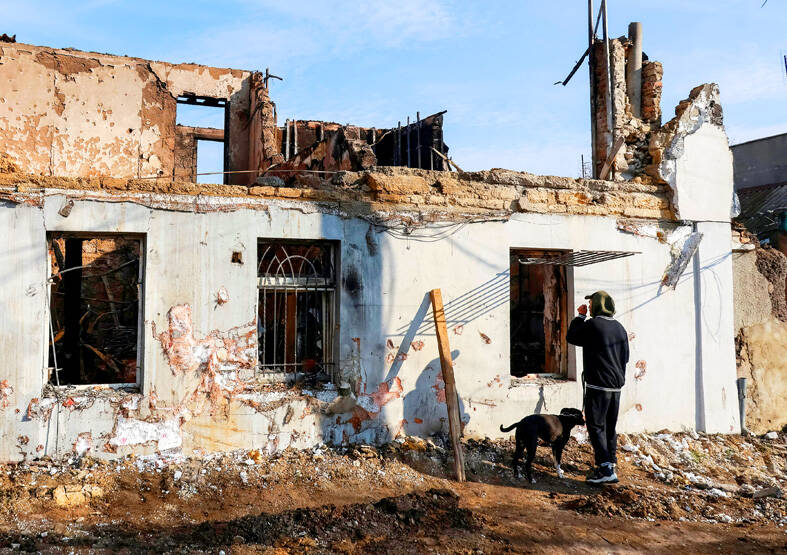
Photo: Reuters
The Russian Ministry of Defense said 99 Ukrainian drones were shot down overnight across Russia and occupied Crimea.
Russian President Vladimir Putin on Thursday declared a 32-hour ceasefire over the Orthodox Easter weekend, ordering Russian forces to halt hostilities from 4pm yesterday until the end of today.
Ukrainian President Volodymyr Zelenskiy said Ukraine is ready to mirror any ceasefire steps, having earlier proposed to Russia a pause in attacks on each other’s energy infrastructure over the Orthodox Easter holiday.
Previous ceasefire attempts have had little impact, with both sides accusing each other of violations.
Kremlin spokesman Dmitry Peskov described Putin’s move as a “humanitarian” gesture, but said Moscow remains focused on a comprehensive settlement based on its longstanding demands — a key sticking point that has prevented the two sides from reaching an agreement.
A possible prisoner exchange over the Easter holiday has also been discussed.
Russia’s human rights ombudswoman Tatyana Moskalkova said last week that both sides were working on exchanges of prisoners.
Periodic prisoner exchanges have been one of the few positive outcomes of otherwise fruitless US-brokered negotiations between Moscow and Kyiv.
The talks have delivered no progress on key issues preventing an end to Russia’s invasion of its neighbor, now in its fifth year.

Crowds in Bangladesh are flocking to snap photographs with an unlikely social media star — an albino buffalo with flowing blond hair nicknamed “Donald Trump” that is due to be sacrificed within days. Owner Zia Uddin Mridha, 38, said his brother named the 700kg bull over its flowing helmet of hair resembling the signature look of the US president. “My younger brother picked this name because of the buffalo’s extraordinary hair,” he said at his farm in Narayanganj, just outside the capital, Dhaka. Mridha said that a constant stream of curious visitors — social media fans, onlookers and children — have come throughout

It began as a satirical online project. Now millions of young people in India are flocking to it as an outlet for their frustration. A parody political party called the Cockroach Janta Party, with the insect as its symbol, has exploded across India’s social media by turning absurdist humor into protest. Memes and short videos mocking corruption, joblessness and political dysfunction have flooded social media sites, where millions of users are embracing the cockroach — known for its ability to survive harsh conditions — as a tongue-in-cheek symbol of endurance. The online movement’s rise has been unusually rapid. The Cockroach Janta Party (CJP)
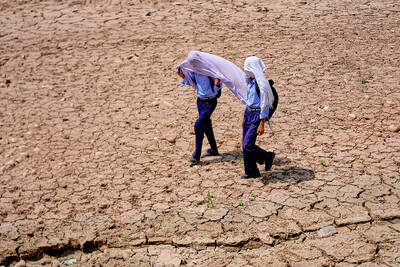
HOTTER: While Indians are accustomed to summer heat, climate change has caused northwestern India to warm faster than other parts of the country, an academic said Roads and markets have emptied during afternoons and some farmers have switched to nighttime work to avoid scorching temperatures as a heat wave grips large parts of India. The India Meteorological Department forecast maximum temperatures for yesterday of about 45°C in the capital, New Delhi, where authorities have opened temporary “cooling zones” to help people cope. The weather department warned that conditions would likely persist across several northern regions in the coming days, with temperatures staying well above seasonal averages. Authorities urged people to stay indoors during the hottest hours and take precautions against heat-related illnesses. India declares a heat wave whenever maximum temperatures
BIGGER ROLE: Beijing has said it maintains an impartial stance on the war in Ukraine, but by training Russian troops, China is far more involved than previously known China’s armed forces secretly trained about 200 Russian military personnel in China late last year, and some have since returned to fight in Ukraine, according to three European intelligence agencies and documents seen by Reuters. While China and Russia have held a number of joint military exercises since Moscow’s full-scale invasion of Ukraine in 2022, Beijing has repeatedly said that it is neutral in the conflict and presents itself as a peace mediator. The covert training sessions, which predominantly focused on the use of drones, were outlined in a dual-language Russian-Chinese agreement signed by senior Russian and Chinese officers in Beijing on


 RSS
RSS