


The Artemis II astronauts yesterday wrapped up their lunar flyby as they continued their journey back to Earth, bringing with them rich celestial observations, including little-known lunar craters, a solar eclipse and meteor strikes that scientists hope would open doors.
Their eyes glued to the spacecraft windows for nearly seven hours, the team of four who spent their day breaking records and making history were treated to a view of the moon unlike any other.
“Humans probably have not evolved to see what we’re seeing,” Victor Glover said. “It is truly hard to describe. It is amazing.”
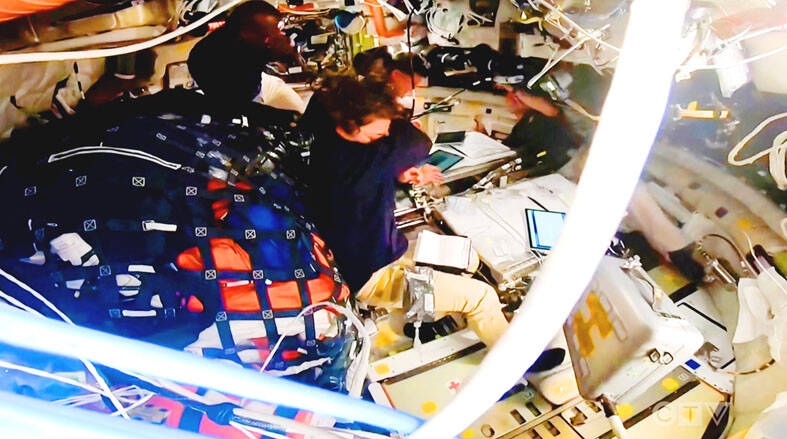
Photo: AFP /NASA
The crew reported in vivid detail features of the lunar surface and later witnessed a solar eclipse, when the moon passed in front of the sun.
They also described flashes of light — meteor strikes — on the moon’s surface.
“I can’t say enough how much science we’ve already learned,” Kelsey Young, lead scientist for the Artemis II mission, told the astronauts.
“You really brought the moon closer for us today, and we cannot say thank you enough,” she said.
However, even after becoming the furthest humans ever to travel from Earth, their day was not over: The bleary-eyed astronauts remained in good spirits as they took a late-night call from US President Donald Trump.
Unlike the Artemis astronauts and NASA Administrator Jared Isaacman, Trump, at 79, is old enough to remember the Apollo program.
“You’ve really inspired the entire world,” Trump said, calling them “modern-day pioneers” who have “a lot of courage doing what you’re doing.”
“America will be second to none in space and everything we’re doing, and we will continue to lead the whole thing into the stars, this incredible journey into the stars,” he said.
The journey wrapped up late on Monday and had plenty of milestones, including when the Artemis II team broke the distance record set by the 1970 Apollo 13 mission, which they surpassed by more than 6,000km when they reached the journey’s furthest distance from Earth 406,771km.
Astronaut Jeremy Hansen said the moment should “challenge this generation and the next, to make sure this record is not long-lived.”
And as noted by Trump, the crew lost contact with planet Earth for about 40 minutes as their spacecraft passed behind Earth’s satellite.
The blackout period was expected, but still notable: They were the first people in more than 50 years to lose contact with the rest of humanity.
“It is so great to hear from Earth again,” astronaut Christina Koch said, as the crew regained connection with their home planet.
“We will always choose Earth,” she said.
The Orion capsule is traveling back to Earth in a so-called “free-return trajectory,” a trip that would take about four days.
Adding to the historic nature of the mission led by Reid Wiseman, the Artemis II crew includes several firsts.
Glover was the first person of color to fly around the moon, Koch was the first woman and Canadian Hansen the first non-American.
The celestial workday on Monday included a poignant moment just after the crew broke the distance record, when they proposed designating two previously unnamed craters.
The first they requested to name in honor of their spacecraft’s nickname, “Integrity.”
They offered a second name, “Carroll,” for another crater, which they asked be named after the late wife of mission commander Reid Wiseman, who died of cancer.
“It’s a bright spot on the moon,” Hansen said, his voice breaking with emotion. “And we would like to call it Carroll.”
The astronauts embraced, and mission control in Houston held a moment of silence.
“Integrity and Carroll crater, loud and clear. Thank you,” Gibbons said.
NASA said it would formally submit the name proposals to the International Astronomical Union, the body charged with naming celestial bodies and surface features.

Crowds in Bangladesh are flocking to snap photographs with an unlikely social media star — an albino buffalo with flowing blond hair nicknamed “Donald Trump” that is due to be sacrificed within days. Owner Zia Uddin Mridha, 38, said his brother named the 700kg bull over its flowing helmet of hair resembling the signature look of the US president. “My younger brother picked this name because of the buffalo’s extraordinary hair,” he said at his farm in Narayanganj, just outside the capital, Dhaka. Mridha said that a constant stream of curious visitors — social media fans, onlookers and children — have come throughout

It began as a satirical online project. Now millions of young people in India are flocking to it as an outlet for their frustration. A parody political party called the Cockroach Janta Party, with the insect as its symbol, has exploded across India’s social media by turning absurdist humor into protest. Memes and short videos mocking corruption, joblessness and political dysfunction have flooded social media sites, where millions of users are embracing the cockroach — known for its ability to survive harsh conditions — as a tongue-in-cheek symbol of endurance. The online movement’s rise has been unusually rapid. The Cockroach Janta Party (CJP)

HOTTER: While Indians are accustomed to summer heat, climate change has caused northwestern India to warm faster than other parts of the country, an academic said Roads and markets have emptied during afternoons and some farmers have switched to nighttime work to avoid scorching temperatures as a heat wave grips large parts of India. The India Meteorological Department forecast maximum temperatures for yesterday of about 45°C in the capital, New Delhi, where authorities have opened temporary “cooling zones” to help people cope. The weather department warned that conditions would likely persist across several northern regions in the coming days, with temperatures staying well above seasonal averages. Authorities urged people to stay indoors during the hottest hours and take precautions against heat-related illnesses. India declares a heat wave whenever maximum temperatures

SPEAKING OUT: After Siranudh Scott’s allegations surfaced, celebrities and public figures took to social media to share their own experiences of sexual misconduct and abuse A high-profile alleged sexual abuse case within a wealthy Thai beer brewing family has prompted a wave of painful accounts from survivors of unconnected abuse in the conservative nation. Siranudh Scott, a member of the billionaire Thai family that founded the ubiquitous Singha beer brand, posted an emotional video this month accusing his elder brother Sunit of repeatedly abusing him when he was a teenager. Sunit, who is in his 30s, later denied the allegations in a video posted online, but Singha parent Boonrawd dismissed him from his executive role with the company on Tuesday last week. “I felt I needed to speak


 RSS
RSS