


One of the world’s most important collections of 20th-century Mexican art, including works by Frida Kahlo and Diego Rivera, is set to be exported to Spain under an agreement with Banco Santander, sparking outrage among Mexico’s cultural community.
Nearly 400 cultural professionals have signed an open letter calling on the Mexican government to offer greater clarity on what the deal means for the masterpieces, particularly the works by Kahlo, which the Mexican state has declared an “artistic monument.”
“It’s a very serious issue,” said Francisco Berzunza, a historian and one of eight people who published the open letter. “She [Kahlo] is the most important artist in the history of our country and it’s easier to see her work outside of Mexico than in Mexico itself.”
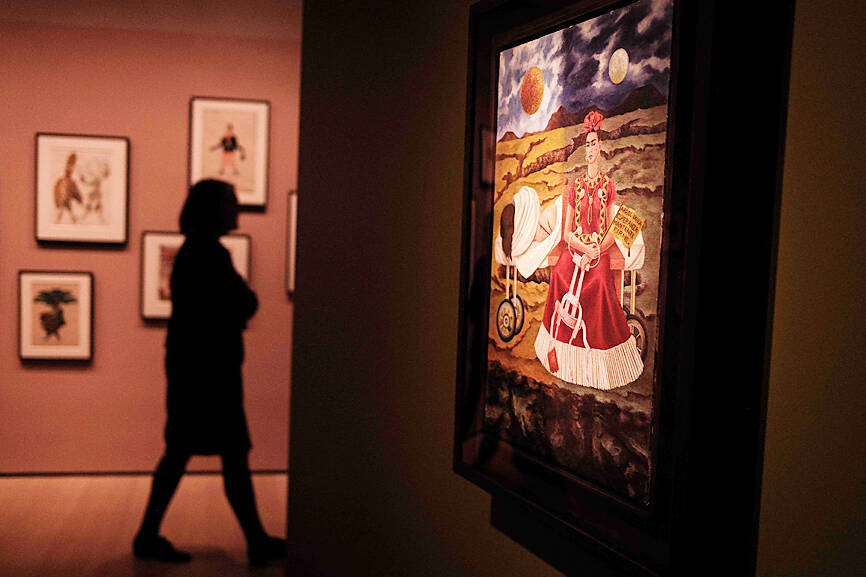
Photo: AFP
The row centers on a collection of 160 works from the Gelman collection, rebranded as the Gelman Santander collection. Originally owned by the collectors Jacques and Natasha Gelman, the paintings, sketches and photographs were bought by the Mexican Zambrano family in 2023.
As well as Kahlo and Rivera, the collection includes works by Rufino Tamayo, Jose Clemente Orozco, Maria Izquierdo and David Alfaro Siqueiros, and a selection of Mexican photography.
Under the Santander deal, the collection, currently on public display in Mexico for the first time in nearly 20 years, is to return to Spain this summer, where it will become a cornerstone of the bank’s new cultural center, the Faro Santander.
In announcing the agreement in January, Santander said it would be “responsible for the conservation, research and exhibition” of the collection.
However, the ambiguity of the announcement, which did not say how long the works would remain in Spain, sparked concern.
The concern turned to indignation when Faro Santander’s director, Daniel Vega Perez de Arlucea, told El Pais that legislation governing the works was “flexible” and that the collection would have a “permanent presence” at the new cultural center.
Members of Mexico’s cultural community fear the deal means the works might never return to Mexico and say the law is unambiguous when it comes to these national treasures.
“Current legislation is very protective of these works, specifically those designated as national artistic monuments,” said Gabriela Mosqueda, a curator and another one of the letter’s initial signatories. “It deems them to be of significant value to Mexican identity and to the history of Mexican art.”
The dispute is particularly pertinent to Kahlo’s works, which received the “artistic monument” status in 1984: The presidential decree states clearly that her oeuvre may leave Mexico only temporarily and that the country’s National Institute of Fine Arts and Literature is responsible for “repatriating” any works held in private collections overseas.
Artists, curators and others in Mexico’s cultural scene say that with the Santander deal, the institute, which owns only four of Kahlo’s 150 or so pieces, has done just the opposite.
“This decree was specifically intended to put a lock on private collections. To ensure they would not leave the country or be dispersed. That’s why we’re defending it so vigorously,” Berzunza said.
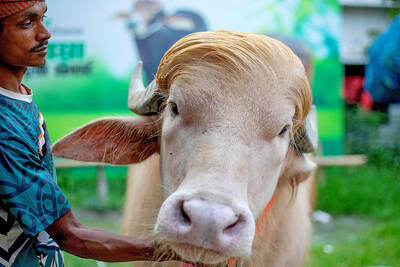
Crowds in Bangladesh are flocking to snap photographs with an unlikely social media star — an albino buffalo with flowing blond hair nicknamed “Donald Trump” that is due to be sacrificed within days. Owner Zia Uddin Mridha, 38, said his brother named the 700kg bull over its flowing helmet of hair resembling the signature look of the US president. “My younger brother picked this name because of the buffalo’s extraordinary hair,” he said at his farm in Narayanganj, just outside the capital, Dhaka. Mridha said that a constant stream of curious visitors — social media fans, onlookers and children — have come throughout

It began as a satirical online project. Now millions of young people in India are flocking to it as an outlet for their frustration. A parody political party called the Cockroach Janta Party, with the insect as its symbol, has exploded across India’s social media by turning absurdist humor into protest. Memes and short videos mocking corruption, joblessness and political dysfunction have flooded social media sites, where millions of users are embracing the cockroach — known for its ability to survive harsh conditions — as a tongue-in-cheek symbol of endurance. The online movement’s rise has been unusually rapid. The Cockroach Janta Party (CJP)

BIGGER ROLE: Beijing has said it maintains an impartial stance on the war in Ukraine, but by training Russian troops, China is far more involved than previously known China’s armed forces secretly trained about 200 Russian military personnel in China late last year, and some have since returned to fight in Ukraine, according to three European intelligence agencies and documents seen by Reuters. While China and Russia have held a number of joint military exercises since Moscow’s full-scale invasion of Ukraine in 2022, Beijing has repeatedly said that it is neutral in the conflict and presents itself as a peace mediator. The covert training sessions, which predominantly focused on the use of drones, were outlined in a dual-language Russian-Chinese agreement signed by senior Russian and Chinese officers in Beijing on
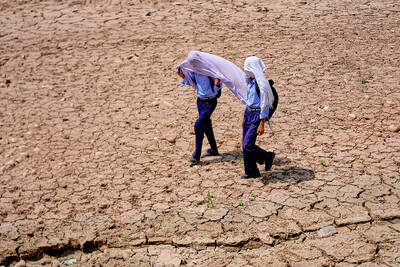
HOTTER: While Indians are accustomed to summer heat, climate change has caused northwestern India to warm faster than other parts of the country, an academic said Roads and markets have emptied during afternoons and some farmers have switched to nighttime work to avoid scorching temperatures as a heat wave grips large parts of India. The India Meteorological Department forecast maximum temperatures for yesterday of about 45°C in the capital, New Delhi, where authorities have opened temporary “cooling zones” to help people cope. The weather department warned that conditions would likely persist across several northern regions in the coming days, with temperatures staying well above seasonal averages. Authorities urged people to stay indoors during the hottest hours and take precautions against heat-related illnesses. India declares a heat wave whenever maximum temperatures


 RSS
RSS