


If Hungarian Prime Minister Viktor Orban emerges victorious from this month’s general election, it would have consequences far beyond the central European country, analysts said.
Since his return to office in 2010, Orban has repeatedly tussled with the EU, with Polish and Irish leaders on Tuesday condemning his government’s close links with Moscow as “sinister” and “repulsive” after the latest revelations of leaked phone calls between Hungarian Minister of Foreign Affairs and Trade Peter Szijjarto and Russian Minister of Foreign Affairs Sergei Lavrov.
EU High Representative for Foreign Affairs and Security Policy Kaja Kallas said that “European ministers should work for Europe, not for Russia.”

Photo: Reuters
Orban has regularly paralyzed EU foreign policymaking by wielding Hungary’s veto.
He has repeatedly held up EU sanctions against Russia over its invasion of Ukraine and blocked aid to the war-torn country, even trading barbs with Kyiv during the election campaign.
If Orban were to score a fifth consecutive term on April 12, analysts believe he would dig in further.
However, with the campaign entering its final stretch, independent polls show challenger Peter Magyar well ahead.
If Magyar and his TISZA party win, he is expected to improve relations with the EU and unlock billions of euros for Hungary that Brussels has frozen over rule-of-law and other concerns.
Another Orban win “would mean the continuation of the current course, where Hungary acts as a spoiler, blocking common European action and limiting the EU’s ability to speak with one voice,” said Zsuzsanna Vegh of the German Marshall Fund, a US think tank.
Vegh said that the 62-year-old would feel “increasingly emboldened” because he “enjoys [US President Donald] Trump’s backing.”
However, Zoltan Kiszelly, from the Budapest-based Szazadveg think tank, foresees an eventual compromise with the EU.
“Brussels wants Hungarian votes for unanimous decisions, while the government wants EU funds to get the economy back on track,” Kiszelly told reporters.
Hungary could negotiate a formal “opt out” from some EU decisions as a possible solution, he said.
Neither analyst expected “unconditional” pro-EU policies or changes on migration policy if Magyar wins, nor that he would be strongly pro-Ukraine.
Kiszelly said that under Magyar, “the Hungarian veto would cease to exist within the EU” and he would not oppose Brussels as “dramatically” as Orban.
“The country would not present such a sharp alternative, but it would still attempt to restrain the Brussels mainstream, as [Italian Prime Minister Georgia] Meloni and [Slovakian Prime Minister Robert] Fico are doing,” he added.
Orban’s defeat could have consequences for an ideological battle far beyond Hungary.
“Trump would lose his biggest advocate within the EU and nobody would be at the table to offer the same kind of alternative, for a while at least,” Kiszelly said.
Orban is a “symbolic figure in the global sovereigntist-nationalist, far right movement,” said Andras Biro-Nagy, the head of the Budapest-based Policy Solutions think tank.
If he were to lose the vote, it could “affect this entire network”, Biro-Nagy told reporters.
“Many leaders consider Orban a source of inspiration and his 16-year hold on power is what ultimately lends him his credibility,” he added.
Most analysts believe an Orban victory would see Hungary continue down an anti-democratic path.
“He clearly gave up on implementing reforms to secure the EU funds and, with that, is moving to openly disregard EU law and even EU court decisions,” Vegh said.
“If Orban wins, we can expect further radicalization and escalation of aggressive actions against political opponents,” Biro-Nagy said.
He pointed to a speech Orban made in February, in which he vowed to continue his crackdown against “fake civil society organizations, bought journalists, judges [and] politicians.”
Magyar has pledged to carry out the reforms required of Hungary to access frozen EU funds, but whether he can bring lasting change depends on the scope of his victory, Biro-Nagy said.
“If TISZA obtains a two-thirds supermajority, then it could attempt to dismantle Orban’s system,” he said.
However, a narrow win would mean just a “change in government rather than the change of system” promised by Magyar, he added.

ROCKY RELATIONS: The figures on residents come as Chinese tourist numbers drop following Beijing’s warnings to avoid traveling to Japan The number of Chinese residents in Japan has continued to rise, even as ties between the two countries have become increasingly fractious, data released on Friday showed. As of the end of December last year, the number of Chinese residents had increased by 6.5 percent from the previous year to 930,428. Chinese people accounted for 22.6 percent of all foreign residents in Japan, making them by far the largest group, Japanese Ministry of Justice data showed. Beijing has criticized Tokyo in increasingly strident terms since Japanese Prime Minister Sanae Takaichi last year suggested that a military conflict around Taiwan could

Germany is considering Australia’s Ghost Bat robot fighter as it looks to select a combat drone to modernize its air force, German Minister of Defense Boris Pistorius said yesterday. Germany has said it wants to field hundreds of uncrewed fighter jets by 2029, and would make a decision soon as it considers a range of German, European and US projects developing so-called “collaborative combat aircraft.” Australia has said it will integrate the Ghost Bat, jointly developed by Boeing Australia and the Royal Australian Air Force, into its military after a successful weapons test last year. After inspecting the Ghost Bat in Queensland yesterday,
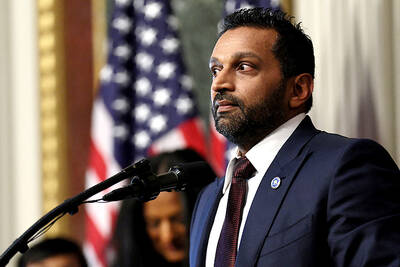
A pro-Iran hacking group claimed to breach FBI Director Kash Patel’s personal e-mail inbox and posted some of the contents online. The e-mails provided by the hacking group include travel details, correspondence with leasing agents in Washington and global entry, and loyalty account numbers. The e-mail address the hackers claim to have compromised has been previously tied to Patel’s personal details, and the leaked e-mails contain photos of Patel and others, in addition to correspondence with family members and colleagues. “The FBI is aware of malicious actors targeting Director Patel’s personal email information,” the agency said in a statement on
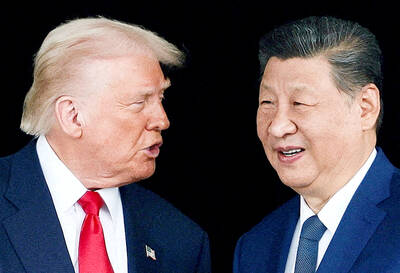
RIVALRY: ‘We know that these are merely symbolic investigations initiated by China, which is in fact the world’s most profligate disrupter of supply chains,’ a US official said China has started a pair of investigations into US trade practices, retaliating against similar probes by US President Donald Trump’s administration as the superpowers stake out positions before an expected presidential summit in May. The move, announced by the Chinese Ministry of Commerce on Friday, is a direct mirror of steps Trump took to revive his tariff agenda after the US Supreme Court last month struck down some of his duties. “China expresses its strong dissatisfaction and firm opposition to these actions,” a ministry spokesperson said in a statement, referring to the so-called Section 301 investigations initiated on March 11.


 RSS
RSS