


Germany is considering Australia’s Ghost Bat robot fighter as it looks to select a combat drone to modernize its air force, German Minister of Defense Boris Pistorius said yesterday.
Germany has said it wants to field hundreds of uncrewed fighter jets by 2029, and would make a decision soon as it considers a range of German, European and US projects developing so-called “collaborative combat aircraft.”
Australia has said it will integrate the Ghost Bat, jointly developed by Boeing Australia and the Royal Australian Air Force, into its military after a successful weapons test last year.
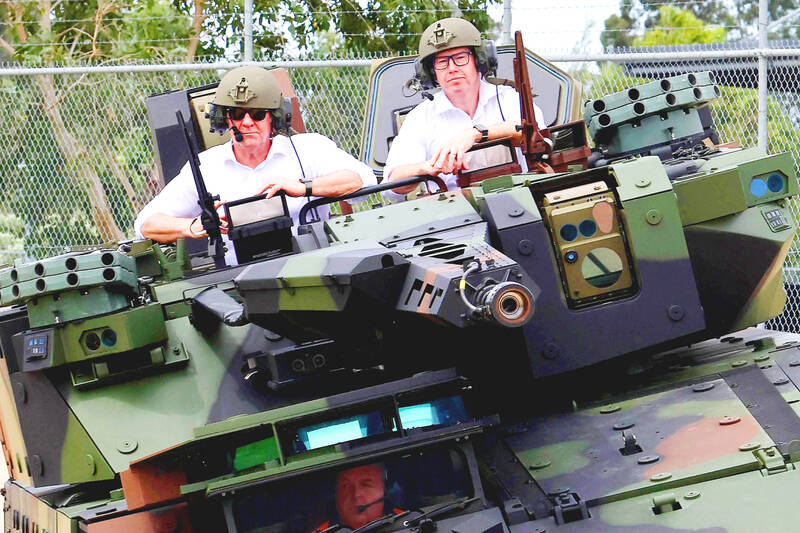
Photo: AFP
After inspecting the Ghost Bat in Queensland yesterday, Pistorius told reporters that it was a “serious competitor” and Germany would “make a decision as soon as possible.”
Australian sources said that Canberra would consider striking a deal to transfer the technology to Germany to allow the Ghost Bat to be manufactured in Europe.
German company Rheinmetall makes troop carriers in Brisbane under a similar arrangement.
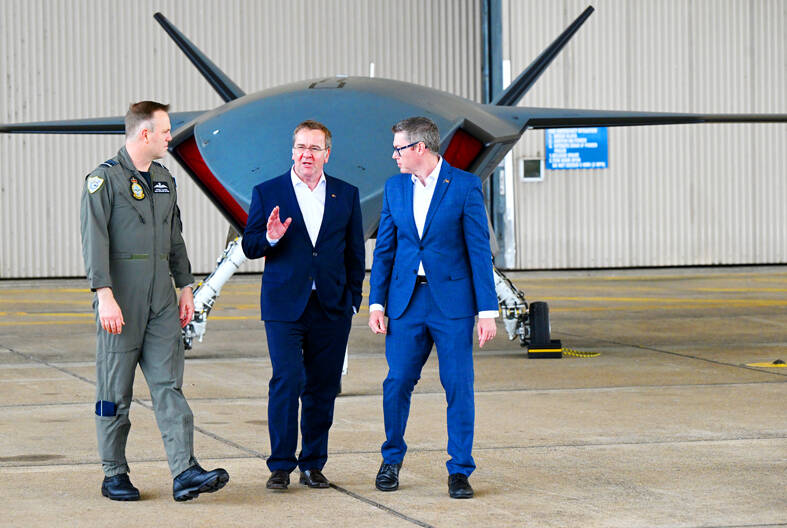
Photo: EPA
Ghost Bat is not subject to strict US defense export controls that other projects involving US partners must navigate to sell to foreign customers, analysts said.
Australia’s vast coastline and small population have spurred its focus on developing robot submarines and fighter jets.
Australian Strategic Policy Institute defense analyst Malcolm Davis said that the Ghost Bat was designed to work alongside a crewed jet and return to base — unlike the cheap kamikaze drones used by Iran and in the Ukraine conflict.
“This is a new type of approach to air power where you have a crewed fighter giving directions to four or five Ghost Bats flying in formation with it,” he said. “It is a robot fighter that is told to go off and patrol that target, shoot that down.”
Uncrewed aircraft would allow Australia to make its air force larger and more powerful at lower cost, he said.
Pistorius said that cheaper, mass-produced drones have proliferated during the Iran and Ukraine conflicts.
“We can’t ignore high-end products as well as low-cost products — we need both,” he said.
A ship that appears to be taking on the identity of a scrapped gas carrier exited the Strait of Hormuz on Friday, showing how strategies to get through the waterway are evolving as the Middle East war progresses. The vessel identifying as liquefied natural gas (LNG) carrier Jamal left the Strait on Friday morning, ship-tracking data show. However, the same tanker was also recorded as having beached at an Indian demolition yard in October last year, where it is being broken up, according to market participants and port agent’s reports. The ship claiming to be Jamal is likely a zombie vessel that

Japan is to downgrade its description of ties with China from “one of its most important” in an annual diplomatic report, according to a draft reviewed by Reuters, as relations with Beijing worsen. This year’s Diplomatic Bluebook, which Japanese Prime Minister Sanae Takaichi’s government is expected to approve next month, would instead describe China as an important neighbor and the relationship as “strategic” and “mutually beneficial.” The draft cites a series of confrontations with Beijing over the past year, including export controls on rare earths, radar lock-ons targeting Japanese military aircraft and increased pressure around Taiwan. The shift in tone underscores a deterioration

LAW CONSTRAINTS: The US has been pressing allies to send warships to open the Strait, but Tokyo’s military actions are limited under its postwar pacifist constitution Japan could consider deploying its military for minesweeping in the Strait of Hormuz if a ceasefire is reached in the war on Iran, Japanese Minister of Foreign Affairs Toshimitsu Motegi said yesterday. “If there were to be a complete ceasefire, hypothetically speaking, then things like minesweeping could come up,” Motegi said. “This is purely hypothetical, but if a ceasefire were established and naval mines were creating an obstacle, then I think that would be something to consider.” Japan’s military actions are limited under its postwar pacifist constitution, but 2015 security legislation allows Tokyo to use its Self-Defense Forces overseas if an attack,
A retired US colonel behind a privately financed rocket launch site in the Dominican Republic sees the project as a response to China’s dominance of the space race in Latin America. Florida-based Launch on Demand is slated to begin building a US$600 million facility in a remote region near the border with Haiti late this year. The project is designed to meet surging demand for the heavy-lift rockets needed to put clusters of satellites into orbit. It is also an answer to China’s growing presence in the region, said CEO Burton Catledge, a former commander of the US Air Force’s 45th Operations


 RSS
RSS